Tag Archives: China

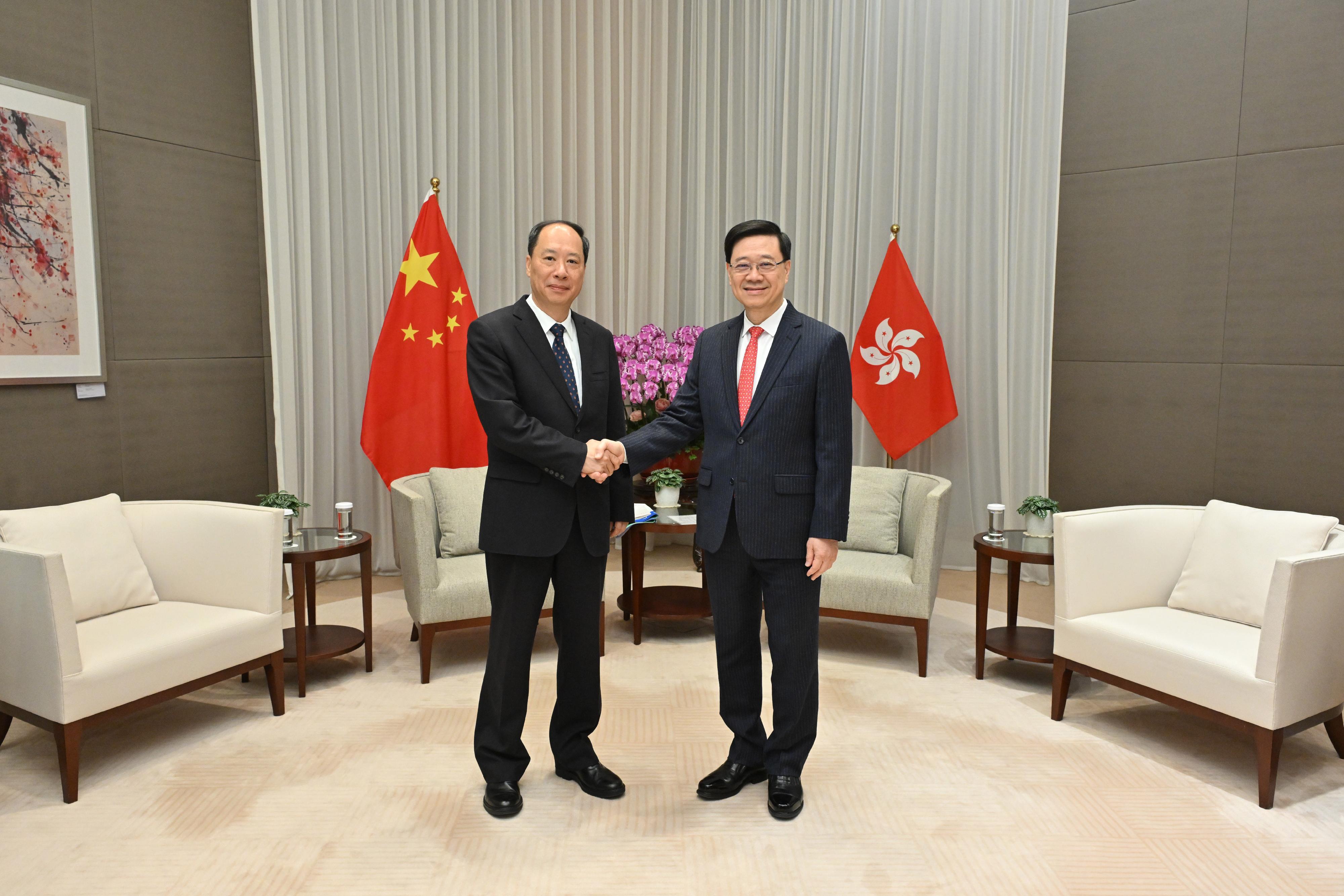
CE meets Secretary of CPC Jiangmen Municipal Committee (with photo)

     â€‹The Chief Executive, Mr John Lee, met the Secretary of the CPC Jiangmen Municipal Committee, Mr Chen Anming, today (March 19) to exchange views on further deepening Hong Kong’s co-operation with Jiangmen and promoting the high-quality development of the Guangdong-Hong Kong-Macao Greater Bay Area (GBA). Also attending the meeting were the Secretary for Constitutional and Mainland Affairs, Mr Erick Tsang Kwok-wai, and the Secretary for Environment and Ecology, Mr Tse Chin-wan.
      
     Mr Lee welcomed Mr Chen and his delegation to Hong Kong. Noting Jiangmen is a hub and gateway city in the western part of the GBA, and that the city is experiencing rapid development in advanced manufacturing, Mr Lee said that Hong Kong, being an international city in the GBA, enjoys the unique advantages of having the strong support of the motherland and being closely connected to the world under the “one country, two systems” principle. There is vast potential for collaboration between the two places. Hong Kong will continue to give full play to its roles as a “super connector” and a “super value-adder”, leveraging its highly internationalised and market-oriented business environment with its pool of professional services talent to explore business opportunities with Mainland enterprises and inject new impetus into the high-quality development of the GBA.
      
     Mr Lee expressed his confidence that Hong Kong and Jiangmen will continue to complement each other’s strengths, enhancing co-operation in areas such as green industries, scientific research and elderly care services, and jointly building an international first-class bay area ideal for living, working and travelling.

Photo  
read more

LCQ4: Kai Tak Sports Park

     â€‹Following is a question by the Hon Paul Tse and a reply by the Secretary for Culture, Sports and Tourism, Miss Rosanna Law, in the Legislative Council today (March 19):
 
Question:
 
     It has been reported that at the Kai Tak Sports Park (KTSP) Grand Opening Ceremony, some self-proclaimed “insiders” charged a fee of $1,000 per person to lead people without tickets to enter the venue “through the back door”, and they even claimed that there were ways to bring reporters to the scenes of other activities without tickets. Subsequently, at the World Snooker Grand Prix 2025 held in the KTSP, the word “curfew” appeared on the screen of the venue before the end of the competition, requesting the audience to leave the venue. Some foreign media reported the incident, and the foreign players in the venue also thought that Hong Kong had imposed a curfew. There are views that the incident has brought Hong Kong’s international image into disrepute. Moreover, it is learnt that a businessman lost his way when leaving the venue but did not receive any assistance from the staff. In this connection, will the Government inform this Council:
 
(1) of the number of stress tests conducted by different government departments before the opening of the KTSP; the number of staff members involved, as well as the contents, objectives and public expenditure of each stress test;
 
(2) whether it has examined why the aforesaid incidents of “passage without tickets”, “midnight curfew” and “nobody showing the way” still occurred after public money has been spent on stress tests; and
 
(3) without incurring substantial public money, of the measures in place to ensure that the aforesaid mistakes will not recur when organising the concerts by the band Coldplay and major competitions such as the National Games in the future?
 
Reply:
 
President,
 
     Being the largest sports infrastructure project in Hong Kong’s history, the Kai Tak Sports Park (KTSP) will boost sports development and inject impetus into related industries such as recreation, entertainment and tourism, and mega-event economy. The KTSP provides Hong Kong with the largest and state-of-the-art venues, including a 50 000-seat Kai Tak Stadium, a 10 000-seat Kai Tak Arena and a 5 000-seat Kai Tak Youth Sports Ground.
      
     With its official commissioning on March 1, the KTSP becomes a new hub for hosting major sports and entertainment events, creating favourable conditions for further promoting the mega-event economy. A series of mega events have been scheduled to take place in the KTSP, including the Hong Kong Sevens at the end of this month, followed by concerts of renowned bands and singers in Asia and around the world at the Kai Tak stadium. Competition events of the 15th National Games, the 12th National Games for Persons with Disabilities and the 9th National Special Olympic Games will also be held in the KTSP towards the end of this year. Mega sports and entertainment events, one after another, will bring to the audience an exciting experience.
      
     My consolidated reply to the questions raised by the Hon Paul Tse is as follows:
      
     Since late October last year until February this year, the Government and the Kai Tak Sports Park Limited (the Operator) conducted almost 20 test events and stress tests of different nature and scale across the three major venues in a gradual and orderly approach, with a view to evaluating different operation and contingency arrangements of the KTSP to better prepare its official commissioning. Both sport and non-sport test events took place in the three major venues with particular objectives, allowing relevant departments, the Operator and all participating parties to familiarise themselves with the preparatory work of both the hardware and software of the Sports Park, such as entry and exit arrangements, transportation, stage setup and backstage facilities.
      
     In addition, to assess the maximum capacity of the KTSP and better understand the patterns of spectator flow after its full opening, the Government organised five large-scale stress tests involving civil servants, district personalities, youth groups, and stakeholders of the Operator, among which were two stress tests with 63 000 participants each and one with approximately 50 000 participants. The costs associated with these stress tests were covered by the construction cost of the KTSP, recurrent expenditure of the Culture, Sports and Tourism Bureau (CSTB) and other participating departments and hence, cannot be quantified separately.
      
     The Operator is responsible for the day-to-day operation of the KTSP after its opening. It has the duty to oversee the security, optimise operational arrangement, as well as maintain close liaison and co-ordination with event organisers to ensure a pleasant experience for visitors. Both the Operator and event organiser attach high importance to security checks and ticket verification. With respect to earlier reports of suspected unauthorised entry to the venue without valid tickets, the Operator has retrieved its records and referred the case to law enforcement agency for follow-up. We note that signage within the precinct and training for front-line staff have been improving during the test events and stress tests over the past months, which will be further enhanced taking into account the needs of different events upon commissioning, so as to provide the most appropriate assistance to visitors.
      
     The World Snooker Grand Prix 2025 concluded recently was the first major sport event staged at the KTSP after its commissioning. It was also the first time that the event organiser hosted the event in Hong Kong. There was obviously room for improvement in terms of internal and external communication, as well as event co-ordination and arrangements between the Operator and the event organiser, with a notable example being the spectators were asked to leave before the match concluded on the first day. As I have said earlier in public, the incident was highly undesirable. Having reviewed the arrangements on the day, the Operator and the event organiser responded immediately and revised the match arrangements afterwards to accommodate the needs of the match and spectators. Subsequent matches were completed smoothly and successfully, with both spectators and players commending the arrangements of the venue.
      
     The CSTB attaches great importance to ensuring a good experience for visitors attending events at the KTSP. Being the party responsible for day-to-day operations, the Operator must put in place a sound response and contingency mechanism for handling emergency matters to ensure effective internal communication of accurate information, allowing the team (including front-line staff) to execute directives accordingly. External communication of official information should also be sufficient and timely to avoid confusion. The CSTB has expressed serious concerns to the Operator’s management of the Sports Park thus far and has directed the Operator to make prompt adjustments to its structure, including improvements to its mechanism in decision-making, communication and crisis management. The CSTB has also requested the Operator to provide further training to its staff on their sensitivity and arrangements for external communication, including assigning a dedicated spokesperson, so as to enhance public knowledge and build their confidence in the operation of the KTSP.
      
     As the KTSP has officially commenced its operation, the Operator must learn from every experience and strive to improve operations, as well as maintain close communication with all stakeholders to ensure an enjoyable experience for visitors. The CSTB will continue to monitor the performance of the Operator and maintain close liaison with both the Operator and relevant stakeholders to realise the opportunities presented by this world-class infrastructure in joint hands, with a view to unleashing the potential of the KTSP to promote the development of sports and mega-event economy. read more
LCQ12: Non-governmental organisations’ acceptance of advantages from overseas organisations

     Following is a question by Dr the Hon Junius Ho and a written reply by the Secretary for Security, Mr Tang Ping-keung, in the Legislative Council today (March 19):
 
Question:
 
     It has been reported that the new-term United States Government has recently planned to substantially reduce the spending of the United States Agency for International Development (USAID). It is learnt that USAID has been providing funding support for overseas non-governmental organisations (NGOs) on a long-term basis, and assisting such NGOs in carrying out work that endangers the national security of the place where the NGOs are based, such as exporting Western values, performing infiltration and sabotage, and inciting riots. In this connection, will the Government inform this Council:
 
(1) whether the Government currently has a mechanism in place to verify if local NGOs have accepted advantages from overseas organisations (such as USAID and the National Endowment for Democracy of the United States); if it has, of the details;
 
(2) whether it has assessed if the acceptance of financial contributions from overseas organisations by NGOs in Hong Kong violates the Hong Kong National Security Law and the Safeguarding National Security Ordinance; and
 
(3) whether the Government will consider establishing a mechanism to regulate the acceptance of financial contributions from overseas organisations by NGOs in Hong Kong, and regularly review if the financial contributions accepted by NGOs pose risks to national security?
 
Reply:
 
President,
 
     The Hong Kong Special Administrative Region (HKSAR) Government has all along been steadfast in safeguarding national sovereignty, security and development interests, fully and faithfully upholding the highest principle of “one country, two systems”, while protecting the legal interests, rights and freedoms of Hong Kong residents and other people in Hong Kong in accordance with the law. It will resolutely safeguard the overall interest of the community and the long-term prosperity and stability of Hong Kong, ensuring the steadfast and successful implementation of “one country, two systems”.
 
     With the promulgation of the Hong Kong National Security Law (HKNSL) on June 30, 2020 and the commencement upon gazettal of the Safeguarding National Security Ordinance (SNSO) on March 23, 2024, the legal system and enforcement mechanisms of the HKSAR for safeguarding national security have been improved. The HKNSL and the SNSO are compatible and complementary, building a strong line of defence to safeguard national security in the HKSAR, ensuring the effective protection of national security, and enabling the HKSAR to make good use of the relevant laws to effectively prevent, suppress and punish acts and activities endangering national security in accordance with the law.
 
     As a cosmopolitan city and an international financial centre, Hong Kong welcomes exchanges between local institutions, organisations and individuals and those from all parts of the world, as well as foreign institutions or organisations to set up offices and establish operations in Hong Kong. On the other hand, given the increasingly complicated geopolitical situation, the HKSAR faces ever-changing risks to national security. External forces, anti-China and destabilising individuals are waiting for opportunities to make malicious attacks and smears. The HKSAR Government will definitely take all necessary countermeasures to safeguard national security if any of them uses improper means to carry out acts of foreign interference in violation of the principle of non-intervention under international law, in an attempt to undermine the stability and prosperity of the HKSAR, posing national security risks.
 
     My reply to the three parts of the question is as follows:
 
     Various measures have been put in place under the legal system of the HKSAR for safeguarding national security to prevent external forces from interfering in the normal operation of the HKSAR, and to prevent external forces from unlawfully interfering in the affairs of our country or of the HKSAR through agents or agent organisations, thus undermining the sovereignty and political independence of our country, and endangering national security.
 
     In particular, Division 1 of Part 6 of the SNSO provides for offences relating to external interference endangering national security. Under section 52 of the SNSO, a person (including any organisation) who, with intent to bring about an interference effect, collaborates with an external force to do an act and uses improper means when so doing the act commits an offence of “external interference endangering national security”. The elements of this offence are clearly defined in sections 53 to 55. “Bringing about interference effect” covers influencing the executive authorities, the legislature and the judiciary in performing functions, interfering with an election, prejudicing the relationship between the Central Authorities and the HKSAR, the relationship between the HKSAR and any foreign country, etc. “Collaborating with external force” covers the circumstance that a person does the act with the financial contributions, or the support by other means, of an external force. “Using improper means” covers the making of a material misrepresentation, the commission of acts of violence or acts constituting criminal offences, etc.
 
     In addition, Division 2 of Part 6 of the SNSO has improved the mechanism originally provided for in the Societies Ordinance for prohibiting organisations endangering national security from operating in the HKSAR. Under section 60, if the Secretary for Security reasonably believes that it is necessary for safeguarding national security to prohibit the operation or continued operation of an organisation, or if a local organisation is a political body and has a connection with a political organisation of an external place (including the acceptance of financial contributions or substantive support by other means from a political organisation of an external place), the Secretary for Security may prohibit the operation or continued operation of the organisation in the HKSAR. In addition, the mechanism for prohibiting organisations endangering national security from operating in the HKSAR also applies to any organisation which is established outside the HKSAR but is related to the HKSAR. For example, a person in the HKSAR conducts activities in the HKSAR under the control, supervision or direction of that organisation; or that organisation provides financial contributions, or aid of other kinds to any person in the HKSAR.
 
     The HKSAR Government has all along been committed to resolutely, fully and faithfully implementing the HKNSL, the SNSO, and other laws of the HKSAR relating to safeguarding national security, with a view to effectively preventing, suppressing and punishing acts and activities endangering national security in accordance with the law. If any individual or organisation is suspected of committing an offence endangering national security, the law enforcement agencies will take decisive actions to enforce the law and pursue their legal liabilities in accordance with the law, and will not allow them to evade justice. The HKSAR Government’s actions to safeguard national security have all along been taken in strict accordance with the statutory procedures and relevant laws.
 
     Safeguarding national security is a top priority for the HKSAR and the most important task of the HKSAR Government. Details of relevant efforts of the HKSAR is information about the work on safeguarding national security and therefore cannot be disclosed. read more