Tag Archives: China

Revisions of fees under Land Registration Ordinance published

     The Government published in the Gazette today (May 16) the Land Registration Fees (Amendment) Regulation 2025 (the Amendment Regulation) to revise the fees for registration services provided by the Land Registry Trading Fund.

     The types of fees to be revised include:
(i) registration of instruments including assignment and mortgage;
(ii) registration of agreement for sale and purchase;
(iii) registration of lease, agreement for a lease, or renewal or surrender of a lease;
(iv) registration of other instruments; and
(v) registration of instruments whereby any charge or mortgage on any share or interest in any property is assigned or transferred.

     A Government spokesman said, “The above-mentioned five types of fees have not been adjusted for almost 30 years and are significantly under-recovered. The Government has reviewed and adjusted the relevant fees in accordance with the established mechanism and ‘user pays’ principle. The revised fees are set at levels generally adequate for recovering the full costs of providing the services. In order for the affected parties to adapt to the fee revisions progressively, we propose to increase the above-mentioned fees in three phases in the financial years of 2025-26, 2026-27 and 2027-28 respectively, with the increases ranging from around 15 per cent to around 35 per cent in each phase. Among them, registration fee types (i) and (ii) are related to conveyancing transactions. After the fee revisions, the increase in registration fees is still limited compared with the overall costs involved in a typical property conveyancing transaction including property price, stamp duty, and fees for conveyancing solicitors and estate agents. Regarding the other three types of non-conveyancing related registration fees, the payers are primarily corporate clients and financial institutions. It is anticipated that the impact of the fee revisions will be manageable to them.” The revised fees can be viewed from the Land Registry’s website (www.landreg.gov.hk/en/new/fee.htm).

     The Amendment Regulation was published in the Gazette today and will be tabled at the Legislative Council (LegCo) next Wednesday (May 21). Subject to approval of the Amendment Regulation by the LegCo by negative vetting, the revised fees will come into effect in three phases on July 16, 2025, July 1, 2026, and July 1, 2027, respectively. read more
Hong Kong Customs detects one drug trafficking case involving incoming passenger at airport

     â€‹Hong Kong Customs today (May 15) detected a drug trafficking case involving baggage concealment at Hong Kong International Airport and seized about 12 kilograms of suspected cannabis buds with an estimated market value of about $2.6 million.

     The case involved a 18-year-old female passenger arriving in Hong Kong from Bangkok, Thailand today. During customs clearance, Customs officers found the suspected cannabis buds, concealed inside 25 plastic bags and weighing about 12kg, in her check-in suitcase. The woman was subsequently arrested.

     An investigation is ongoing.

     Customs will continue to step up enforcement against drug trafficking activities through intelligence analysis. The department also reminds members of the public to stay alert and not participate in drug trafficking activities for monetary return. They must not accept hiring or delegation from another party to carry controlled items into and out of Hong Kong. They are also reminded not to carry unknown items for other people.

     Customs will continue to apply a risk assessment approach and focus on selecting passengers from high-risk regions for clearance to combat transnational drug trafficking activities.

     Under the Dangerous Drugs Ordinance, trafficking in a dangerous drug is a serious offence. The maximum penalty upon conviction is a fine of $5 million and life imprisonment.

     Members of the public may report any suspected drug trafficking activities to Customs’ 24-hour hotline 182 8080 or its dedicated crime-reporting email account (crimereport@customs.gov.hk) or online form (eform.cefs.gov.hk/form/ced002). read more

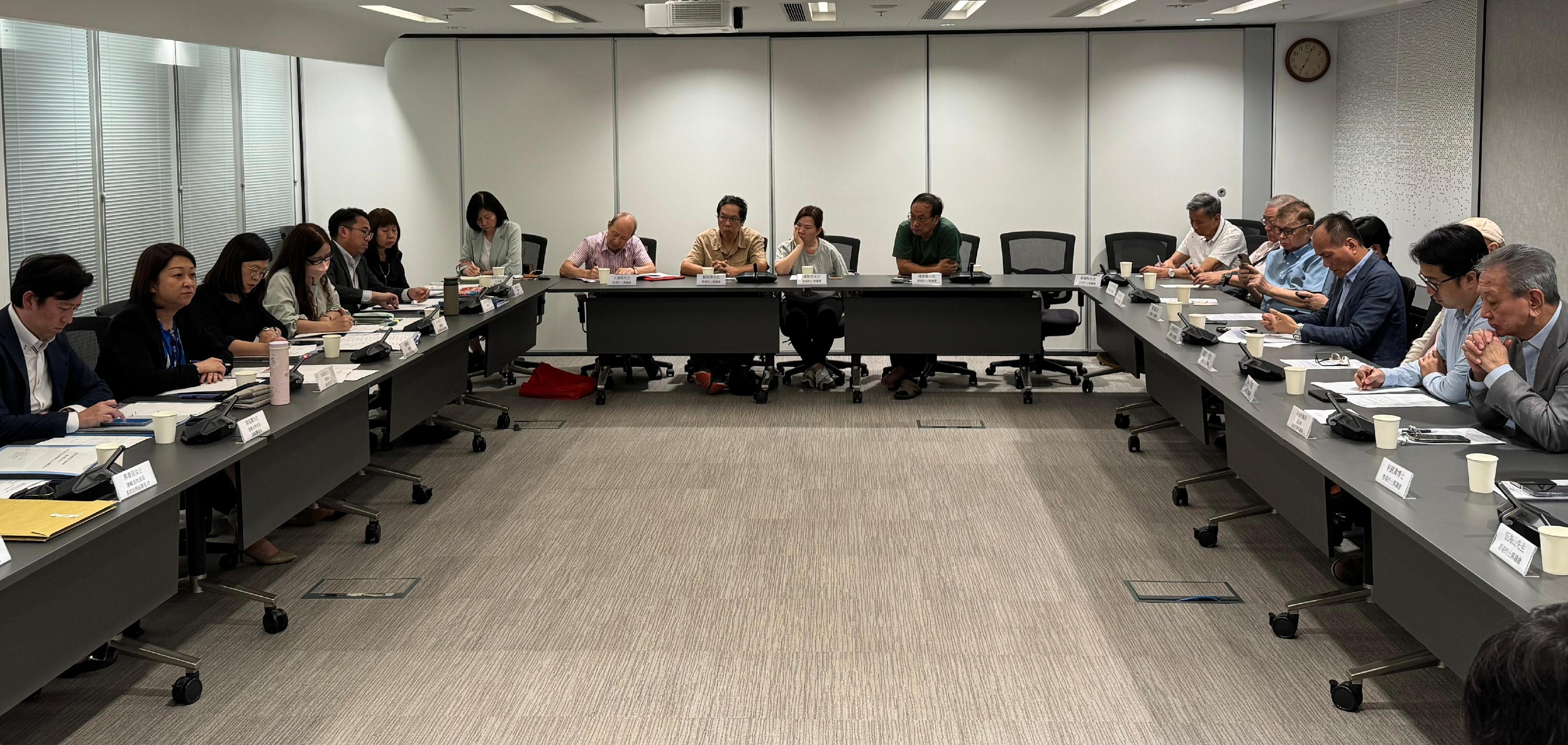
C for T meets taxi trade and reiterates determination to continuously combat illegal carriage of passengers for reward activities and formulate legislative proposals on regulation of online car hailing platforms within 2025 (with photo)

     The Commissioner for Transport, Ms Angela Lee, met with some 20 taxi trade representatives and Legislative Council Member concerned this afternoon (May 15), and exchanged views on their concerns about illegal carriage of passengers for reward activities, regulating online car hailing platforms and improving taxi service quality, reiterating the Government’s determination to continuously combat illegal hire car services in accordance with the law and formulate legislative proposals on regulation of online car hailing platforms within 2025. Representatives of the Transport and Logistics Bureau also attended.

     Trade representatives comprising various stakeholders, including trade associations, taxi dealers, taxi fleet operators and vehicle owners, attended the meeting. Ms Lee said, “Combating illegal carriage of passengers for reward activities, regulating online car hailing platforms and improving taxi service are the common goals of both the Government and the trade. We had candid exchanges at the meeting and we understand the taxi trade’s concern regarding online car hailing platforms and illegal hire car activities. The Government is determined to continuously combat illegal carriage of passengers for reward activities with a view to protecting the safety and interests of the public.”

     The Transport Department (TD) sternly pointed out that any online car hailing platform operator providing carriage of passengers for reward services must comply with the laws and regulations. The Hong Kong Police Force have been continuously combating illegal carriage of passengers for hire or reward across the territory during the past several months. Appropriate enforcement actions will be taken immediately for cases with sufficient evidence and enforcement actions are ongoing. Meanwhile, the Government is proactively studying legislative amendments, so that vehicles involved in the offence of illegal carriage of passengers for hire or reward can be impounded even if the driver’s identity cannot be confirmed, heightening the deterrent effect against illegal carriage of passengers for reward activities.

     In addition, the TD has stepped up publicity on the penalties of illegal carriage of passengers for reward. For the first conviction, the maximum fine is $10,000 with six months of imprisonment while the vehicle licence concerned will be suspended and the vehicle will be impounded for six months. Drivers are urged not to defy the law. Further, passengers using illegal hire car services may be at risk, as the vehicle’s third party insurance may become invalid in case of a traffic accident.

     At the meeting, the taxi trade also made suggestions on regulating online car hailing platforms and their vehicles and drivers. Ms Lee said that the Government is actively conducting a study on the overall demand and supply of personalised point-to-point transport services. She stressed that the service sustainability will be taken into account, meeting passengers’ needs for point-to-point services while safeguarding passenger safety and upholding service quality. The Government will holistically consider the report to be submitted by the Working Group for Enhancing Personalised Point-to-Point Transport Services under the Transport Advisory Committee, the views collected including the taxi trade’s views and relevant data in formulating legislative proposals on regulation of online car hailing platforms and licensing requirements for their vehicles and drivers within 2025, aiming to promote the platforms’ operations in a regulated manner.

     Ms Lee was pleased to note that the taxi trade representatives shared the need to act in concert to improve taxi service quality, including pressing ahead for the taxi fleets’ completion of gearing-up work for the commissioning of their services by end-July 2025, thereby improving passengers’ riding experiences and enhancing the trade’s competitiveness. The TD will continue to maintain close communication with the taxi trade to achieve the common goal of bringing mutual benefits to the transport sector and commuters at large.

Photo  
read more

Medical Laboratory Technologists Board responds to requests for clinical practice/attachment hours

​The following is issued on behalf of the Medical Laboratory Technologists (MLT) Board:
 
     The MLT Board is aware of a statement made by individual groups and training institutions regarding the hours required for clinical practice/attachment for medical laboratory technologists and responds today (May 15) as follows:
      
     The MLT Board, established under the Supplementary Medical Professions Ordinance (Cap. 359), is a statutory body that reviews the training arrangements of MLT from time to time to enhance their professional development. The MLT Board has started to discuss and review the requirement for clinical practice/attachment in the curriculum since 2023. It has agreed to strengthen the training of students in different medical laboratory-related areas under the principle that the overall number of training hours should remain unchanged. The objective is to ensure that the curriculum keeps abreast of the times and aligns with the latest developments in the medical field.
      
     Since 2023, the Registration Committee of MLT Board has been discussing and reviewing the hours required for clinical practice/attachment, which were formulated in 2013. Subsequently, at the MLT Board meeting of February 5, 2024, the MLT Board endorsed revising the required hours for clinical practice/attachment from 400 hours, covering only four basic areas, namely “Clinical Microbiology & Infection”, “Anatomical Pathology”, “Chemical Pathology” and “Haematology”, to 200 hours. This change will enable the institutions to allocate the released 200 hours to elective study modules according to the characteristics of their respective curricula without affecting the total number of hours. Under this arrangement, institutions can optimise the released training time to strengthen students’ learning in the basic areas or arrange for the students to explore other medical laboratory-related subjects beyond the basic areas, such as clinical immunology, molecular techniques and genetic testing etc. This encourages the diversified development of different institutions while maintaining their professional standards. Contrary to the allegation made in the statement, it is not a hasty reduction of clinical practice/attachment hours from 400 to 200 before graduation.
      
     Before making the decision, the MLT Board has been in close liaison with the industry through its Registration Committee (which comprises institutions, members of the associations and practitioners from different work backgrounds) and has held in-depth discussions on various accreditation requirements. Meetings were held to discuss the above issues and a Working Group on Review of Accreditation Criteria and Checklist was set up to invite experts to provide views in optimising the accreditation criteria and to continuously review both the local and international situations. The allegation that “academic institutions and industry stakeholders were not adequately consulted” is off the mark. The MLT Board stands ready to further explain to the MLT industry and training institutions the rationale of revising the required hours for clinical practice/attachment , and will work closely with stakeholders on the implementation details to facilitate the smooth execution of the resolution.
      
     The MLT Board is a statutory body established under the Supplementary Medical Professions Ordinance (Cap. 359) to promote adequate standards of professional practice and of professional conduct in the MLT professions. The MLT Board members (see Annex) comprises a wide representation of stakeholders, who are from the medical laboratory testing and medical professions, professional education, the Government, the Hospital Authority, and private sector. read more