Tag Archives: China

Cleanup on world’s highest mountain

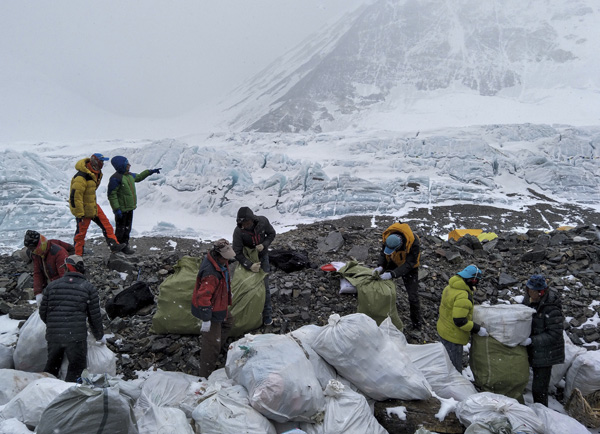
Volunteers sort garbage on the north slope of Qomolangma in the Tibet autonomous region on May 8, 2017. [Photo/Xinhua]

More than 100 climbers have collected 4.5 metric tons of garbage on the north slope of Qomolangma, known as Mount Everest in the West, in an annual cleanup campaign.

The volunteers, including local Tibetans, domestic and overseas mountaineers, and staff of Tibet’s mountaineering work units, have been working at altitudes of between 5,200 and 6,500 meters since May 6.

Pema Trinley, deputy secretary of the Tibet Mountaineering Association, said the mountaineers are from more than 20 countries, such as the United States, Italy, Spain, the United Kingdom and Switzerland.

Kari Kobler, president of Swiss outfitter Kobler & Partner and one of the volunteers, was reported by Xinhua News Agency to have lauded the cleanup campaign as a sign of China’s increased environmental awareness. The 62-year-old climbing enthusiast said he has climbed the mountain many times over the past 17 years.

The campaign is expected to wrap up in mid-May.

With a height of 8,844 meters, Qomolangma is the world’s highest mountain and attracts thousands of visitors, hikers and mountaineers every year from around the world.

“The altitude between 5,200 to 6,500 meters is where most of the human activities such as mountaineering and training take place, and so it has the most waste,” said Pema Trinley.

Of the 4.5 tons collected so far, about one-third is tin cans. Other solid waste left by mountaineers include plastic bags, oxygen tanks and mountaineering ropes.

The organizers-the China Mountaineering Association and the Tibet Sports Bureau-have arranged 102 yaks to carry the waste down to the base camp at an altitude of 5,200 meters for sorting. The garbage is then trucked to Dingri county for further treatment.

The cleanup work on the north slope started in 1997. But this year’s efforts have reached a higher altitude than past efforts.

Nyima Tsering, deputy director of the Tibet Sports Bureau, said the bureau has plans to install sorting, recycling and degradation stations along the campsites on the north slope.

The bureau is also considering cleanup campaigns at higher altitudes, probably reaching 8,300 meters, starting next year, he said.

“We are considering establishing a professional cleanup team that can remove waste and participate in rescue operations when necessary,” Nyima Tsering added.

read more
Beijing promotes culture under B&R Initiative

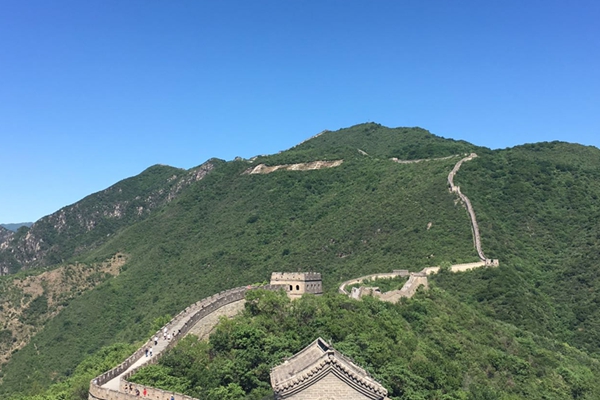
The Mutianyu section of the Great Wall in Huairou, a mountainous district in the north of Beijing, capital of China. [Photo by Cui Can/China.org.cn]

Reporters from home and abroad were invited to visit the International Culture Village of the Great Wall at Mutianyu ahead of the Belt and Road Forum for International Cooperation on May 13, as part of Beijing’s efforts to better demonstrate the capital’s achievements on protecting cultural relics and building beautiful villages.

Attracted by the charm of the Mutianyu Great Wall, lots of foreigners have settled in nearby villages. Located at the foot of the Great Wall, the International Culture Village covers an area of 17.8 square kilometers and consists of four villages—Mutianyu, Beigou, Tianxianyu and Xinying.

The culture village has attracted 30 foreign entrepreneurs to settle down and establish businesses since 2005.

Jim Spear and his Chinese wife Tang Liang run a hotel named “The Brickyard” at the village. Mr. Spear gave an introduction to their design ideas — “enjoy the luxury of simple comfort,” which means getting close to nature and using existing buildings to realize sustainable development.

He also stressed the importance of respecting ancient culture in building new villages. With Spear’s help, local villagers have re-decorated their own houses reflecting a mixture of old and the new, and also East and West. They then rent the houses to foreigners. A unique town with international characteristics has gradually taken shape here.

The Mutianyu Great Wall was built on the ruins of a previous structure from the Northern Qi Dynasty (550-577), becoming a quintessence of the Great Wall developing during the Ming Dynasty (1368-1644). As one of the best-preserved parts of the Great Wall, the Mutianyu section draws masses of tourists attracted by its beautiful scenery and traditional culture. Over 70 percent of visitors come from overseas.

Wang Zhigang, deputy manager of Financial Street Holdings Co.Ltd., delivered a welcome address to visiting reporters, pointing out the importance of the Mutianyu Great Wall in promoting international cultural exchanges, as well as describing efforts to protect ancient cultural relics.

“Under the background of the Belt and Road Initiative, we are going to deepen the historical relic’s development, and to provide a better travel experience for visitors,” he said.

read more