 |
|
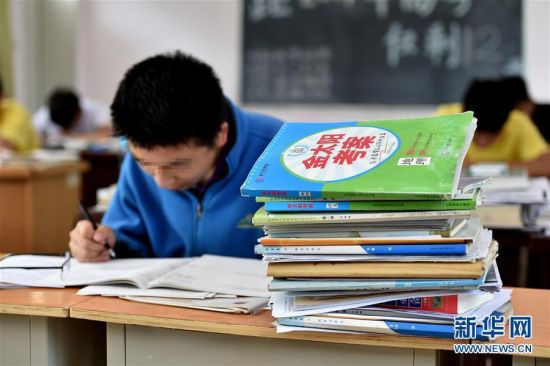
Students in Linfen Red Ribbon School prepare for the national college entrance exam, May 25, 2017. [Photo/Xinhua]
|
A school for children infected with HIV in north China has been given permission to hold the national college entrance examination in its classrooms to prevent potential disruption for other students taking the test.
Sixteen of the 36 students enrolled at Linfen Red Ribbon School in Shanxi Province will take the exam, known as the Gaokao, on June 7 and 8.
The school, which opened in 2004, offers 12 years of elementary education to children who were infected with HIV-usually in their mothers’ wombs or through breastfeeding. It will be the first time any of its students have taken the exam.
The Shanxi Education Commission gave permission for the independent testing site shortly after the school held a commencement ceremony for its first high school graduates.
“I take that as a goodwill stance by the authorities,” said principal Guo Xiaoping. “We have to face the reality that discrimination is still rife against people living with HIV and AIDS.”
He said his students are allowed to take the exam at the regular examination site, which is 20 kilometers from the school, but that taking it in a familiar environment would help their performance.
Hu Zetao, 18, who is among the students who will take the exam, appeared in a public service announcement with China’s first lady, Peng Liyuan, to fight AIDS discrimination in 2012. In that widely circulated presentation, he showed his face and became familiar to the public. Guo said it made him a public figure in Linfen.
Hu said he and his fellow students were determined to attend universities in other parts of the country.
“Fewer people know us there and we are more likely to have a normal college life,” he said.
Chinese law safeguards the privacy of people with HIV and AIDS. Also, HIV is not tested during the routine health check for college entrance.
Guo said tolerance for HIV-positive people is much better at universities where students are adults, compared with primary and middle schools.
“I hope our children can lead a normal life after college,” he said. But for Hu, it’s much harder, as he became well known during many awareness-raising events.
With the Gaokao approaching, “I feel increasingly nervous”, Hu conceded.
“I don’t know whether any college will accept me, whether the college teachers will treat me like they do others or whether other college students will study beside me and live in the same dormitory with me,” Hu said.
But he said he was committed to a lifelong fight against AIDS and related discrimination. Guo said he would help communicate with the universities that students from Linfen Red Ribbon School strive for normal and happy study lives.
After Hu and his classmates leave for colleges following the Gaokao, Guo said, “We’ll have our next college entrance examination in six to seven years, and I am confident a more tolerant and well-informed society then will welcome the HIV-positive children to sit in the examination side by side with the HIV-free ones,” he said.
Without intervention, 30 percent of HIV-positive women will pass on the virus to their children. Currently, roughly 5.7 percent of infected mothers give birth to an HIV-positive baby, government statistics show.
read more