Tag Archives: China

Beijing ‘can offer help’ to Xiongan

 Aerial photo taken on April 1, 2017 shows Anxin county, North China's Hebei province.[Photo/Xinhua]

Aerial photo taken on April 1, 2017 shows Anxin County, North China’s Hebei Province.[Photo/Xinhua]

Beijing and Xiongan New Area will need systematic cooperation to achieve coordinated development and mitigate urban ills, experts said on Sunday.

Lin Jian, a researcher at Renmin University of China’s National Academy of Development and Strategy, said Xiongan will take over many functions of Beijing to help the capital ease its population pressure.

“How to attract people to move there will be a crucial task,” he said. “The authorities need to make plans in the sectors of education, medical care and cultural development in Xiongan,” Lin said. “Beijing can offer its help.”

He said many State-owned enterprises, colleges and government institutions will move to Xiongan. The corresponding educational and medical resources should be planned in advance for people who will move there; otherwise, problems could occur, he warned.

“Xiongan cannot be a cultural desert, which means Beijing should also provide cultural facilities to the new area,” Lin said.

On Friday, Beijing pledged to closely cooperate and fully support the development of Xiongan and encourage people to move there as needed.

Liu Bozheng, deputy director of the Beijing-Tianjin-Hebei development leading group, said Beijing will cooperate with Xiongan on construction and services, accelerating the relocation of industries that suit the new area.

“The Beijing municipal government attaches high importance to the development of Xiongan New Area,” he said.

He said Beijing will assist in planning and policymaking in sectors such as infrastructure construction, transportation integration and the sharing of public services. The capital will also encourage innovative companies to establish themselves in Xiongan.

China announced plans to create Xiongan New Area in April as part the integration of the Beijing-Tianjin-Hebei region. It is designed to ameliorate urban ills such as traffic congestion and air pollution.

Located about 100 kilometers southwest of downtown Beijing, the new area will have a substantial footprint in three existing counties of Hebei province-Xiongxian, Rongcheng and Anxin.

Zhao Weidong, spokesman for the Beijing Municipal Commission of Commerce, said on Friday that Beijing has established a platform to cooperate with Tianjin and Hebei and has transferred some wholesale markets and logistics facilities to Hebei.

The commission promoted 26 projects with a total investment of more than 5 billion yuan ($740 million) last year involving the move of markets and logistics facilities to Hebei.

According to data from the city, Beijing’s population and its growth rate has been declining for the past three years. Meanwhile, the city’s GDP was up 6.7 percent last year compared with 2015.

read more
Scholar: Chinese innovative talent education should go beyond knowledge

Innovative talent education in China should look beyond mere knowledge accumulation, and protect curiosity and imagination and cultivate sound values in students, said Qian Yingyi, counsellor of China’s State Council in Beijing on June 9.

Qian Yingyi, counsellor of China’s State Council and also dean of School of Economics and Management at Tsinghua University, delivers a lecture on innovative talent education in Beijing on June 9. [Photo/Xinhua]

In a lecture, Qian, who is also the dean of School of Economics and Management at Tsinghua University, said the innovation-driven development of a nation requires innovative talents with creative thinking, with this quality dependent not only on knowledge but also curiosity and imagination.

Qian’s remarks came in the wake of China’s annual national entrance exam, in which a record 9.4 million students took part this time,

He said that, though China is the most populous country in the world and educates the world’s largest number of students, its achievements in science and technology, arts and humanities, new products, brands and business model remain scanty.

“Why is there the shortage of innovative talents under our education system?” Qian reiterated the question which was once raised by Qian Xuesen, Father of the Chinese missile program, 25 years ago. The answer was that the education of innovative talents required an innovative approach of its own.

He highlighted several critical factors – curiosity, imagination and sound values for future educational reform to reflect on.

In his view, the notion “knowledge is power” seems to prevail however, education does not equal knowledge. He quoted a few sentences from the world-renowned physicist Albert Einstein, to highlight the factors that he thought should be valued in education reform, namely: “I have no special talents. I am only passionately curious” and “imagination is more important than knowledge’. He Illustrated the thought in a formula “creativity = curiosity /imagination * knowledge.” Qian said knowledge invariably accumulates with time, but it is not the same case when it comes to curiosity and imagination, which depend more on the educational environment and methods.

The curiosity and imagination so intense during childhood may fade away with time or under pressure, especially under exam-oriented education, so student curiosity and imagination should be protected to become innovative talents, he stressed.

In the lecture, Qian also emphasized the cultivation and guidance of sound values in students under innovative talent education. He said that innovative education should guide students to have a “purpose” and even a “higher purpose” to overcome any anxiety about achieving quick success and gaining instant benefits.

Only by educating students to uphold sound values can there be more innovations, and, indeed, more revolutionary innovations, he emphasized.

read more

Chinese submersible Jiaolong to dive in Yap Trench

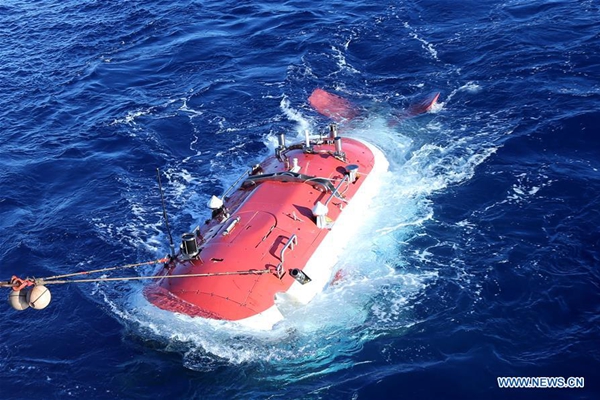
China’s manned submersible Jiaolong surfaces after its dive in Yap Trench, June 9, 2017. Jiaolong completed its 150th dive on Friday since 2009. [Photo/Xinhua] 

China’s manned submersible Jiaolong will conduct two dives in the Yap Trench on Sunday and Tuesday.

The upcoming dives will be the final dives of China’s 38th oceanic scientific expedition that started on Feb. 6, according to scientists on the ship.

Before reaching the Mariana Trench and the Yap Trench in June, Jiaolong had successfully completed two stages of operation in the Indian Ocean and the South China Sea.

Jiaolong descended to 6,488 meters in the Yap Trench on Friday, which was its 150th dive since August 2009.

Jiaolong reached its deepest point of 7,062 meters in the Mariana Trench in June 2012.

read more