|
|
|
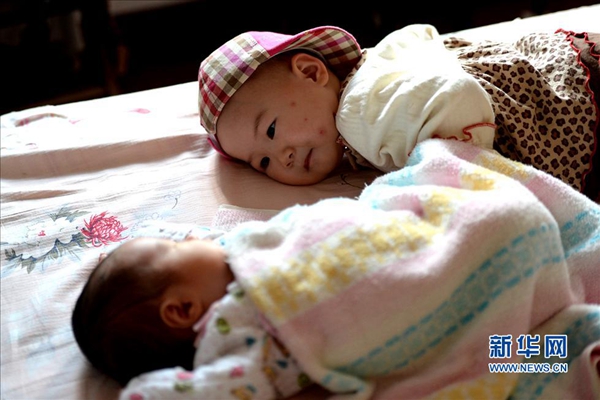
A baby girl lies on the bed with her younger brother in Liuzhou City, Guangxi Province. [Photo/Xinua]
|
More than half of the births in China during the first five months of the year involved a second child – or even additional ones – more than a year after the universal second-child policy was introduced in January 2016, according to China’s top health authority.
The number of births at Chinese hospitals between January and May was 7.4 million, an increase of 7.8 percent over the same period last year, Wang Peian, vice-minister of the National Health and Family Planning Commission, said at an annual meeting of the China Population Association held in Kunming, Yunnan Province, last week.
Of all births in the first five months, 57.7 percent were at least the second child of their parents, an increase of 8.5 percentage points over the same period last year, he said.
The total number of births at hospitals in China last year was about 18.5 million, the highest level since 2000, according to the commission. More than 99 percent of births in China take place in hospitals.
The universal second-child policy has produced good results, and the number of babies born has been increasing significantly despite a drop in the number of women of fertile age, Wang said.
Over the past year, health authorities have been improving measures to support the policy and establish a social environment that encourages childbirth, he said.
With an increasing number of pregnancies, China faces some health challenges in the next few years – for example, a significant number of the mothers are over 35 – according to health officials and doctors. The number of pregnant women over age 35 is expected to remain at about 3 million through 2020.
“Surveys show that many couples from the generation born in the 1970s who were hesitant about having a second child during the initial period when the universal second-child policy was adopted are now hurrying to give birth to a second child so they won’t miss that last chance,” Ma Xiaowei, another vice-minister of the commission, said last week.
In Guilin, in the Guangxi Zhuang autonomous region, more than 28 percent of women who gave birth last year were at higher risk in pregnancy and childbirth, according to a report in Guilin Evening News on Friday. One factor was age.
At Guilin Women and Children’s Hospital, doctors saved 140 pregnant women in critical condition in the first half of the year. The oldest pregnant woman treated so far this year was 56, the report said.
China introduced its family planning policy in the late 1970s to check its soaring population by limiting most urban couples to one child. Couples in rural areas could have a second child if the first one was a girl, and in some ethnic regions couples in rural areas could have more than two children.
A major policy change at the end of 2013 allowed couples nationwide to have a second child if either parent was an only child. That limitation was erased last year.
read more

 0 Comment(s)
 Print
 E-mail China.org.cn, July 24, 2017


