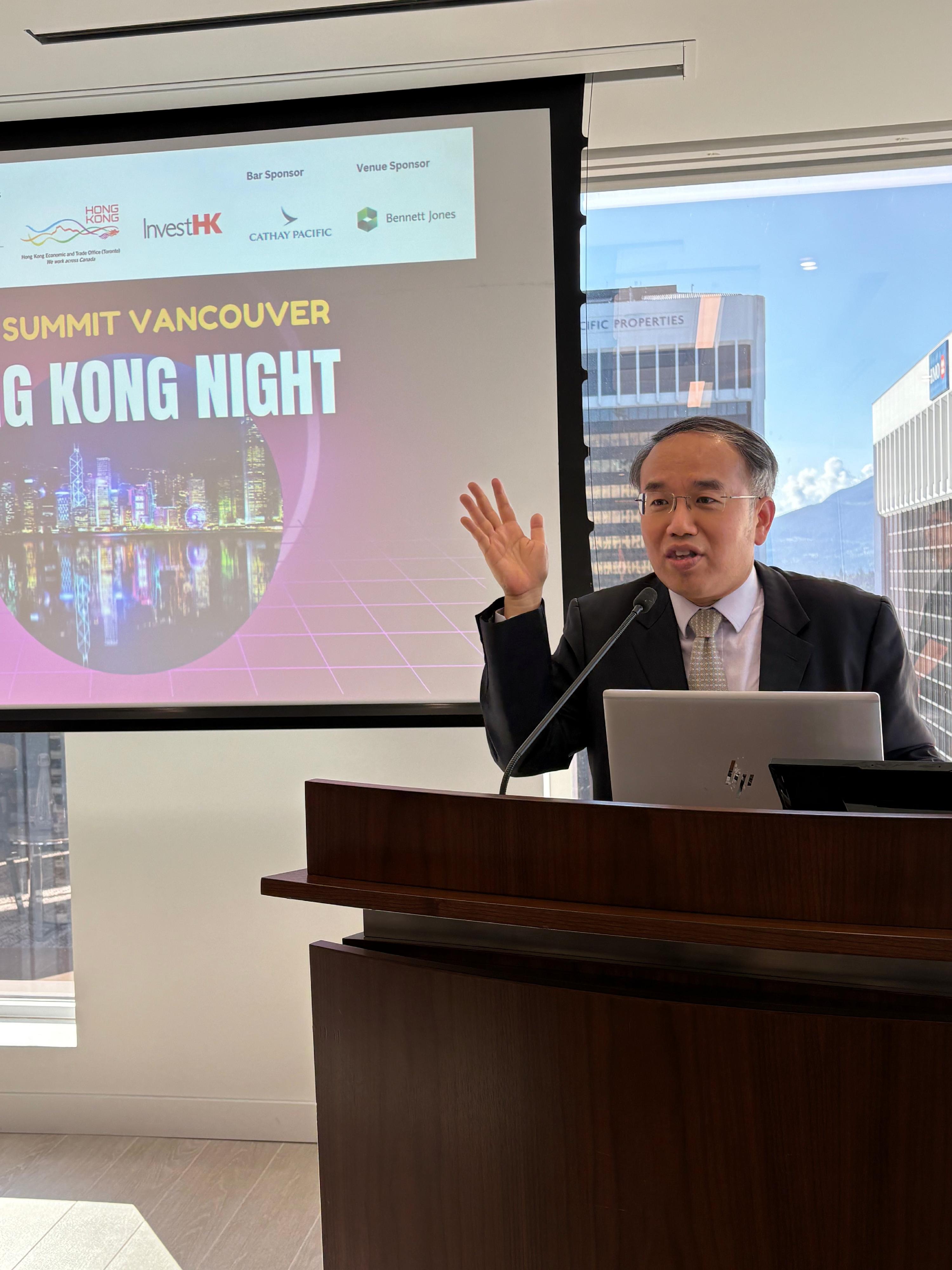
Following is the speech by the Secretary for Financial Services and the Treasury, Mr Christopher Hui, at the business networking reception and seminar “Hong Kong Night” organised by Invest Hong Kong (Canada) in Vancouver, Canada, on May 29 (Vancouver time):
Distinguished guests, industry leaders and innovators, friends in Canada and from around the world,
Good evening, everyone. Thanks for having me today for this very special occasion, called “Hong Kong Night”. I must say I always wonder why we have “Hong Kong night” in broad daylight. I suppose it could be a distinctive feature of this city which everybody loves. Just now, our colleague from Cathay Pacific mentioned to me that there will be a draw right after for tickets so I’m sure that explains why you are all here.
Let me give you some flavour in terms of how Hong Kong has been faring, and also at the same time some talking points that you may want to share after this session. I want to give you an overview in terms of how Hong Kong has done so far in financial services under my portfolio, and also in particular the reason why I’m here in Vancouver because this is my last stop, after Toronto and also Ottawa. Through this visit, I had the opportunity to see many people at the government, regulators and also financial institutions. What I am impressed most is that it’s really a place where people are looking for a change. You already have a new government. At the same time, you are looking for ways to diversify, in terms of your economy, and also in terms of financial activities. So I think Hong Kong comes at the right time, where it’s a very viable option, either you are a corporate, an individual, or even an investor, to consider that in the context of diversification.
Before I further proceed, maybe first of all, let me give you an overview of how Hong Kong’s been faring so far. I’ve been asked a lot in terms of the impact of tariffs on Hong Kong. I understand that there will be a fireside chat by Rocky (the Director and Head of Policy Research of the Financial Services Development Council, Dr Rocky Tung) later on, and I’ll leave that to the experts. But that said, Hong Kong being a service economy, I must say we don’t have much to export. At the same time, we are a free economy as stipulated in our Basic Law. So far so good in terms of our resilience, I would say, in the broader context of geopolitical change.
More specifically, in our capital market, recently we do see an upsurge in our stock market. Right now, our average daily turnover is exceeding US$32 billion, and also we’ve welcomed a number of key mega IPOs (initial public offerings), like the recent one is CATL (Contemporary Amperex Technology Co Limited). It’s a major or global battery manufacturer for EVs (electric vehicles), and they just got listed at the same time, offering a shares equivalent to the size of around HK$41 billion. And funny enough, when you look at the composition of the investors, we have those from the US. At the same time, we also have investors from the Middle East, where the Kuwait Sovereign Wealth Fund, what we call the KIA, Kuwait Investment Authority, actually put in US$500 million in that offer. So you can see that despite all the talk about the deglobalisation or decoupling, finance, in particular, capital formation takes place, and also monies after returns.
Of course, that is not alone in terms of what we are welcoming. We also welcome Canadian companies to list in Hong Kong as well. Right now, we have around six Canadian companies already listed in Hong Kong, like Manulife and also some of the mining and oil and gas companies. I do very much welcome many more listings, especially from this part of the world, where it could be tech, could be mining, or for other types of new economic activities.
The second part I want to highlight, apart from how Hong Kong has been faring, is in terms of my observations so far this year, so far in my visit. Apart from the general ones that I just highlighted, I do see a number of areas that Hong Kong and Canada can work together. First of all, wealth management, because I got the chance to see and meet a number of insurance companies and banks from this part of the world. In fact, many of them are heavily invested and also have a strong presence in Hong Kong, like Manulife, which takes up 27 per cent of our Mandatory Provident Fund, a pension service system in Hong Kong. And also Sun Life, which is in collaboration with Dah Sing Bank in Hong Kong through the bank insurance businesses. Also we have CIBC (Canadian Imperial Bank of Commerce) and others that already have a strong presence in corporate banking in Hong Kong.
Many people see wealth management as an emerging trend, an area where we should work together. Because in the way that we see the world, like all of you, people are looking for ways to diversify. Many of the traditional markets where people want to park their wealth in the Anglo-Saxon world, people are still changing their minds in terms of whether they should diversify through geography or through products. In either way, Hong Kong is an option, because we have been the largest offshore cross-boundary wealth management centre so far in Asia, and we are looking to be the biggest one in the world. It is an area that we are very keen to develop further. Right now, we have 2 700 single family offices. We are going to have facilitated at least 200 more family offices by the end of this year. Also, we are going to have more tax concessions for family offices to cover private credit, carbon credit, and virtual assets. I will leave these details to our Invest Hong Kong colleagues. They will have all the details. All I want to say is wealth management, in particular in terms of family offices and high-net-worth individuals, is an area that I think Hong Kong can walk closely together with this country.
The second area that I think is important to note in terms of collaboration is about what the host mentioned just now – the Web Summit Vancouver. The reason that I’m here is because we just passed a law to regulate stablecoin issues in Hong Kong. It is a big topic, not just in Hong Kong, but regionally, because many people see virtual assets as speculative. But that said, stablecoins being underpinned by fiat currency is a different animal, which potentially can be used in the form of payment. At a time when the US dollar or US-related assets are being questioned, I think many of the alternatives, also at the same time, in the form of stablecoins, have that role to play.
In that regard, I have more to share in terms of our ecosystem effort to build an ecosystem in Hong Kong for our virtual assets. We have already 10 virtual asset exchanges, and also at the same time, we are going to issue licenses for stablecoin issuers. And very soon, we will also regulate these virtual asset custodians. For anyone of you who are participating, in this space, I do urge you to look at what Hong Kong has done and also at the same time how you can leverage the opportunities for your own development.
Last but not least, in terms of what I want to inform this group is having debriefed all of you about what Hong Kong has done in terms of wealth management and virtual assets and also fintech in general, I’m sure that you do see a lot of need to come to Hong Kong. So even though you may not be able to get those free tickets, I’m sure you’re all rich enough to buy your own and also give yourself a reason to come to Hong Kong soon. And anytime, anywhere, you’re most welcome. Thank you.