Tag Archives: China

image_pdfimage_print

Hong Kong Customs seizes suspected scheduled dried shark fins (with photo)

     Hong Kong Customs yesterday (December 23) seized about 200 kilograms of suspected scheduled dried shark fins of endangered species with an estimated market value of about $120,000 from a container at the Tsing Yi Cargo Examination Compound.

     Through risk assessment, Customs officers selected a container arriving in Hong Kong from Sri Lanka for inspection and found the batch of suspected scheduled dried shark fins mix-loaded with another batch of non-scheduled dried shark fins inside the container.

     The case has been handed over to the Agriculture, Fisheries and Conservation Department for follow-up investigation.

     Under the Protection of Endangered Species of Animals and Plants Ordinance, any person found guilty of importing or exporting an endangered species without a licence is liable to a maximum fine of $10 million and imprisonment for 10 years.

     Customs will continue to take vigorous enforcement action against different kinds of smuggling activities during the Christmas and New Year holidays.

     Members of the public may report any suspected smuggling activities to Customs’ 24-hour hotline 2545 6182 or its dedicated crime-reporting email account (crimereport@customs.gov.hk).
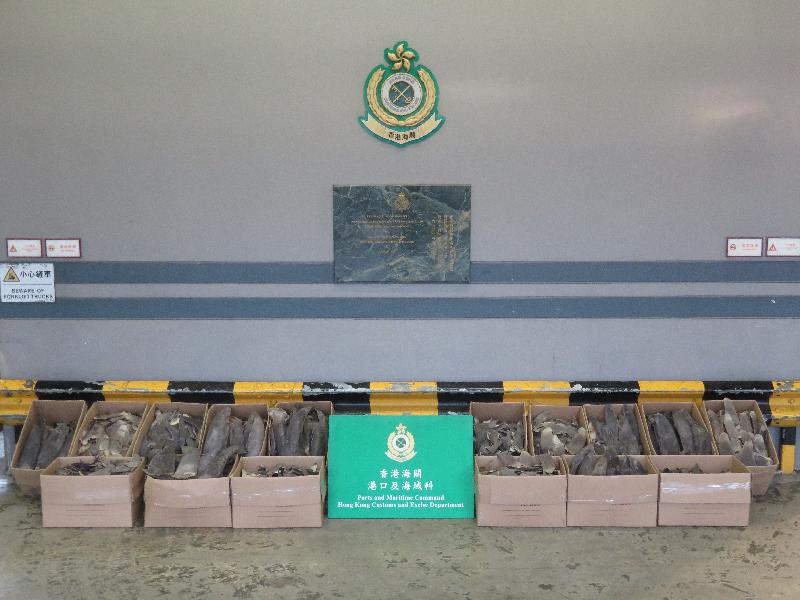
Photo  
read more

Asphalt plants in Tuen Mun convicted of violating Air Pollution Control Ordinance

     Two asphalt plants in Lung Kwu Sheung Tan, Tuen Mun, under the companies Hong Kong Asphalt (Green) Limited and Road Asphalt Limited respectively, were convicted of violating the Air Pollution Control Ordinance (APCO) today (December 24) at the Fanling Magistrates’ Courts for failing to properly operate their dust-filtering equipment and storing aggregates, thus causing air pollution. The two companies were respectively fined $9,000 and $10,000. In addition, a director of Hong Kong Asphalt (Green) Limited was also prosecuted for violating the APCO, and was ordered to pay bail of $5,000 on his own recognisance and bound over for 24 months by the court.

     The Environmental Protection Department (EPD), during a routine inspection in April, found that a large amount of fine dust was being discharged from the asphalt plant under Hong Kong Asphalt (Green) Limited, causing air pollution. After investigation, EPD officers found that the plant did not properly operate its dust-filtering equipment, thus causing a large amount of fine dust to disperse from its filters and breaching the requirements stipulated in the Specified Process Licence. Records showed that the asphalt plant had been convicted repeatedly for such violations and its director was also suspected of management negligence or omission, having failed to ensure that the plant was operating in compliance with the licence requirements. Meanwhile, when investigating another complaint in June, the EPD found that an asphalt plant of Road Asphalt Limited located at Lung Kwu Sheung Tan had stockpiled aggregates in an open area, causing dust emission and contravening requirements of the Specified Process Licence. After collecting evidence, the EPD prosecuted the two asphalt plants and a director concerned in accordance with the APCO.

      Under the APCO, asphalt works are classified as specified processes, which must be licensed by the EPD and should be carried out strictly in accordance with the terms stipulated in the licence. If licence holders fail to observe licence conditions, first-time offenders are liable to a maximum fine of $100,000. Upon second or subsequent conviction, a maximum fine of $200,000 and six months’ imprisonment may be imposed. Negligent operators shall also be held personally liable upon conviction in court. read more

Designation of Domestic Systemically Important Authorized Institutions

The following is issued on behalf of the Hong Kong Monetary Authority:
 
     The Hong Kong Monetary Authority (HKMA) has completed its annual assessment of the list of Domestic Systemically Important Authorized Institutions (D-SIBs). Based on the assessment results, the list of authorised institutions designated as D-SIBs remains unchanged compared to the list of D-SIBs published by the HKMA on December 21, 2018. The latest list of D-SIBs is shown in the Annex.
 
     Under the D-SIB framework, each of the authorised institutions designated as a D-SIB will be required to include a Higher Loss Absorbency (HLA) requirement into the calculation of their regulatory capital buffers within a period of 12 months after the formal notification of its designation. The HLA requirement applicable to a D-SIB (expressed as a ratio of an authorised institution’s Common Equity Tier 1 capital to its risk-weighted assets as calculated under the Banking (Capital) Rules) ranges between 1 per cent and 3.5 per cent (depending on the assessed level of the D-SIB’s systemic importance). 
 
     Compared with the list of D-SIBs published in December 2018, the HLA requirement for one authorised institution (Standard Chartered Bank (Hong Kong) Limited) has increased from 1 per cent to 1.5 per cent and that for another authorised institution (Hang Seng Bank Limited) has decreased from 1.5 per cent to 1 per cent.
 
     Further details about the decision can be found on the HKMA website (Systemically Important Authorized Institutions (SIBs)).
 
Background

(1) D-SIB framework in Hong Kong

     The Banking (Capital) Rules and the HKMA’s regulatory framework for D-SIBs follow the provisions in “A framework for dealing with domestic systemically important banks” issued by the Basel Committee in October 2012, by enabling the Monetary Authority (i) to designate an authorised institution as a D-SIB if the Monetary Authority considers the authorised institution to be of systemic importance in the context of the Hong Kong banking and financial system and (ii) to require an authorised institution designated as a D-SIB to be subject to an HLA capital buffer.
 
     The rationale for imposing an HLA requirement on D-SIBs is to reduce any probability of them becoming non-viable. This is considered both prudent and justified in view of the greater impact that they could have, in the unlikely event of their failure, on the domestic financial system and the local economy more broadly. 
 
(2) HLA requirement for authorised institutions designated as D-SIBs

     The Monetary Authority is empowered under sections 3U and 3V of the Banking (Capital) Rules to designate D-SIBs and to determine an HLA requirement for each of these D-SIBs by reference to the degree of domestic systemic importance which the Monetary Authority assesses them to bear. To achieve this aim, the HKMA’s regulatory framework for D-SIBs provides for authorised institutions designated as D-SIBs to be allocated to different HLA “buckets”. This differentiated approach reflects the diversified nature and varying degrees of systemic importance of authorised institutions in Hong Kong.
 
     The designated D-SIBs must apply the HLA in the calculation of their regulatory capital buffers within 12 months of the formal notification of their designation. There are five HLA buckets in total ranging from 1 per cent to 3.5 per cent. While only the first four buckets (i.e. from 1 per cent to 2.5 per cent) have been populated so far, the framework includes an empty 3.5 per cent bucket to encourage D-SIBs to refrain from becoming even more systemically important.  
 
     The HLA applied to a D-SIB serves (together with the Countercyclical Capital Buffer) as an extension of the Basel III Capital Conservation Buffer. Accordingly, if and when a D-SIB’s CET1 capital ratio falls within the extended buffer range, the D-SIB will be subject to restrictions on the discretionary distributions it may make. The effect of this is that D-SIBs will be required to retain earnings in order to bolster their regulatory capital. read more