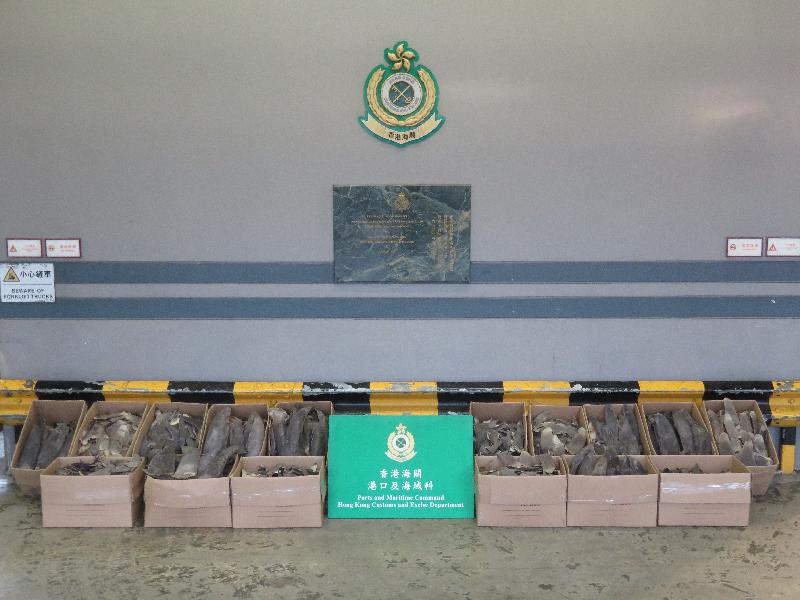
Hong Kong Customs seizes suspected scheduled dried shark fins (with photo)

     Hong Kong Customs yesterday (December 23) seized about 200 kilograms of suspected scheduled dried shark fins of endangered species with an estimated market value of about $120,000 from a container at the Tsing Yi Cargo Examination Compound.

     Through risk assessment, Customs officers selected a container arriving in Hong Kong from Sri Lanka for inspection and found the batch of suspected scheduled dried shark fins mix-loaded with another batch of non-scheduled dried shark fins inside the container.

     The case has been handed over to the Agriculture, Fisheries and Conservation Department for follow-up investigation.

     Under the Protection of Endangered Species of Animals and Plants Ordinance, any person found guilty of importing or exporting an endangered species without a licence is liable to a maximum fine of $10 million and imprisonment for 10 years.

     Customs will continue to take vigorous enforcement action against different kinds of smuggling activities during the Christmas and New Year holidays.

     Members of the public may report any suspected smuggling activities to Customs' 24-hour hotline 2545 6182 or its dedicated crime-reporting email account (crimereport@customs.gov.hk).

Photo  


Surface mail services to certain destinations discontinued

     Hongkong Post announced today (December 24) that due to the termination of sea transit operations by some postal administrations, surface mail services to the following destinations are discontinued immediately.
 

Service type Destinations
Surface letter Anguilla; Bhutan; Cayman Islands; Channel Islands; Falkland Islands, South Georgia and South Sandwich Islands; Kiribati; Maldives; Mariana Islands; Micronesia; Sao Tome and Principe; St Christopher (St Kitts) and Nevis; St Lucia; Tortola; Turks and Caicos Islands; Vatican; and Wake Island
Surface parcel Azerbaijan
Surface letter and parcel Caroline Island, Marshall Islands, Timor-Leste


Asphalt plants in Tuen Mun convicted of violating Air Pollution Control Ordinance

     Two asphalt plants in Lung Kwu Sheung Tan, Tuen Mun, under the companies Hong Kong Asphalt (Green) Limited and Road Asphalt Limited respectively, were convicted of violating the Air Pollution Control Ordinance (APCO) today (December 24) at the Fanling Magistrates' Courts for failing to properly operate their dust-filtering equipment and storing aggregates, thus causing air pollution. The two companies were respectively fined $9,000 and $10,000. In addition, a director of Hong Kong Asphalt (Green) Limited was also prosecuted for violating the APCO, and was ordered to pay bail of $5,000 on his own recognisance and bound over for 24 months by the court.

     The Environmental Protection Department (EPD), during a routine inspection in April, found that a large amount of fine dust was being discharged from the asphalt plant under Hong Kong Asphalt (Green) Limited, causing air pollution. After investigation, EPD officers found that the plant did not properly operate its dust-filtering equipment, thus causing a large amount of fine dust to disperse from its filters and breaching the requirements stipulated in the Specified Process Licence. Records showed that the asphalt plant had been convicted repeatedly for such violations and its director was also suspected of management negligence or omission, having failed to ensure that the plant was operating in compliance with the licence requirements. Meanwhile, when investigating another complaint in June, the EPD found that an asphalt plant of Road Asphalt Limited located at Lung Kwu Sheung Tan had stockpiled aggregates in an open area, causing dust emission and contravening requirements of the Specified Process Licence. After collecting evidence, the EPD prosecuted the two asphalt plants and a director concerned in accordance with the APCO.

      Under the APCO, asphalt works are classified as specified processes, which must be licensed by the EPD and should be carried out strictly in accordance with the terms stipulated in the licence. If licence holders fail to observe licence conditions, first-time offenders are liable to a maximum fine of $100,000. Upon second or subsequent conviction, a maximum fine of $200,000 and six months' imprisonment may be imposed. Negligent operators shall also be held personally liable upon conviction in court.


Appointments to Youth Square Management Advisory Committee announced

     The Home Affairs Bureau (HAB) announced today (December 24) the re-appointment of two incumbent members and appointment of two new members to the Youth Square Management Advisory Committee (MAC) for a two-year term from January 1, 2020, to December 31, 2021.
 
     The Chairperson and non-official members of the MAC are as follows:
 
Chairperson
————–
Deputy Secretary for Home Affairs (1)
 
Ex-officio members
———————-
Vice-Chairperson of the Youth Development Commission, or a representative
Chairperson of the Committee on the Promotion of Civic Education, or a representative
Representative from the Eastern District Council
Representative from the Board of Management of the Chinese Permanent Cemeteries
 
Newly appointed members
——————————
Mr Victor Lam Tsz-hung
Mr Jan Noel Shih
 
Re-appointed members
————————–
Mr Allen Che Wai-hang
Mr Stefan Chui Kai-hin
 
Existing members
——————–
Ms Christina Chan Sye-min
Mr Dave Ho
Mr Angus Ho Kwok-lai
Ms Lo Kam-ping
Mr Poon Siu-chi
Mr Yeung Hok-lam
 
     The MAC also includes representatives from the HAB, the Education Bureau and the Leisure and Cultural Services Department as members.
 
     A spokesman for HAB thanked the outgoing members, Ms May Chan Cheuk-kwan and Ms Samantha Kong Wing-man, for their support since their appointment to the MAC.
 
     The MAC is a non-statutory advisory body to advise the Government on matters pertaining to the operation of Youth Square, including the overall strategy and objectives of Youth Square; themes and contents of youth development programmes; the use, allocation, leasing and charging arrangements of various facilities; the evaluation of the effectiveness of the use of Youth Square in promoting youth development programmes and monitoring the performance of the operator.


November’s monthly ovitrap index for Aedes albopictus drops further

     The Food and Environmental Hygiene Department (FEHD) today (December 24) announced that the monthly ovitrap index for Aedes albopictus for November dropped further to 1.1 per cent from 2.9 per cent in October, indicating that the infestation of Aedes albopictus in the areas surveyed was not extensive.

     After months of enhanced collaborative efforts by various departments in mosquito prevention and control work, no area has recorded an Area Ovitrap Index (AOI) exceeding the alert level of 20 per cent since August this year. Moreover, FEHD's year-end clean-up operation will commence on December 31, during which mosquito preventive and control work will also be enhanced.

     A spokesman for the FEHD said, "Aedes albopictus is a kind of mosquito that can transmit dengue fever (DF) as well as the Zika virus infection. DF is commonly found in tropical and subtropical regions of the world, and has become endemic in many countries in Southeast Asia. The World Health Organization also issued warnings that the number of DF cases recorded in Asia this year was exceptionally high compared with last year. Since Hong Kong recorded this year's first local DF case last month and the dengue activity in neighbouring areas has remained high, while the breeding and activity of mosquitoes also continue in the winter season, the community must remain vigilant and continue to carry out effective mosquito prevention and control measures. The FEHD and relevant government departments will continue their mosquito preventive and control work covering areas under their purview."

     Among the 57 areas surveyed last month, positive ovitrap indices, ranging from 0.8 per cent to 7.3 per cent, were recorded in 27 areas. As for the port areas, the monthly ovitrap index for Aedes albopictus for November fell to 0.1 per cent from 0.4 per cent in October.

     The spokesman added that as Aedes albopictus breeds in small water bodies, members of the public should carry out effective mosquito prevention and control measures, including inspecting their homes and surroundings to remove potential breeding grounds, changing the water in vases and scrubbing the inner surface as well as removing the water in saucers under potted plants at least once a week, properly disposing of containers such as soft drink cans and lunch boxes, and drilling large holes in unused tyres. He also advised public and estate management bodies to keep drains free of blockage and level all defective ground surfaces to prevent accumulation of water. They should also scrub all drains and surface sewers with an alkaline detergent at least once a week to remove any mosquito eggs.

     In addition, rural areas and the vicinity of shrubby areas are natural habitats for mosquitoes, other insects and animals. Members of the public living in rural areas may install mosquito screens on windows and doors if necessary. Those staying in the natural environment should take appropriate personal protective measures against mosquitoes, such as avoiding staying in the vicinity of shrubby areas for a long time, wearing light-coloured long-sleeved clothes and trousers, and applying DEET-containing insect repellent. Members of the public are reminded to make reports to relevant government departments via 1823 if mosquito problems are detected.

     The spokesman reminded travellers to take the following precautionary measures when visiting areas where mosquito-borne diseases are prevalent during the Christmas and New Year holidays:

     * Wear light-coloured, long-sleeved clothes and trousers;
     * Use insect repellents over exposed parts of the body when outdoors; and
     * Use mosquito screens or nets when a room is not air-conditioned.

     Travellers returning from these places should seek medical advice if they have symptoms such as fever, severe headache or muscle and joint pain. They should also inform their doctor of their travel history.

     The ovitrap indices for Aedes albopictus in different areas and information on mosquito prevention and control measures are available on the department website at www.fehd.gov.hk.