SOEs have potential in mass entrepreneurship, innovation: Premier

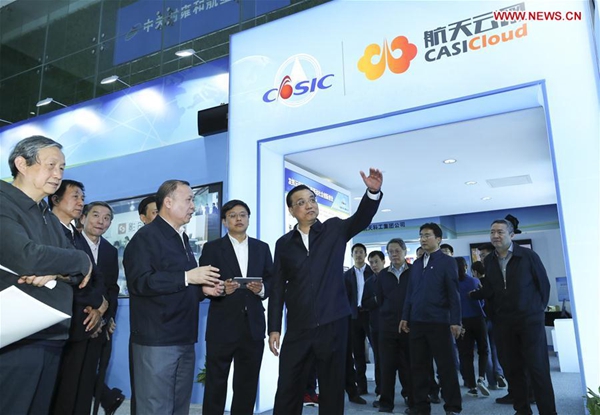
Chinese Premier Li Keqiang (C) inspects China Aerospace Science and Industry Corporation (CASIC) in Beijing, capital of China, April 27, 2017. (Xinhua/Xie Huanchi)

China’s centrally-administered state-owned enterprises (SOEs) have a promising future in boosting mass entrepreneurship and innovation, Premier Li Keqiang has said.

Premier Li said he believes centrally-administered SOEs have more potential and opportunity in implementing mass entrepreneurship and innovation as they are rich in technology, talent, capital and resources.

China Aerospace Science & Industry Corp. is among the leading SOEs in the area. Its web-based innovation platform has attracted more than 2,000 teams of makers, which generates ideas and products and sets an example for innovators across the country.

During an inspection at the company’s science park on Thursday, Li applauded the efforts, saying mass entrepreneurship and innovation will be a way to success for both small firms and industry giants.

“The mass entrepreneurship and innovation initiative is a reform in essence,” said Li, explaining that it taps human potential in improving productivity and uses Internet technology to match businesses with makers.

It will substantially stimulate economic and social development, Li said.

He encouraged other SOEs to build platforms to invite small firms to entrepreneurship and innovation as a new means of integrated development among large, medium and small companies.

The premier also listened to reports from other SOEs, including Aviation Industry Corporation of China and China Mobile.

In a meeting held following the tour, Li called on SOEs to strengthen efforts to reform and restructure.

SOEs, especially centrally-administered SOEs, should continue to focus on improving growth quality and efficiency by advancing reforms, carrying out the innovation-driven development strategy, and building a modern corporate system, Li said, urging them to maintain profit increases and help the economic recovery.

SOEs’ profit growth accelerated to 37.3 percent from a year ago in the first quarter, compared with the 13.8-percent decline registered in Q1 of 2016 and the increase of 1.7 percent over the whole year, data from the Ministry of Finance showed.

Li said centrally-administered SOEs should serve as vanguards in revitalizing the real economy by developing new growth engines and advancing industrial upgrades.

To meet the nation’s strategic needs and implement the “Made in China 2025” strategy, centrally-administered SOEs should move up the industrial and value chains and increase their presence in emerging sectors, through developing revolutionary new technologies and new business models that bring into full play China’s unique advantage of having a vast market, according to Li.

They should also use Internet and other new technologies to upgrade their production, management and marketing models so as to revive traditional sectors, Li said.

To facilitate overhauls of SOEs, governments should implement favorable measures to create a sound business environment, by reducing red tape, increasing fiscal and financial support, and improving supervision, Li added.

Remarks by High-Representative/Vice President Federica Mogherini at the joint press conference with Minister for Foreign Affairs

Valletta, 28 April 2017

Check against delivery!

Thank you very much George [Vella, Minister for Foreign Affairs of Malta]. I would like to start by thanking you personally for the dedication and the professionalism with which you have prepared this meeting and you are running the presidency; and all your team, really extremely dedicated. Indeed I am now enjoying my third day in Malta, leaving tomorrow morning, for what I considered to be a very useful, fruitful, constructive and important sequence, yesterday the informal meeting of the Defence Ministers who took some important orientations and today, our exchanges were particularly important.

Thank you for leaving the content to me.

On Turkey in particular, we had a long and frank, open exchange with the Member States on the future of our relations with Turkey. I will summarise some common points, five points if I am not wrong on which we have common orientations. You know that informal ministerial meetings are not for taking formal decisions or for adopting conclusions but we shared a common ground that I will report now to you.

First, we respect and recognise the sovereign right of any country, including Turkey obviously, to decide its governance system as Turkey has done through the referendum on the constitutional amendments. So, we respect the result of the referendum even if we acknowledge that there are appeals ongoing or foreseen. We expect that the implementation of the constitutional amendments will be done first of all following the Venice Commission recommendations and the observation of the OSCE-ODIHR [Organisation for Security and Cooperation in Europe – Office for Democratic Institutions and Human Rights], especially when the final report of the referendum observation mission will come out. And second, we expect its implementation seeking the highest degree of

national unity and inclusiveness, given especially the very divided picture of the country, as the result of the referendum has shown, with the maximum attention of the Turkish authorities side to respect all political positions, including those who supported the camp that has lost the referendum, and seeking for the maximum degree of unity within the Turkish society and the political spectrum.


Second point, the European Union has a clear interest in a stable, secure, economically successful and democratic Turkey which is – as George was saying – a relevant partner, a relevant player on many different issues. Our intention is not and will never be of doing anything that could damage Turkey or the Turkish people. On the contrary, we are seeking cooperation – constructive cooperation on many different things – for the benefits of our citizens respectively: all Turkish citizens, all European Union citizens.

The Turkish people, the Turkish citizens, all of them, are at the centre of our dialogue and cooperation; we will continue to support strongly the civil society in the country. And people from Turkey, the citizens for Turkey, are at the centre of our talks and work also when it comes to negotiations on accession process.

Then, the accession process continues, it is not suspended, nor ended but as you might know, we are currently not working on opening any new negotiation chapter. And second, the criteria for accession negotiations are extremely clear, are very well known to Turkey. If Turkey is interested in accession negotiations – as Foreign Minister [Mevlüt] Çavuşoğlu told us today and I understand President [Recep Tayyip] Erdoğan expressed the same views in recent hours – if Turkey is interested in accession negotiations, it knows very well what it implies, especially in the field of human rights, rule of law, democracy, fundamental freedoms including media freedom, obviously the death penalty, and the respect of international law and the principle of good neighbourly relations. These are core principles to which Turkey is called as a candidate country to the European Union but also as a member of the Council of Europe. We are determined as the European Union, together with all the Member States,

to work very closely with the Council of Europe i in the follow-up of the process.

We will discuss with our Turkish interlocutors the way forward, from our side in a very frank, open, constructive, serious, but serene manner. We have started today; I will have a proper – let’s say full-fledged – bilateral meeting with Minister Çavuşoğlu just after this press conference, we will continue in the next weeks at different levels to exchange with our Turkish interlocutors on the way forward on this very clear basis.

We had, as George mentioned briefly, a working session with all the candidate countries’ Foreign Ministers

on our Global Strategy [for the European Union’s Foreign and Security Strategy], because it is a common field for common work especially when it comes to security but also stability in our region. I updated the Ministers also on the work of the Defence Ministers yesterday so that candidate countries can have a direct insight to what the process entails, because they will one day be part of this work from the inside. And also because enlargement – what we call enlargement, the accession process, is in itself an element both of European Union security, of the European Union strategy to increase resilience in our region especially with our support to reforms – be it economic, institutional, political reforms or the support to rule of law.

Obviously the exchange was also the opportunity to discuss openly, frankly, constructively I would say among ourselves about different issues that are of concern for most us around the table and I am sure we will continue this conversation even more informally during the evening as we will continue our evening still with the candidate countries’ Foreign Ministers.

As George was saying, we had a session on how the European Union can help Europeans to manage the effects of globalisation. It is indeed through the European Union that Europeans can have an impact on managing and shaping some of the aspects of globalisation; when it comes to maximising opportunities, when it comes to solving or managing challenges especially in the field of international free and fair trade, when it comes to some of the big global agendas that are in this moment currently put under question, I think of the climate change agreement; of the overall approach to multilateralism and peacekeeping, the support to the UN system but also our strong and common commitment to the Sustainable Development Goals, including our work on the G7 and G20 agenda, on financial regulations, on managing the outcome of the effects of the economic crisis of the last years, increasing competitiveness, reducing inequalities both in the world and inside the European Union. We have exchanged in details about that, sharing the view that we have to use even more our common Union, to bring the European interest and agenda and values also on the global scene, using our European Union to strengthen our impact on globalisation. And as you might know, I was already doing part of this work in the last week with my visit to China, India and Russia; I will continue visiting our major partners in the world on this agenda, also obviously on some bilateral issues but mainly on how the European Union and some global partners or interlocutors can strengthen rules based global order and a system of governance of globalisation that can defend our citizens better.

Thank you.

Q and A:

Q. The German Foreign Minister [Sigmar Gabriel] asked for a visa free travel for certain parts of the Turkish population – journalists, artists, intellectuals. Do you think that this would be possible and that this is a way to go? Is it your assessment that after implementing the constitutional changes, Turkey will be in a position to meet the Copenhagen criterion and eventually become a member of the European Union?

On your last question it depends very much on how the implementation will take place. When, first of all – I think that the calendar is not yet determined. We understand that some of the provisions might be taken in quite short time but others might take place during this year. It will depend on the way on which Turkey will implement amendments, when and how. That is why I stressed the fact that we agreed or we convened among ourselves that we see it as key that this is done in line with the recommendations of the Venice Commission and also with the observations of the OSCE/ODHIR mission. So it will depend very much on Turkey.

On the first question on visa liberalisation, we have an ongoing dialogue and negotiations with Turkey on visa liberalisation as such. We will have to see together with the Turkish interlocutors how we proceed on that, where we stand and I would leave this at that stage for the moment, also because you know the basic rule of any kind of dialogue and partnership is that you tend to get there with a very clear ideas on how you approach the table, but then you enter into a serious conversation and exchange with the other part and you bring that forward together.

Q. After this conversation today, knowing that there were no formal decisions and that it was just a discussion, do you have any clear sense of what a partnership with Turkey that was not oriented to membership at the EU would look like? Were there ideas floating of what a meaningful cooperation could look like without accession?

You know, I think I am on the record in the last couple of years saying that Turkey is not only a candidate country, that Turkey is also a strategic partner for the European Union on many different things. Turkey is essential from the European Union perspective when it comes to settling the Cyprus issue, Turkey is essential when it comes to counterterrorism cooperation, it is an essential partner when it comes to the crisis in Syria, it is a NATO ally, it is a member of G20, it is an economic partner. Actually, the European Union is the first economic and trade partner of Turkey. So our relation with Turkey goes beyond the accession negotiations and covers many other different fields relevant both for Turkey and the European Union. So when it comes to what type of relationship we have, this covers different fields, issues and can take different forms.

As I said, we today can say that on the European Union side the process of negotiation on accession continues. It is not suspended, it is not ended, but, as I said, at the moment there is no work ongoing to open new chapters. And there are, and this is always the case with all the candidate countries, extremely clear criteria, very well-known from the beginning to all our interlocutors – and especially those on the rule of law, human rights, democracy, freedoms are very well known to our Turkish counterparts.

So now it is on them to express their willingness to continue to be a candidate country, to continue to be interested or not to join our family. The rules of the club are clear, if you want to enter you know what you can expect. We would be happy to have them in, but a level of clarification is needed I would say on their side on this. On our side we are clear where we stand.

Q. Can you tell us exactly how frank and open the language was being used towards Turkey given that some EU countries felt deeply alienated by Nazi allegations President [of Turkey, Recep Tayyip] Erdogan made during the referendum campaign for example?

We had two different sessions. We had one session among us at 28 where we discussed the present and the future of our relations with Turkey, all very open and frank discussions but not particularly dramatic otherwise I would not have been in the position of presenting to you some common ground that is quite substantial.

But they were very frank, very open and this is exactly the spirit of the informal ministerial meetings which are not pressed to achieve a final communiqué, or agreeing on a wording or taking a formal decision. We have the luxury of taking our time, reflecting a little bit more in a strategic manner, listening to each other carefully and understanding what the sense of direction is, so extremely frank.


The afternoon session was not a EU-Turkey session. It was a session that we have regularly every time we have an informal meeting of foreign ministers together with all candidate countries. It would have been completely inappropriate for any of the candidate countries to somehow hijack or monopolise the conversation over bilateral issues between the European Union and any of them. This is not the spirit of the exchange and this was not happening.

Obviously we also raised from time to time some issues not only regarding Turkey by the way, but also some other candidate countries present at the table that are of concern or that are on our agenda. This being an informal meeting and being clearly not my role to disclose single positions expressed around the table, I would not do it, but I can tell you that the overall spirit was frank, open, but very constructive and very positive. Things that needed to be said were said but this was not the first time. We meet often, not only with our Turkish interlocutors, also with other candidate countries. I would say that this is the added-value of being able to be clear among ourselves and with our partners.

Links to the videos:
Green Party responds to Isle of Wight MP resignation

28 April 2017

The Green Party has responded to news Andrew Turner, Conservative MP for the Isle of Wight, has resigned [1] after making offensive comments about homosexuality on a visit to a college [2].

Vix Lowthion, Green Party candidate for the Isle of Wight, said:

“Andrew Turner was unfit to represent the Isle of Wight and his recent, abhorrent comments left his place in Parliament completely untenable. People here deserves someone who will stand up for them. Today the Green Party announced radical plans to protect LGBTIQA+ refugees, provide decent HIV protection and promote rights for intersex and trans people – that is the kind of politics people in the Isle of Wight need and only the Green Party can offer.”

ENDS.

For more information contact: press@greenparty.org.uk / 0203 691 9401

Notes:

  1. http://www.islandecho.co.uk/news/andrew-turner-resigns-mp
  2. https://www.greenparty.org.uk/news/2017/04/28/green-party-condemns-conservative-mp%E2%80%99s-comments-on-homosexuality/ 
  3. Vix Lowthion is a teacher in the Isle of Wight and Green Party national education spokesperson

Back to main news page

Let’s block ads! (Why?)

FEATURE: Highlighting ‘positive impact’ of migration key to changing policies, public opinion – UN envoy

28 April 2017 – Recognizing that the issue of large movements of refugees and migrants is too vast for any one country to handle on its own, the United Nations convened a meeting of world leaders in September 2016 with the aim of finding durable solutions. At the summit, all 193 Member States came together around one plan, the New York Declaration, expressing their political will to save lives, protect rights and share responsibility on a global scale.

Migration is a very big issue. It is very much part of public opinion these days. It is discussed in governments, around kitchen tables. It involves everybody. And it is not new.UN envoy Louise Arbour

As a follow-up to the meeting, Secretary-General António Guterres last month appointed Canadian lawyer, prosecutor and jurist Louise Arbour as his Special Representative for International Migration.

Ms. Arbour – who has served as UN High Commissioner for Human Rights and Chief Prosecutor of the International Criminal Tribunals for the former Yugoslavia and Rwanda – is tasked with working with Member States as they develop a first-ever global compact for safe, orderly and regular migration, which is due to be adopted in 2018.

She also leads UN advocacy efforts on international migration, including providing support to the ‘Together’ campaign, a new dialogue about refugees and migrants to foster social cohesion while countering negative stereotyping and falsehoods about them. In addition, she provides policy advice and coordinates the engagement of UN entities on migration issues.

Ms. Arbour recently spoke to UN News about the need to enrich the narrative on migration which, she believes, focuses overwhelmingly on the negative aspects of migration and obscures the positive impact it has on the prosperity of many countries.

UN News: You were appointed as Special Representative of the Secretary-General for International Migration last month. Could you tell us more about the scope of the issue and the challenges ahead?

Louise Arbour: Migration is a very big issue. It is very much part of public opinion these days. It is discussed in governments, around kitchen tables. It involves everybody. And it is not new. People have been on the move for as long as there have been people on this Earth. But with modern communication technology, transportation, we have seen an increase in human mobility.

Migration comprises everything from refugees fleeing persecution and conflict zones to what we sometimes call economic migrants – people who sometimes voluntarily, sometimes not by choice, or are forced, decide to leave their country of birth or their country of origin often in search of employment or to be reunited with their families.

The best estimate is that there are today about 245 million migrants in the world. And I am not sure we are well equipped to facilitate safe, orderly, regular migration, which is the mandate that the General Assembly gave itself last September to bring some order to this.

VIDEO: UN envoy for international migration, Louise Arbour, flags the need to highlight the benefits migrants and refugees bring to societies.

UN News: As Special Representative you will lead the follow-up to the 2016 High-level Summit on addressing large movements of refugees and migrants. How do you see your role in the forthcoming global compact negotiations?

Louise Arbour: The General Assembly last September in the New York Declaration has decided to launch a process with respect to migration that is owned by Member States. And my role is to support that process, to coordinate all the knowledge, expertise, ideas that exist inside the United Nations and with the International Organization for Migration (IOM), which has come in last September as a related organization. So it is to try to coordinate, to capitalize on all this knowledge to assist Member States in their negotiations.

My role is also to develop a policy, to develop ideas, initiatives; and I have an advocacy role. I will also be the Secretary-General of a big conference at the end of 2018 which has the mandate of delivering a global compact of Member States on migration. There is a parallel process that deals specifically with the question of refugees. Refugees are in essence a subset of migrants but they are governed by the refugee conventions. So there is already a better definition on the refugee side. A lot of work remains to be done to deal with migrants more generally.

UN News: What are the key milestones over the next 18 months in the lead up to delivering two global compacts – on migration and on refugees – at the conference in 2018?

Louise Arbour: The Member States have agreed on a process. The formal process consists of six thematic sessions on different topics related to migration. The first one will take place in Geneva at the beginning of May, specifically on the question of the human rights of migrants and issues related to racism, xenophobia and intolerance generally.

The second one, towards the end of May, will deal with the drivers of migration – what are sometimes called the pushes and pulls that induce people to move or force them to leave their countries of origin. So it is the spectrum of origin, transit and destination. And we will have sessions on labour issues, migration governance, human trafficking, smuggling, and lots of issues.

This will bring us to the fall at which point there will be, towards the end of this year, a stocktaking meeting so Member States can have a sense of where they are. And then the drafting of the document which will serve the basis of their negotiations is scheduled to take place between January and July of 2018. So this is the formal process.

In parallel to all that… I intend to try to energize the conversation and in particular try to mobilize not just policymakers but general public opinion. I think we have a lot of educating to do, so people could understand better what we are talking about when we talk about the mobility of people, what it is and how we can manage it better.

UN News: Discrimination and violence against refugees and migrants are rising. The United Nations launched the ‘Together’ campaign to promote respect, safety and dignity for all. Could you tell us why we need this campaign and how it ties in with the intergovernmental process you have just described?

Louise Arbour: I think the ‘Together’ campaign is really very much tailored, in large part, to support this Member States’ initiative on migration. It is one thing to develop sometimes pretty complex policy arguments for policymakers. We could talk about the remittances that migrants who work in one country send to their home country. It’s a huge amount of money, much larger than international aid to development. A lot of people are not aware of this, which is one of the many positive impacts of migration.

I think the focus is overwhelmingly on the negative sides of migration, and completely obscures the immensely positive impact that it has made to date on the prosperity of many, many countries, both of origin and of destinationUN envoy Louise Arbour

It’s one thing to talk to policymakers, decision-makers, but for them to have the insight and the courage, sometimes, to make the right decision, they have to feel that they have their public opinion behind them. And as we develop our policies, it’s really critical that we engage more and more in conversations – to some extent, we talk about changing the narrative, to enrich the narrative about migration, and to highlight its many very positive aspects, both for the migrants themselves, but also for countries of destination, where they will eventually settle, be productive members of the work force, pay rent, pay sales taxes, live in the country.

So I think that the ‘Together’ campaign is going to be an extremely important vehicle to attack some of the stereotypes of migrants as either suspicious, as being a burden or a threat, which in reality, we have to concede that, as in any other field of human endeavour, there may be some negative aspects, some who don’t behave according to the rules. Currently, I think the focus is overwhelmingly on the negative sides of migration, and completely obscures the immensely positive impact that it has made to date on the prosperity of many, many countries, both of origin and of destination, and to the prospect it has in the future to be extremely transformative of the way we live collectively.

UN News: UN human rights experts said that accessible social and health services should be made available for persons with disabilities in the new global framework on refugees and migrants. What’s your answer to their concerns?

Louise Arbour: One of the things we need to highlight is the need for migrants, like everybody else, to have their fundamental human rights respected and protected without discrimination on the basis of their status. It is the same argument we have been making for years with respect to various groups or persons who may present with certain vulnerabilities. In some cases, it’s children. In some cases, it could be persons with disabilities who sometimes need treatment that is appropriate for their needs; not to give them an advantage, just to bring them on par with everybody else. Accessibility in transportation is an obvious example.

In the case of migrants, and it may sound a bit strange, particularly migrants who are in a position of irregularity, who are not properly documented, their irregular situation makes them even more vulnerable. In lots of cases, they cannot have access to the very basic healthcare for instance that they need for themselves or their children. So irregularity sometimes increases vulnerability. So again the argument is not to give preferential or privileged treatment to any segment; it is to ensure that all human beings, regardless of their situation, are protected in their fundamental human dignity, human rights, without discrimination.

But I need to stress here that… we should keep in mind that very often when migrants arrive in a new country, they are received or they find themselves in the most impoverished part of that community. And I think it is going to be critical that, as we pay attention to the needs of these newcomers, the migrants, that we also bring concrete benefits to the host communities that are receiving them.

It is true of countries that receive sometimes unexpected large flows of populations who are moving not only because of war, in which case they are refugees for the most part, but because of famine, bad governance, depravations of all kind; so then we need to assist, have humanitarian gestures vis-à-vis migrants but also very much so vis-à-vis people they have left behind and people who will be hosting them, sharing with them the little they themselves have.

.

FEATURE: International Jazz Day – a global celebration of creativity and diversity

28 April 2017 – Blues, boogie, bebop or ragtime, no matter what it is called, jazz is a language that translates across cultures and continents, bridging gaps and bringing unity.

According to the United Nations Educational, Scientific and Cultural Organization (UNESCO), for more than a century jazz has helped soothe and uplift the souls of millions of people in all corners of the world.  And so, it is no wonder that the UN’s cultural arm has organized International Jazz Day to harness “the virtues of jazz as an educational tool, and a force for peace, unity, dialogue and enhanced cooperation among people.”

Since 2012, International Jazz Day, celebrated annually on 30 April, has highlighted the power of this musical art form as a force for freedom and creativity, promoting intercultural dialogue through respect and understanding and uniting people from all corners of the globe.

“Today, we celebrate the international art form of jazz and its power to promote dialogue among cultures, to make the most of diversity, to deepen respect for human rights and all forms of expression,” UNESCO Director-General Irina Bokova said in her message for the Day.

“The story of jazz is written into the quest for human dignity, democracy and civil rights. Its rhythms and variety have given strength to the struggle against all forms of discrimination and racism – this is the message we must take across the world today.”

VIDEO: Jazz is dialogue, a conversation that, crosses boundaries and helps build bridges of communication

2017 Global Host City: Havana, Cuba

Each year a different city hosts the global concert marking International Jazz Day, and this year that honour goes to the musically vibrant and culturally rich city of Havana, Cuba.

“UNESCO is proud to be associated once again with the Thelonious Monk Institute of Jazz, as well as with the Instituto Cubano de la Música, to raise the flag for jazz, for freedom, for creativity, for diversity and for unity,” said Ms. Bokova.

“This year’s focus on Cuba is testament to the power of jazz to build bridges and join women and men together around shared values and aspirations,” she added.

Herbie Hancock, UNESCO Goodwill Ambassador for Intercultural Dialogue, thanked the citizens of Cuba for their enormous support of jazz, saying “Afro-Cuban jazz and its rich history have played a pivotal role in the evolution and enrichment of the entire jazz genre.”

VIDEO: When Africans were brought to Cuba, they also brought their traditions. They embraced the tempo and music of the indigenous population and mixed it with their own. Now young people keep the music alive.

The celebration in Havana also marks the seventieth anniversary of Cuba’s accession to UNESCO.

In anticipation of the Day, schools, art venues, community centres, jazz clubs and parks across Havana and throughout Cuba have already begun engaging its citizens.

Jazz history and education classes are being provided for tens of thousands of students in more than 11,000 schools across the country. This is among the thousands of International Jazz Day live performances, educational activities and community service programmes taking place in more than 190 countries on all continents.

Jazz for peace

UNESCO points out that jazz breaks down barriers and creates opportunities for mutual understanding and tolerance. International Jazz Day carries the unique mandate of utilizing and promoting the values of jazz for peace.

According to the agency, jazz reduces tensions between individuals, groups and communities and reinforces the role youth play for social change, including stimulating intercultural dialogue and empowering young people from marginalized societies.

On International Jazz Day, education programmes worldwide promote and emphasize the importance of sharing the history of jazz, and of reflecting on the kind of mutual respect and democratic principles necessary for the music to thrive.