1 ex-official sentenced, 1 pleads guilty in corruption cases

Wang Baoan, former head of the National Bureau of Statistics, pleaded guilty on Thursday to accepting 154 million yuan (US$22.3 million) in the Zhangjiakou Intermediate People’s Court, Hebei Province.

A verdict will be issued at a later date.

In a separate case on the same day, in Lanzhou, Gansu Province, Mao Xiaobing, a former high-ranking official from Qinghai Province, was sentenced to life in prison for taking bribes and embezzling public funds.

The Lanzhou Intermediate People’s Court found that Mao, a former member of the Standing Committee of the Communist Party of China Qinghai Provincial Committee, had accepted more than 104 million yuan in bribes and embezzled 400 million yuan in public funds.

In the Hebei case, prosecutors said Wang, the former NBS head, abused power to gain benefits for others on project approvals, business contracts and job promotions, then accepted bribes, which were either paid in cash or property, of 154 million yuan, either to himself or through family members, between 1994 and 2016.

Over the course of 22 years, Wang served as the Party chief of the General Office of the State Administration of Taxation, vice-minister of finance and head of the NBS, among other roles.

In January 2016, the country’s top anti-graft watchdog, the Central Commission for Discipline Inspection, opened an investigation of Wang for “serious violations.” It said he seriously violated Party political discipline and made speeches that went against the CPC Central Committee position on important matters.

The watchdog said he obstructed the investigation and disobeyed the eight-point code to cut bureaucracy, while living a corrupt life that included stays at high-end hotels and visits to expensive entertainment venues.

He was expelled from the Party and removed his post in August.

In the other case on Thursday, the court in Gansu Province deprived Mao Xiaobing, the former Qinghai official, of his political rights and ordered his personal property confiscated. Illicit gains will be turned over to the State treasury.

The verdict said that between 1995 and 2013, Mao took advantage of various official positions to seek benefits in project contracts, stock acquisitions, purchasing and sales of products and real estate developments on behalf of others.

In exchange, he extorted or accepted money or gifts from companies and individuals.

The court also found that in 2006, Mao had taken advantage of his post and embezzled public funds.

It said that in deciding the sentence, it took into consideration the fact that Mao had extorted bribes, which deserves harsher punishment. But it also noted that he had confessed, shown remorse, cooperated in returning illegal gains and provided information about other people’s violations during the investigation, facts that may warrant leniency.

Mao said he will not appeal.
China increases funding for hospitals

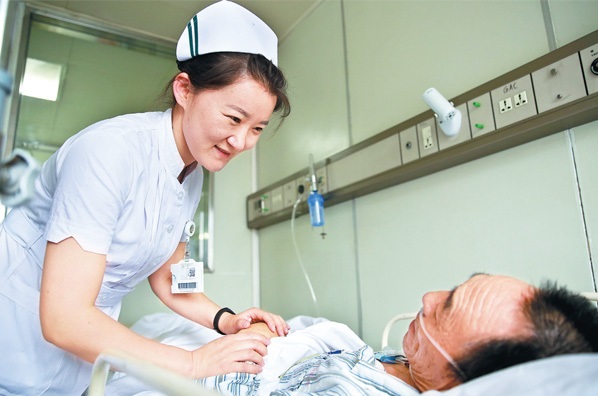
A nurse at the China-Japan Friendship Hospital cares for an inpatient. [Photo/China Daily]

China has been increasing financial support for the healthcare sector to guarantee all citizens affordable and proper medical services, according to senior finance and health officials.

The central government has earmarked more than 1.4 trillion yuan ($205 billion) this year for healthcare, Song Qichao, deputy director of the Ministry of Finance’s Social Security Department, said at a joint news conference on Thursday with the National Health and Family Planning Commission.

That accounts for 7.2 percent of government expenditures, he said, up from about 5 percent in 2008.

“We see healthcare as an important sector that affects people’s livelihoods, and we will continue to increase financial support,” Song said.

The latest round of changes is a continuation of nationwide healthcare reforms that started in 2009 to eliminate irregularities, particularly in drug distribution and pricing, and to ensure public access to proper and affordable medical services.

The government investment has helped the country achieve universal healthcare by extending health insurance policies to the rural population and urban unemployed, who previously had no coverage at all.

The two new programs are largely subsidized by the government, and people can participate on a voluntary basis, with users paying a reasonable premium.

For instance, the government is allocating 450 yuan for each participant this year, up 30 yuan from 2016, according to Liang Wannian, head of the commission’s Medical Reform Department.

The premium paid by the participant varies by region but is less than the government’s contribution, he added.

Liang said the government had increased its allocation for each participant for eight consecutive years.

At the same time, he said, the government would strictly curb improper increases of medical costs.

The average annual increase in medical costs at public hospitals, he said, has to be kept under 10 percent. To meet that goal, the commission has been pushing reforms of public hospitals. That includes ending a longtime policy of marking up drug prices, which led to over-prescriptions and unnecessary treatments, and wasted the money of patients and insurance programs.

Last month, Beijing led the way by scraping drug price markups at all public hospitals, and all hospitals nationwide will follow suit by the end of September, ang said. Government funds will support the hospitals, he added.

BCC: Businesses across the UK hobbled by mobile ‘not-spots’

Today the BCC releases the results of its digital survey on mobile connectivity.

12 May 2017 

Businesses in all parts of the UK, particularly rural areas, are experiencing full or partial ‘not-spots’ in their mobile coverage according to the results of a survey released today (Friday) by the British Chambers of Commerce (BCC).

The survey of over 1,400 businesses, found that 70% of firms experience mobile ‘non-spots’, areas of no mobile coverage by any operator, or ‘partial not-spots’, where there is some coverage but not from all networks, in their local area.

The findings show the proportion of companies based in rural areas which report such issues (91%) is considerably higher than those in inner cities (56%).

The results also show that 29% of businesses have unreliable mobile internet connections, with the figure rising to 54% in rural areas. The survey found that a considerable proportion of UK businesses are not accessing the highest connection speed, with only 42% of businesses reporting a 4G connection.

Other key findings of the survey are:

  • 6% of companies still typically obtain a 2G connection and 25% a 3G connection
  • Inner city firms (54%) are more likely to have 4G than those based in rural areas (25%)
  • Big businesses are more likely to report 4G connections (57% of businesses with more than 500 employees) than their smaller counterparts (41% with 1-4 employees)

Dr Adam Marshall, Director General of the British Chambers of Commerce, said:

“All across the country businesspeople complain about patchy mobile coverage and unreliable internet connections in their local areas. Time and again, I hear from frustrated businesspeople who can’t use their mobiles or access the internet when they need to – basic requirements for companies to work on the move, trade online, and connect with customers and suppliers.

“Rural businesses are particularly affected by poor mobile coverage and connectivity, but our research shows that ‘not-spots’ are prevalent across the UK. It’s incredible to hear that in this day and age there are even places in the City of London where businesses can’t get reliable coverage.

“Some of the solutions are obvious. Relaxing planning laws to allow for taller masts would be a quick win for the next government to help improve mobile coverage.

“As the regulator, Ofcom must do more to hold providers to account for the services advertised to business customers, and put in place remedies that are as strong for business users as they are for individual consumers. According to their rules, virtually all UK premises must receive 4G signal by the end of the year, but the results of our research suggest that we’re a long way off achieving that target.

“It’s clear that the UK is lagging in the delivery of access to a world-class digital infrastructure. While there have been welcome announcements to roll out 5G in the future, it’s clear that getting all businesses access to 4G first remains a top priority. The Chamber Network’s election manifesto specifically calls for these issues to be rectified, and for the next government to provide all businesses with super-fast and reliable broadband and mobile connectivity to boost confidence and productivity.”

Ends


Notes to editors:

The British Chambers of Commerce (BCC) surveyed 1,465 business people from all regions of the UK online in January 2017 to understand how businesses rate the overall reliability of their broadband connections, and how a more reliable connection could help their businesses. Of the businesses surveyed, 96% were SMEs, 22% operate in the manufacturing sector, and 78% operate in the services sector.

The British Chambers of Commerce (BCC) sits at the heart of a powerful network of 52 Accredited Chambers of Commerce across the UK, representing thousands of businesses of all sizes and within all sectors. Our Global Business Network connects exporters with nearly 40 markets around the world. For more information, visit: www.britishchambers.org.uk

Media contacts:

Allan Williams – Senior Press Manager

020 7654 5812 / 07920583381

Orla Hennessy – Press and Communications Officer

020 7654 5813 / 07825746812

Remarks by HR/VP Mogherini on the EU’s humanitarian support at the 2017 London Conference on Somalia

Check against delivery!

Thank you very much and thanks to you and to the Secretary General of the United Nations [António Guterres] for convening this meeting and also for having this focus on the humanitarian situation. Just a few weeks ago in Brussels, we gathered some of the key partners and key donors that are around this table exactly to focus on how we can step up our humanitarian support to face the risk of famine now.

The European Union, as you know well, is by far the first donor for Somalia in all different sectors. When it comes to our response to the drought, it amounts to over €460 million; still we know that this is not enough and that we need to mobilise more resources. We will do our part, we will continue to do our part, but we need others to come in and increase the level of support if we want to avoid the catastrophe.

We believe also that the availability of resources is not the only challenge we are facing in Somalia when it comes to the risk of famine. Insecurity, access constraints, extortions of aid are among the biggest obstacles to deliver aid to the most needy. Restrictive access remains for us the major impediment for the roll out of full relief operations covering the majority of the needs.

We also have a concern about the visibility of the return process of up to 250 000 Somali refugees living in Kenyan refugee camps in the current context of severe droughts.

Beyond human suffering, we believe it is important – as the Secretary General mentioned – to contain the political risks. We are in a delicate moment for the institutions, the government, which is very much absorbed by the impact of the droughts while it has started its process only a few months after the inauguration of the President. We believe it is essential that we support and help the government to be seen delivering on the expectations of the population and remain focused also on the other critical political and security challenges the population needs to find answers to because there are somehow interrelated.

Two last things. One is the regional dimension; we are focusing on Somalia here because assisting Somalia at this moment also means assisting its neighbours to limit the spill over. Yet each country in the region, and particularly Ethiopia and Kenya, deserve specific attention and support. We should not forget it.

And, last but not least, we need to take climate change more seriously. This is true in general political terms – and I discussed this in the UN with the Secretary General in the last days- but also in our projections for the region.

Secondly, only stability and development can create an environment in which natural disasters can be coped with. And this is why the rest of the conference today will be also so important.

I thank you.

Eurojust Annual Report 2016 at the EP

Brussels, 11 May 2017

Today, the President of Eurojust, Ms Michèle Coninsx, presented the Eurojust Annual Report 2016 at a hearing of the Committee on Civil Liberties, Justice and Home Affairs of the European Parliament (LIBE Committee), followed by a question and answer session with LIBE Committee members on topics ranging from radicalisation, freezing and confiscation, the European Arrest Warrant, harmonisation of legislation, and complementarity with other agencies.

Ms Coninsx highlighted the operational, strategic and tactical work of Eurojust. The year 2016 has been challenging in the security context. Eurojust has stepped up its activities to counter terrorism, cybercrime and serious organised crime, including illegal immigrant smuggling and trafficking in human beings. To do so, Eurojust connects and cooperates with practitioners’ networks, the centres at Europol and its network of judicial contact points in third States. Eurojust was involved in the judicial response to all the terrorist attacks in 2016, ensuring speedy mutual legal assistance in 2 306 cases, support to 148 joint investigation teams and assistance with the execution of more than three hundred European Arrest Warrants. Three hundred cases involved third States.

Ms Coninsx said: ‘Eurojust is a bridge-maker and trusted partner of the Member States, the EU institutions, other agencies and international organisations. Security demands both actions and reactions. Eurojust ensures quick reactions to crimes and criminal networks. I wish to thank the European Parliament for their financial and moral support.’

The Eurojust Annual Report is now available in English, and all 24 official EU language versions will be on our website in late summer.

Related links:

Photo: © European Union 2017

Note to readers: Due to maintenance in preparation for the move to the new Eurojust premises, the Eurojust website will not be available on 13 and 14 May 2017. We apologise for any inconvenience.