Taming the market?

I have received many phone calls from media and newspaper outlets wanting me to criticise the Conservative leadership for proposing some curbs on big business in areas like energy to help consumers. There is growing frustration by these people,often pro Remain commentators desperate to create a split in the pro Brexit Conservatives. Let me explain why they are wasting their time.

Many Conservatives regard delivering Brexit as the most important thing the next government has to do. We want strong and stable leadership able to get through the legislation needed. Together we seek a mandate to show the Lords the public are behind the Commons on this matter. The legislation to remove the power of the EU will be a Manifesto Bill, which by convention the Lords allow to pass. If we deliver Brexit well, then the UK can embrace free trade with non EU countries. The Uk can be more outward looking and enterprising, to be able to pursue our own path to prosperity. We can choose our own taxes, spend our own money and amend our own laws.

Conservatives including the Prime Minister of course regard markets as the important source of choice,jobs and prosperity.Together we are against renationalising the railways, the water companies and the Postal service. Together we seek to create a climate favourable to business in the UK, and are pleased that so far Conservative led governments since 2010 have created conditions which have led to a big surge in investment and jobs. Together we want lower taxes, with proper rewards for work and venturing. Together we want to see more challenger businesses and more innovative small companies rise and flourish as signs of a healthy enterprise economy.

Belief in the importance of markets and competition is not the same as belief in a free for all. I and others of like mind have always accepted that Parliament and government needs to set out a clear legal framework to control business and ensure fair competition. We have always accepted the need for redistribution through taxes and benefits. We seek lower tax rates, but not lower tax revenues. One of the reasons we want lower tax rates on work and profit is to encourage more growth and prosperity. We support a legal framework to protect employees from any bad employer that might be out there.

Like the Prime Minister, I am all in favour of imposing requirements on large companies that have an overmighty market position, and especially intervening against monopolies and cartels that act against the customer interest. No Conservative supports large corporations tax cheating, overcharging or abusing their market power. Large corporations who distort markets or let their customers down or get out of line with the mood of the public they serve should not expect Conservative candidates and future MPs to turn against their Leader if she wishes to curb their abuses. The UK under the Conservatives should be a great place to do business for all those with competitive goods and services who wish to serve UK customers in all their diversity.

Published and promoted by Fraser Mc Farland on behalf of John Redwood, both at 30 Rose Street Wokingham RG40 1XU

Speech: Future Education – A Father’s Perspective

Education is an increasingly complicated business, and you are all experts, which left me wondering how I should approach this speech to you today;

Should I come to you as Paul Rennie, DHM Malaysia, and regional head of the British Government’s ASEAN Education campaign, spouting numbers and stats about futures and impacts;

Or should I draw from my experience as a governor of a leading international school in Kuala Lumpur, and explain how the market is shifting around us, and the challenges that governors face to read the tea leaves;

But in the end I decided it would probably be far more useful to talk to you about none of that, and instead talk to you straightforwardly as the father of a six-year old daughter. Because, as someone who hopes to be a customer of your services for the next decade and a bit, I can tell you that I am utterly terrified about the future;

Now this is not some dystopian monologue about global warming, deforestation, or the extinction of species – though all of them are things my daughter has already lobbied me on. Instead it is a recognition of the competing demands that education is going to place on my daughter, and on me, and ultimately on you;

I will start with my first favourite statistic – that 90% of the jobs that my daughter is likely to apply for by 2032 don’t exist yet. Think back to the six-year olds of 2003. How many of their parents planned for them to be social media strategists, app designers, iphone engineers – how many of them thought they would get a nice stable job at Nokia;

And those trends of globalisation are not limited to jobs that don’t exist yet;

I look down the road, and see that globalisation is going to be pushing work up, as well as down. Mega companies will become even more mega, but at the same time harder to get into. While the market for the self-employed entrepreneur, these job makers not job takers, is going to explode;

Work will become more cross cultural and more international, which means a boy like me, who grew up, went to school, and went to university within five miles of the hospital he was born in, getting a job with an international company, let alone the Foreign Ministry will seem like an absurdity. (Joke though I know Scotland remains on the brink of being a foreign country to the UK);

The ability to scale at speed will continue. It took Ford Motor Company a little over a century to sell 350 million cars; Apple sold 1 billion iPhones in nine years. That, frankly, isn’t a world I grew up in;

What I would call ‘Combinativity’, the ability to merge different ideas and product together, is likely to become more important than pure creativity, and that will require a broad understanding of the world – but if you don’t specialise, how will you ever get ahead?

Yet what I don’t believe will change is people. In fact those people skills are likely to become more important as automation becomes more prevalent. But would we give up on learning French because we perfected the Babel Fish (as only Hitchikers Guide to the Galaxy fans would understand);

So where does all of that leave my daughter – where does that leave schools? Because one of the biggest challenges in the sector is risk aversion, which is something that I absolutely share as a parent – and you probably need to help me not to;

My father, for example, went on a journey that involved going to school five days a week; sitting a series of individual exams; going to university and then applying to a company for a job;

I went on a journey that involved going to school; sitting individual exams with a bit of individual course work; going to university (to sit more individual exams) and then applying to a company;

My daughter is going to school right now, and at the end of the pathway I still see A-Levels, or IBs, and then University. Because grades matter, and that is what I demand, and what schools live and die by, but is that enough?

Well it’s not enough for me as a parent, which is why I begin to make extortionate demands of you. I want, obviously, straight As, but I also want you to have a drama studio that could host a west-end musical; sports facilities that could hold the 2020 Olympics; and a design and technology centre that could put a probe on the moon.

It is a virtual arms race at international schools, to the point where even Universities are struggling to keep their tech current with what the kids are used to. And it’s all because I want you to keep doing the traditional stuff, but also help her to find her niche;

And that is a challenge for me as a parent, in letting go and trusting schools. One headmaster told me that 90% of everything we know about the human brain we have learned in the last ten years. That’s staggering, but it also post-dates everything about my school experience that I rely on to help my daughter;

Most of you will be familiar with the phonics system of learning to read. I wasn’t. I learned to read via a series of little slips of paper with words written on them, kept in an old tobacco time (spelling smelled like Virginia Gold Leaf until I was ten). It was a huge leap of faith to go with phonics – but it is incredible;

And then there are topics now that I don’t even understand, like coding. I always knew the day would come when I lost track of what my daughter was studying, I have never been much of a scientist so if it came to GSCE Chemistry she was on her own. But to have you six year old daughter teaching you how to use coding programme Light Bot on the iPad, well, I thought I would have more time. (In fact, I got cocky after that and tried to do some of the Year 5 coding activities on the EducationCity website – I got 27%);

She needs those skills, she needs these new ways of learning, but how do schools help to take me as a parent on that journey?

If someone had said to my parents when I was at school they were going to put me up for an exam in game design, they would have wondered what I was going to do with a degree in PacMan, and yet today the games industry is worth more than Hollywood;

There is also the challenge of the cultural shift, which I get glimmers of being here in an international environment, but those in the UK probably don’t see as clearly.

There is little doubt in my mind that the century belongs to Asia, if nothing else they have demographics on their side. There are 140m people under the age of 14 in ASEAN alone, and another 100m yet to be born by 2030. They will be going for those global jobs at the mega corporations too;

Even at six, frankly even in pre-school, it was a startling revelation to see what people have termed ‘tiger parenting’ in action. I’d heard of it, but when you see it in practise, it is both terrifying, but also incredible to see what some children can achieve with that level of investment;

And while it is absolutely not what I want for my child, I realise that as long as the main determinant of University entrance are is still the grades, then that is what my daughter is up against. I find that I have become a bit more like that myself, though probably better described as dwarf leopard than Tiger – but is that right? Should schools be taking a view?

Because when you look to places like Malaysia, you can see the churn in the education sector in all its glory. You have long established schools, and new entrants. For profit, not for profit, and even a few in between. And that innovation in the market means schools have to keep up;

Like in the UK, where around 150,000 children will sit GCSE French, compared to about 4,000 doing Mandarin or Cantonese. Is that imbalance because schools there have carefully thought about the future needs of a British work force when set against growing export markets; or is because we have lots of French teachers, and it’s what their parents learned?

But while it may be easier for new entrant schools to ditch ‘traditions’ there is also the danger of getting caught by fad-ism. Just as someone once described a leader with no followers as simply a person taking a walk, so if you are pioneers in every new field it might turn out to be no field at all – just ask all the people who have big collections of laser discs;

And obviously as a parent I want you to do both. I want a massive French department, as well as a fully staffed Chinese department, and what about Spanish while we’re at it. Because I want you to give her all the skills to be at the cutting edge when she graduates, but I don’t want you to bet her future on it in case she gets it wrong;

It is impossible, and I know every time as a Governor when teaching colleagues come with the next big idea, that schools will have to do all of the above without putting a single penny on tuition fees;

But I also have more fundamental worries as a parent about my daughter’s education, particularly in the international sphere;

Mulitculturalism is amazing, but does becoming a global citizen risk becoming a citizen of nowhere? I didn’t leave Edinburgh until I was twenty one. My daughter is half British, half Dutch, was born in India, and now lives in Malaysia. I have a very clear idea of where I am from, does she, will she, or is that an absurd thing to wonder about? One thing is for sure, I can’t draw on personal experience to help, so do I rely on the teachers who will be steering her in four year chunks as I move around the world – is that your role?

And I worry about the digital and online world, because I know I will always lag in my understanding of it, like my parents did, as teachers probably do. As a tech thinker once told me, if you describe a technology as disruptive, it shows you are already too old to understand it – people who disrupt aren’t disrupting, they are just living. And because nothing ever dies online, can she have fun at school, and yet still start as an adult with a clean slate, as I did?

Which merges into the digital world blurring the lines between home and school, particularly in the future. As her personal life and school life merge into a single iPad, will she ever be able to switch off? And in that space, does it mean she can now take her bullying home with her, and nobody will ever know? Maybe by the time she is fourteen there will be teachers around her who have personal experience of being trolled by cyber bullies and can help, but I suspect few of your teachers could claim that – but does it matter? Is that what your Year 12s and 13s are there for, to bridge the gap?

And, obviously, I worry about the cost of all of this, in a world of shrinking budgets and resources, will I be able to keep her in the schools that are offering her all these opportunities, or will you end up pricing me out of the market, as you keep up with my demands?

There is a lot ahead of you, the margins of success become ever smaller at A-Grade; there is more competition than ever; the reputational risks are only growing; and to meet all the demands I’ve listed you’re going to need a body of staff that is both multi-talented and specialised – who is going to train them for you, and what will they cost? Sadly, we will not all be investors in Snap to pay for it all.

But in spite of these worries, the final thought I would leave you with is my huge pride, and belief, in the British education model I see in international schools today (and I would say that even if my government weren’t paying me to). I think it does have tradition as well as modernity; I think it puts a lot of trust in its teachers, rather than wrote structures; and I think it gives children a wide exposure, but still creates a sense of belonging.

I wish you every success in the conference, and look forward to fruitful discussions. You have great challenges, and even greater responsibilities, and parents like me will need your help more than ever in the future.
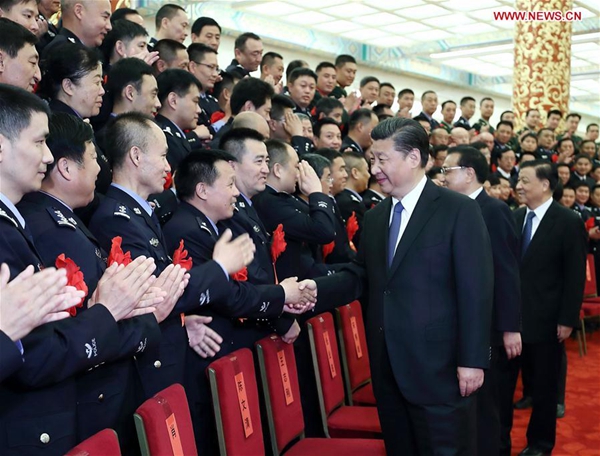
Xi calls for public security forces to be loyal to CPC

Chinese President Xi Jinping, also general secretary of the Central Committee of the Communist Party of China (CPC), Chinese Premier Li Keqiang and Liu Yunshan, a member of the Standing Committee of the Political Bureau of the CPC Central Committee, meet with heroes and role models from public security departments across the country at the Great Hall of the People in Beijing, capital of China, May 19, 2017. (Xinhua/Ju Peng)

Chinese President Xi Jinping met with heroes and role models from public security departments across the country on Friday, stressing loyalty to the Communist Party of China (CPC).

Xi, also general secretary of the CPC Central Committee, called for those working in the country’s public security departments to serve the people, promote impartiality in law enforcement, and remain disciplined.

Premier Li Keqiang and Liu Yunshan, a member of the Standing Committee of the Political Bureau of the CPC Central Committee, also joined the meeting.

Xi said that the heroes and role models are not only models for the public security system, but also the whole of society.

Hailing the public security forces as a team with a glorious tradition and excellent work, Xi said they have made remarkable contributions in safeguarding national security and social stability.

They have forged an “indestructible iron wall” for national security, public security and the safety of people’s lives and property, with their sweat, and even blood and lives, the president said.

Xi said he was deeply moved by stories of public security officers risking their lives when carrying out missions, adding that he also felt sorrow for those who lost their lives during missions.

The great spirit of heroes and role models should be carried forward in the entire country in cultivating and practicing the socialist core values, said Xi.

Xi called on public security forces to devote their utmost efforts to safeguarding national security and social stability, so as to meet the public needs and create a safe and stable social environment for the upcoming 19th National Congress of the CPC later this year.

CPC committees and governments at various levels were also urged to support public security forces and take care of police officers.

A total of 615 public security units and 1,320 individuals were honored at Friday’s meeting.

Radio interview with Banksy & Pinky, Triple M Central Queensland

BANKSY:

Malcolm Turnbull, our Prime Minister is in the area at the moment and is also I believe, on the phone. Good morning Prime Minister Malcolm Turnbull.

PINKY:

You’ll just have to pop him through.

PRIME MINISTER:

Good to be with you.

PINKY:

Hello!

BANKSY:

Good to be with you indeed. Now we’ve got several questions here that we want to pose to you, see if you can shed some light on things. But It hasn’t just come from us, we’ve got it from our listeners as well.

PINKY:

Yeah, first things first Malcolm, how do we know you’re not Laurence Moonie, pretending to be Malcolm Turnbull.

PRIME MINISTER:

Well I’ll just have to be convincing.

BANKSY:

I’m still not sure, listening to that voice.

PINKY:

We’re really pleased you’ve joined us this morning. Of course, you’re on the front page of our paper, The Bulletin saying you want to give CQ region a fair go.

BANKSY:

What do you mean by a fair go Prime Minister, in what way?

PRIME MINISTER:

Well what we’re talking about is the City Deals, the greater collaborations between the Federal Government, state Government and local government. One of the big changes I made as Prime Minister was to say that we should work as partners rather than the Federal Government just being an ATM. So you’ve seen, we’ve done this in Townsville, we have a City Deal there, and we’re working closely with the State Government and Local Government. Ewan Jones of course was a big driver, the former Federal Member. We have, we’re supporting the stadium there, the Townsville Eastern Access Rail Corridor, taking the train line out of the center of the city. Really, promoting the development of that city.

But it’s a different quality of engagement you know. As I said, the states and the local governments to some extend have essentially treated Canberra as an ATM. We’ve got to be better than that, we’ve got to be smarter, we’ve got to be more involved.

BANKSY:

So what you’re saying is you’re trying to put more money into this area so that we get a fair go with tall the money that we seem to give to the Government 24/7?

PRIME MINISTER:

But to be real partners. Of course you need partnership. One of the challenges that we have here in Rockhampton in particular, Michelle Landry and I were talking about this last night with people in the Hedrick’s Lane pub, we had a very good ‘politics in the pub’ evening –

PINKY:

Cool.

PRIME MINISTER:

Which was very –

BANKSY:

Mid strength?

PRIME MINISTER:

(Laughter)

Mid strength yeah, plenty of talking from my part, not a lot of drinking but yeah. Plenty of listening.

BANKSY:

Good.

PRIME MINISTER:

A lot of enthusiasm for that Rookwood Weir, and as I was saying to the Premier yesterday, we really urge the Queensland Government to get behind that. We have $130 million dollars on the table. The business case is being completed, it will stack up very well, we’ve no doubt about that. We should get on with it, because for a big water storage enhancement, it is a relatively low environmental impact, because it’s not like building a dam and flooding a whole valley, it’s backing the river up

BANKSY:

Yeah.

PRIME MINISTER:

I think it’s really worth supporting. That will provide, you know, water is water –

BANKSY:

Is life.

PRIME MINISTER:

Its good soil, it’s life and also money and jobs.

BANKSY:

Well look speaking of money and jobs and environmental impact, can I ask you about Adani?

PRIME MINISTER:

Yes.

BANKSY:

We’ve had a question come through from one of our listeners.

PINKY:

Yeah, a groundsman, he wants to know why we need Adani in Rockhampton.

BANKSY:

Are we looking at an economic boost here, or protection of the environmental impact? What’s a bigger priority for you Malcolm Turnbull?

PRIME MINISTER:

Well you’ve got to do both and I think the environmental argument – there are a number of environmental arguments put against Adani. All of the environmental tests and criteria have been approved now. So the project should be able to go ahead, subject to Mr Adani and his company satisfying –

BANKSY:

Without environmental impact?

PRIME MINISTER:

Yes, but can I just make this point to you? A lot of the protesters about Adani seem to either want Indians to go without electricity, or Queenslanders to go without jobs. We’ve got to be very clear about this. India is a poor country, it is growing rapidly, they need to quadruple their electricity production between now and 2033. Yes, they are doing a lot on renewables. They’re building a lot of solar. Adani has got the biggest solar plant in India. They’re building windmills, windfarms, and hydro. They’re going to need to import a lot more coal in absolute terms for many years. Coal will be, in 20-30 years time in India, coal will be a smaller percentage of their electricity mix than it is today, but they’ll still be importing more of it in absolute terms. Now if they don’t buy it from Queensland, they’ll buy if form somewhere else. It won’t be as clean coal, as it is from Queensland, it will be lower quality coal but the relevant thing is they’ll still be burning coal.

BANKSY:

So they’re gonna get it from somewhere, you would prefer them get it from us to increase our economic fortune?

PRIME MINISTER:

Sure. Well why would we want – I mean again, the protestors have got to ask themselves these two questions – are they saying Indians should go without electricity? Because I’ve been there with the Prime Minister and the Energy Minister. They want to reduce their emissions, their greenhouse gas emissions –

BANKSY:

Look I can assume, sorry Prime Minister –

PRIME MINISTER:

But they feel they have to burn more coal.

BANKSY:

I can only assume that the protestors are saying: ‘We don’t want them to go without, we don’t want our economic situation to fail – we just don’t want it to impact the environment in a way that is going to not benefit generations to come.’

PRIME MINISTER:

Well there are two questions there – there is the global environment and the local environment. In terms of the global environment I think I’ve addressed that – that’s the question of greenhouse gas emissions, India will progress to lower emissions but they’ve got to give people access to electricity rapidly and they feel, their considered judgement is they’re going to need to import more coal for some time yet so we may as well export it to them.

As far as the local environment is concerned, the impact on water and the Reef and all of those factors – that’s all been taken into account very carefully by the federal and state government environmental approvals.

BANKSY:

Right. Look, I just want to shift gears for a moment. We’ve had some more questions come through from our listeners. Parents returning to work – there is a big push by the government at the moment to get parents back into the workplace. What we want to know is why aren’t we supporting parents staying at home to be parents? Why are we pushing them back into the workplace?

PRIME MINISTER:

I wouldn’t say they’re being pushed into the workplace.

BANKSY:

You want more parents to return to the workforce though.

PRIME MINISTER:

What we want is – you’re talking about the ParentsNext announcement that we made here in Rockhampton with Michelle Landry yesterday.

BANKSY:

Yes, that’s the one.

PRIME MINISTER:

That is really about parents, typically young parents, typically single mums with small children who have often not completed school or have been disconnected with the work force, have lost their confidence – there is a risk that unless they get the support and the training and the encouragement they need, they could end up being on welfare for the rest of their lives. Now the best form of welfare is a job and it is important for those young parents, and I say they’re mostly mums, to be getting young mums to be getting that support. I met with some of them with Michelle yesterday here in Rockhampton and some great stories.

BANKSY:

And they want to get back into the work place?

PRIME MINISTER:

Well, yes, they want to be in a position to either get back into the workplace or finish school, get the skills, the training they need so that when the kids are older they can get back into-

BANKSY:

They have the skills.

PRIME MINISTER:

Their goal is to be either employed or employable.

PINKY:

Yes.

BANKSY:

Okay.

PRIME MINISTER:

And I think both of those are important objectives.

PINKY:

Well, it’s breaking a cycle there too so yeah it’s not all about pushing people away from being parents. Being a parent is not easy!

Hey Malcolm, I was wondering – look, I think you’re in great nick – I want to know how you keep fit? Having the most demanding job that you do – I’d like to know your tips? You’re clearly fitting it all in.

BANKSY:

This comes from the fittest member of the show this morning.

(Laughter)

PRIME MINISTER:

You’re very kind. Well, look, I exercise for at least, I would say, at least half an hour and probably on average three quarters of an hour, or an hour most days.

PINKY:

Wow, and what do you do?

PRIME MINISTER:

It depends where I am. I’ll either walk, I’ll use a rowing machine. If I’m with Lucy, if I’m in Sydney or if Lucy is down in Canberra we’ll often go for a long walk. I swim in the summer.

PINKY:

Oh yep.

PRIME MINISTER:

I paddle a kayak. Ride a bike occasionally. So, you know, I do a variety of things – you’ve gotta mix it up but the important thing is to keep moving. Exercise every day and get your sleep. That’s two good tips to be prime minister.

PINKY:

Yeah, I agree. And have you tried CrossFit yet?

(Laughter)

PRIME MINISTER:

CrossFit? No, I’m not sure-

PINKY:

Put that in your diary.

BANKSY:

What is this cross fit you speak of? (Laughter)

PINKY:

You might like, Malcolm, just to mix things up!

PRIME MINISTER:

Is this like a ‘Netflix and chill’ thing? (Laughter)

PINKY:

No it’s not that. (Laughter)

That’s another thing if you haven’t tried out – you should! No CrossFit is weight bearing so lots of weight lifting activities. It’s really cool.

PRIME MINISTER:

Oh yeah, okay.

BANKSY:

He’s got the weight of the nation on him right now Pinky! (Laughter)

PRIME MINISTER:

You know actually that’s a good reminder because I think I probably don’t do enough weights.

PINKY:

Yeah weights!

PRIME MINISTER:

I do some Pilates occasionally. Lucy is very keen on Pilates.

PINKY:

Oh yeah.

BANKSY:

There you go!

PRIME MINISTER:

I do some of that with her.

PINKY:

Keep your core strength strong.

BANKSY:

And all these things are better than eating a raw onion for health purposes I’ve got to say. (Laughter)

PINKY:

Of course.

BANKSY:

Prime Minister Malcolm Turnbull, we thank you for your time this morning. We know you’re very busy and heading around the regions and spreading the message of getting a fair go.

PRIME MINISTER:

Heading to Emerald yep. Okay, terrific, great to be with you.

BANKSY:

And we’d love to have a fair go here in Central Queensland as well. We appreciate your time, enjoy your visit.

PRIME MINISTER:

I will, thanks a lot.

[ENDS]

Press Releases: Acting Assistant Secretary Thornton’s Travel to Manila and Beijing


Media Note

Office of the Spokesperson

Washington, DC

May 18, 2017


On May 23-24, Acting Assistant Secretary for the East Asian and Pacific Affairs Bureau Susan Thornton will travel to Manila, Philippines, to attend Senior Officials Meetings for the East Asia Summit, ASEAN Regional Forum, and Lower Mekong Initiative. She will then travel to Beijing, China, on May 25-26 to discuss bilateral and regional issues of mutual interest with Chinese officials.

For updates, please follow the East Asian and Pacific Bureau on Twitter at @USAsiaPacific.

For press inquiries please contact EAP-P-Office-DL@state.gov.