Press release: Report 09/2017: Fatal accident involving a passenger near Balham

Summary

At about 17:24 hrs on Sunday 7 August 2016 a passenger, travelling on a Gatwick Express service from Gatwick Airport to London Victoria, suffered fatal injuries as a result of having his head out of a window and striking it on a signal gantry near Balham in south London. The train was travelling at about 61 mph (98 km/h) at the time of the accident.

The window concerned was on a door opposite a guard’s compartment in the train; this door was accessible to passengers but it was not intended for passenger use. The RAIB has found no evidence to explain why the passenger put his head out of the window at that time.

The accident occurred because the passenger’s head was out of the window, there was nothing to prevent passengers from opening the window or putting their head out of the opened window, and because there was less than the normal standard clearance between the train and the signal gantry. Although the clearance was compliant with standards for existing structures, it was less than an industry recommended minimum for new structures where there are trains with opening passenger windows.

An underlying cause was that the process for assessing the compatibility of this train on this route did not identify the risk of the combination of reduced structure clearances and opening windows.

Recommendations

The RAIB has made two recommendations and identified one learning point. One recommendation is addressed to Network Rail, and seeks to improve the industry’s management of the interacting risks between infrastructure and rolling stock. The second recommendation is addressed to relevant train operators with the intention of reducing the risk from people leaning out of opening train windows.

The learning point reinforces the need for regular monitoring and management of structure clearances when those clearances are reduced from normal.

Notes to editors

  1. The sole purpose of RAIB investigations is to prevent future accidents and incidents and improve railway safety. RAIB does not establish blame, liability or carry out prosecutions.
  2. RAIB operates, as far as possible, in an open and transparent manner. While our investigations are completely independent of the railway industry, we do maintain close liaison with railway companies and if we discover matters that may affect the safety of the railway, we make sure that information about them is circulated to the right people as soon as possible, and certainly long before publication of our final report.
  3. For media enquiries, please call 01932 440015.
Newsdate: 25 May 2017

If you use assistive technology (such as a screen reader) and need a version of this document in a more accessible format, please email enquiries@raib.gov.uk. Please tell us what format you need. It will help us if you say what assistive technology you use.

Xi’an forum promotes world dialogue of civilizations

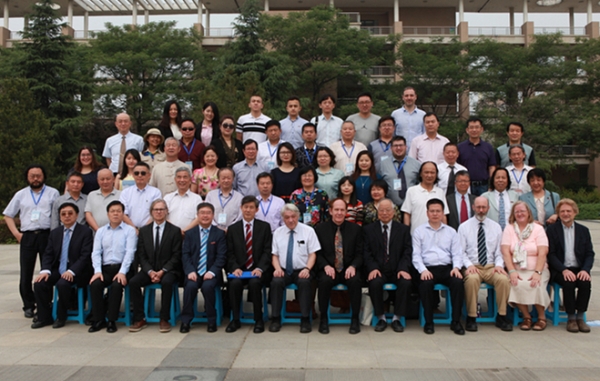
Chinese and foreign top scholars and experts pose for group photo during the 3rd Dialogue of Civilizations – Chang’an Forum held in Xi’an, Shaanxi Province, May 21-22, 2017. [Photo/ China.org.cn]

Chinese and foreign scholars and experts gathered in Xi’an, Shaanxi Province, this week for a dialogue of civilizations, and discussed how to build a community of a shared future for all humankind.

The 3rd Dialogue of Civilizations – Chang’an Forum was held May 21-22 at Northwest University in Xi’an, known Chang’an in Tang Dynasty when it was the capital. More than 30 representatives from academia, science institutes, think tanks, civil societies, diplomacy, business, translation and literature circles from eight countries discussed how to promote Chinese culture abroad, as well as dialogues among cultures and peoples from the countries along the route of the Belt and Road Initiative.

In a congratulatory message read out at the forum, Professor Yue Daiyun, chairman of Chinese Comparative Literature Academy and former head of Peking University Comparative Literature and Culture Institution, stated: “It seems we have entered a time of uncertainty when development and retrogression co-exist… We ought to stand firm and look further ahead, thinking how we can renew our actions and ideology within a much more complex context,”

Ambassador Mussie Hailu, regional director of the United Religions Initiative (URI) for Africa and Representative of URI to the African Union and United Nations, said there was “a strong need in our world more than ever to promote inter-religious and inter-cultural constructive dialogue to build understanding, trust and avoid holding a wrong image of others and overcome the fear of the unknown.

“We are constantly hearing of the challenges our world is facing. We must not wait for fundamental change to come from somewhere; meaningful change must come from within. If everyone does his or her bit, together we can accomplish what is necessary. This forum will help to create such awareness in people’s minds.”

Gong Jianzhong, former ambassador of China to Ghana and the executive vice president of the China Public Diplomacy Association, also pointed out that resolution of complicated global problems should adopt the wisdom of different cultures, and that China always wants to achieve harmony when engaged in diplomatic relationships and exchanges with other countries. He hoped China could learn from other cultures while maintaining the cultural confidence of its own development, build a diversified cultural environment and promote progress and development of all humankind.

Professor Zhang Xiping of Beijing Foreign Studies University, Professor Zhou Hong from Chinese Academy of Social Sciences, Xi’an’s Vice Mayor Professor Fang Guanghua, German sinologist Wolfgang Kubin, Professor Russell Duncan from the University of Copenhagen, CERN physicist and researcher Ren Zhongliang, French Taoist Thomas Morillon, President of Northwest University Guo Lihong, Professor Hu Zongfeng, president of the School of Foreign Languages at Northwest University also attended and addressed the forum.

Gao Ping, president of the China’s Qiaology Institute on Dialogue of Civilizations, told China.org.cn that dialogue at the spiritual and thinking level could guide human society, and dialogue in culture and belief areas bring about new ways of thinking, as well as understanding and reflecting the world and its meaning.

He pointed out that the renowned 20th Century British historian Arnold Joseph Toynbee (1889-1975) predicted, in his later years, that Western civilization had started to decline and Chinese civilization would take over and lead the world. “If Chinese people didn’t realize their mission or they try hard but fail, the prospect of humankind indeed will be gloomy. “

His institute initiated the forum and has been promoting it for three years, “The dialogue of civilizations will be like the multifunctional and delicate Swiss Army knife to resolve human problems,” he said, citing President Xi Jinping’s speech at the Boao Forum for Asia in 2015 as his inspiration, in which President Xi proposed a conference of dialogue among Asian civilizations to be held with an aim to boost regional cooperation and development.

Gao later also proposed a Conference for Dialogue of Asian Civilizations to be inaugurated in Xi’an in 2018 for the sake of its rich culture and history that was for long a capital of dialogue for civilizations from around the world.