Public gaining acceptance of organ donation

image_pdfimage_print

People pay tribute to organ donors at a public cemetery in Shanghai on Friday. The event was held to remember organ donors and promote public understanding of organ donation. [Photo/China Daily]

Nearly 170,000 people had registered as organ donors in China by the end of last year, an event to remember organ donors in China was told on Friday in Shanghai.

The ceremony was also meant to promote public understanding of organ donation.

In March 2010, the Red Cross Society of China and the former Ministry of Health started the organ donation system, encouraging citizens to voluntarily donate organs after their death as a way to extend another’s life.

Remarkable achievements have been made over the past seven years, and now the system has become a major channel for organ donation, Wang Ping, vice-president and secretary-general of the society, said at the event.

Officials said public understanding of organ donations and support has significantly improved over the years, and the number of people registering for organ donation is also on the rise. So far, about three in every 1 million people have registered.

A total of 4,080 organ donations were made in 2016, with 11,296 organs being donated, an increase of 47.5 percent over 2015.

Also last year, 104,538 people registered to become an organ donor, three times more than in 2015.

The event also noted that the development of the organ donation system is still in its initial stages, and varies in different areas. In the future, more policies will be made to support the system’s long-term development.

At the event, Huang Jiefu, chairman of the China National Organ Donation and Transplantation Committee, was recognized for his special contribution to China’s organ donation work.

90-year-old woman survives 4 days with 6 duck eggs

image_pdfimage_print
点击进入下一页

90-year-old woman survives 4 days with 6 duck eggs. [Photo/Video printscreen]

Before being found and rescued by local police, a 90-year-old woman in Chongqing survived in the forest for four days, equipped with only six duck eggs. The woman, surnamed Zhang, became disoriented after losing her way home.

Zhang lives in Nanbin, Chongqing municipality in southwestern China. She became lost while returning home from a fair held in a nearby county on March 20.

Her son, Ma Zewu, reported his mother missing on the evening of the second day of her absence, after finding no trace of the elderly Zhang. Upon receiving the alert, local police organized a rescue team, but failed to find Zhang immediately due to heavy rain.

On March 23, police used security camera footage to spot Zhang near a factory. Tracing her trail, they narrowed her possible location to a 2-kilometer stretch of road, between the factory and a bee farm. In the end, Zhang was found in a bush in the evening.

Though she was weak, her mind was still clear. She was later sent to the hospital.

According to Zhang, she lost her way after changing routes to avoid a vicious dog.

Despite spending three nights in the forest, she said the six duck eggs helped her to make it through. While Zhang is hardly the first person to survive in the wild when equipped with food and drink, it is something of a miracle for a 90-year-old to do so for four days, according to Zhang’s doctor.

Cyberspace haunts ancient tomb rituals

image_pdfimage_print

Tomb sweeping in Qinghua Festival [File Photo]

QR codes are part of daily life for most people. Short for “quick response” code, they are machine-readable labels that allow us to add new WeChat friends, pay bills with smartphones and order food in restaurants, among a myriad of other easy functions.

They have become so ubiquitous that some people joke QR codes will one day replace tombstones, allowing people to scan a code by mobile phone and access the names and achievements of ancestors that used to be engraved in granite.

Actually, it’s no longer a laughing matter.

The annual Qingming Festival, or traditional tomb-sweeping day, falls on Tuesday this year, and QR codes are appearing in graveyards across China.

The matrix bar codes come in various forms, such as stickers, bronze plates or plastic tags. They cost up to 3,000 yuan (US$436). Scanning a code leads to a memorial page honoring the dead.

Many graveyard companies operate online memorial pages, where one can also give virtual flowers, burn virtual candles and buy virtual gifts for the dead, either for free or for a few cents. So far, the new trend hasn’t really caught on much.

Some companies are also offering live streaming services for those who cannot get to cemeteries for Qingming this year. Staff clean the tombstones, bow to them and place flowers on graves for absent clients who can watch the ritual via live streaming video on mobile phone apps.

Needless to say, all this digital intrusion into what is an old and revered festival in China is stirring up a bit of controversy. Some Chinese netizens say that the new practices are fitting substitutes for those who cannot make it to graveyards and that they promote a cleaner environment because less traditional paper money is burned at tombs. Others say online tomb-sweeping services are crass and lack respect.

“The QR code service really ties in well with a more ecological approach to funerals because it is much smaller than the typical tombstone,” the Zhejiang Province Funeral Association said at a recent press conference, recommending the service.

The association staff said they are actively promoting alternative funeral services, like burying the ashes of loved ones under trees or in flower beds, or throwing them onto waterways or into a brisk wind.

Government subsidies of around 1,500 yuan are given to those who chose not to buy a plot of land to bury their dead. Land is becoming scarce.

All the newly fangled ideas don’t sit well with traditional views about how the dead should be treated. Many people are afraid that alternative funeral services will mark them as disrespectful toward elders who have always been afforded a peaceful plot for their souls to rest in peace.

Many also worry that the absence of a large tombstone will rob them of a focal point for paying their respects and burning paper money to honor ancestors.

“The bronze QR code tag is small enough to fit in a flower bed, so people will know where their relatives are buried,” the funeral association staff explained. “We hope it will help some people consider alternative funeral options.”

China has traditionally been an agricultural economy, where the land long played a significant role in the lives and deaths of people. For many Chinese, the first thing to do after making some money is to return to their hometowns and build new houses.

Most still believe that the soul needs a piece of land to rest for eternity and for the others to visit and pay tribute.

“We Chinese always say, ‘You find peace after you are buried under the soil’,” says Peter Kuang, a 36-year-old software engineer who has been doing tomb-sweeping services every April for the past 10 years.

“I am not superstitious enough to believe that there is an afterlife or that the soul really needs a plot of land, but I don’t think it’s necessary to challenge old traditions that others in my family still believe in.”

He adds, “A piece of land and a tombstone are still considered necessities. Being there in person is also crucial. You go there, you burn your paper money, you kneel down and you say your prayers — not because ancestors really hear you but because you are showing them respect.

“We have lost so many traditions,” Kuang concludes. “The tomb-sweeping ceremony is almost the last sacred rite left. It feels ridiculous to just click a button and count that as respect paid.”

Indeed, modern development and the digital revolution have led many people to rue the passing of old traditions in Chinese holidays, especially Spring Festival and the Mid-Autumn Festival.

Nowadays, many people think of the Mid-Autumn Festival only in terms of eating mooncakes and of Spring Festival as just a weeklong break to go on a holiday.

Qingming Festival valiantly clings to old traditions, like burning fake money and other paper gifts for the dead. But with pollution becoming a hot-button issue, some cities have banned such gift-burning at graveyards and are urging residents to forsake their cars to avoid huge traffic jams.

In Shanghai alone, it is estimated that more than 8 million people will travel to suburban graveyards over the three-day Qingming holiday.

“It has become almost as bad as Spring Festival,” says Zhang Yuan, a 27-year-old migrant from Anhui Province, who works in Shanghai. “It’s harder to get back home when there are only three days for Qingming. I would prefer not to go, but my parents worry that we will be criticized by other relatives if I don’t show up.”

When he suggested that he might participate in tomb-sweeping via digital technology, his parents were outraged.

“They were furious,” he says. “They would have killed me via mobile phone if that were possible.”

A draft letter for Mr Donald Tusk to Angela Merkel

image_pdfimage_print

Brussels
April 1st 2017

Dear Angela

I have been holding your line that the UK cannot expect to discuss anything about the future relationship with the EU until they have agreed and settled a large bill for exit. I understand fully Germany’s reluctance to put more money in to the next seven year budget framework just because the UK has left and is no longer helping pay the bills, but I cannot accept your view that is all the EU’s fault. The member states also played their role in developing policies and attitudes which clearly upset too many people in the UK. The European tradition of showing respect for government, and voting again if a referendum miscarries, is not unfortunately practised in the UK where apparently they accept the result.

I have to say I don’t think the current line is going to work. The UK is emboldened by what has happened so far, and they seem to be losing their fear of the consequences as a result. We saw how Project Fear warning them of bad economic consequences did not stop them voting against the EU, and the absence of such negative results so far has strengthened the hand of the Brexit side in the argument. We also need to be aware that there are now pro Brexit Ministers in the government, and advisers who are also of that persuasion. It will be very difficult for us all if at the first meeting we present the bill and the UK simply refuses to accept any liability. They apparently believe there is no legal basis in the Treaties to require them to pay other than their regular contributions up to the date of exit. I am struggling to find a counter to this case.

I am being lobbied by business and farmers from Germany and elsewhere that they want us to keep tariff free trade for cars and to avoid high WTO tariffs on agricultural products, two areas where the EU has a large balance of trade surplus with the UK. I am also being told by other governments that they don’t want to anger the UK, and do not wish to lose the valuable intelligence, military co-operation, scientific collaboration and various joint investments and activities. May I suggest we do not have a prolonged wrangle over talks about talks, as this could also fuel Eurosceptic and other hostile opinions in France, Italy and elsewhere where we face elections soon. May I also respectfully suggest that you do not speak out before consulting other states, as there is some private resentment of this.

Perhaps we could get together soon to see what we can salvage from this tricky situation. There is a case for cutting our losses with the UK quickly before it splits the EU and diverts us from our most important task of creating greater unity amongst the remaining 27.

Yours

etc

Guangdong probes alleged white dolphin butchering

image_pdfimage_print

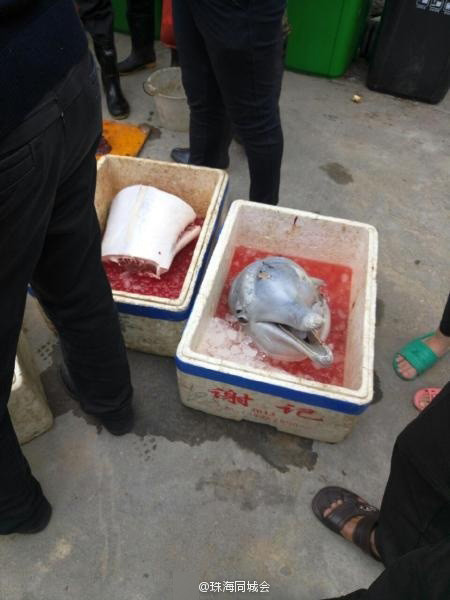
Three photos posted by an internet user show that a Chinese white dolphin was killed, dismembered by two middle-aged men and then sold to customers in Nanshui Town, Zhuhai, Guangdong Province on March 30, 2017. [Photo/ Weibo.com]

Investigations are underway after netizens reported the butchering of an aquatic animal alleged to be a baby Chinese white dolphin in Zhuhai, said Guangdong Ocean and Fishery Administration on Friday.

At 6:30 pm on Thursday, netizens reported that some people were butchering a dolphin near Nanshui in Zhuhai’s Jinwan District.

After receiving the tip-off, law enforcement officers immediately headed to the spot.

They recovered and sealed the remains of the aquatic animal, which will be checked and verified by technical authorities, it was added.

A preliminary investigation by the local fishing bureau said a fisherman surnamed Zhong found a big fish floating in the sea near Gaolan Port. He saw the fish had been dead and dragged it to the wharf and let three other men butcher it.

The three suspects are currently cooperating with police investigations, the administration said.

The Chinese white dolphin, nicknamed “mermaid” and “giant panda of the sea”, is mainly found in the western Pacific Ocean and Indian Ocean. In China, it often appears in the East China Sea, and is guarded under first-class state protection.