

|
|
|
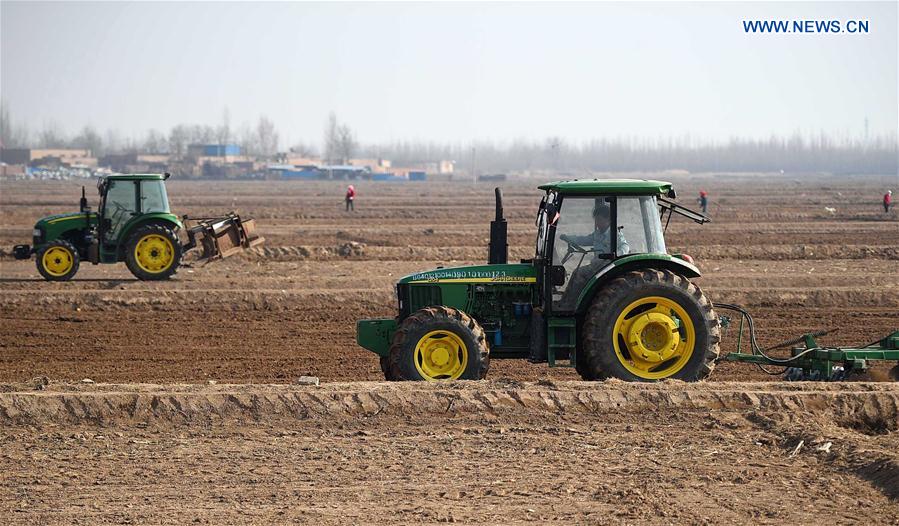
Farmers are seen busy working on farmland as the plowing and sowing season comes along, in Yongning County, northwest China’s Ningxia Hui Autonomous Region, Feb. 29, 2016. (Xinhua/Wang Peng) (File photo) |
China has issued its first strategic plan for territory development and preservation, outlining the protection of arable land reserves and islands.
The plan, issued by the State Council Saturday, demands the retaining of 1.825 billion mu (about 121 million hectares) of arable land by 2030 and reiterates the red-line of holding 1.865 billion mu by 2020.
Urban areas must occupy no greater space than 116,700 sq km by 2030, according to the plan.
The timetable also suggested that the country create 1.2 billion mu of high-standard farmland and bring an additional 940,000 sq km of eroded soil under control.
China, the world’s third largest country by size, has a landmass of 9.6 million sq km and nearly 3 million sq km of maritime area.
The plan calls for enhanced restoration of ecology on the nation’s islands, serving as base points of territorial sea and the environment-friendly development of uninhabited islands.
It also said that infrastructures on islands with development plans, and remote ones, must be improved as a major task in protecting the natural resources and environment of islands.
The plan said that development of tourism projects on remote islands would be encouraged, and the ocean economy would own a greater share of the country’s growth.
China will establish 10 to 20 demonstration zones during the 13th Five-Year Plan period (2016-2020) to test ocean economy polices, according to the country’s top economic planner.
By 2030, the country will get closer to becoming a maritime power given its enhanced ability in oceanic development and protection, according to the plan.
The nation had more than 11,000 islands by the end of 2015, with Zhejiang, Fujian and Guangdong having the largest number, according to the State Oceanic Administration survey.
Since 2010, the nation repaired damaged islands with 3.6 billion yuan (about 525 million U.S. dollars) from the central budget, 2.6 billion yuan from the local budget and 300 million yuan from enterprises, in a total of 169 projects.
The plan also envisions better water quality in the country’s rivers and lakes, so that 75 percent of water in major drainage basins is of good quality by 2030.