Beijing starts landmark medical reform

image_pdfimage_print

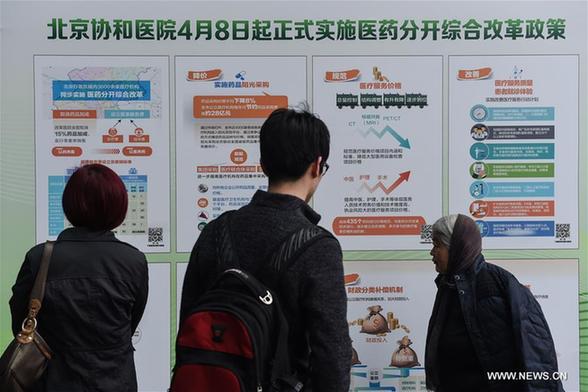
People read informations on medical reforms at Peking Union Medical College Hospital in Beijing, capital of China, April 8, 2017. Beijing started a landmark reform drive Saturday that will separate drug sales from medical treatment at public hospitals, lower medical expenses and improve services for patients. [Photo/Xinhua]

Beijing started a landmark reform drive Saturday that will separate drug sales from medical treatment at public hospitals, lower medical expenses and improve services for patients.

As of 6 am, 2,605 Beijing hospitals had switched to a new billing system, which replaced a registration and treatment fee with a higher medical service charge but scraped the previous markup on drugs, which was as high as 15 percent in the old pricing system.

The reform is applicable to more than 3,600 medical institutions citywide, while some 1,000 small village clinics are not yet equipped with computerized billing system, said Gao Xiaojun, spokesperson with Beijing health and family planning commission.

At Beijing Children’s Hospital, one of the busiest downtown hospitals, dozens of children and their parents at the emergency room shortly after midnight.

One father, surnamed Zhang, said he had paid 10 yuan under the local medical insurance program to see a doctor, five times the former fee he had to pay out of his own pocket. “But it was not a big deal,” he said. “We are quite happy that medication will be cheaper.”

A mother who was collecting a prescription for her child commented on the average drop of 10 percent in drug prices.

Price changes were also seen across 435 medical services offered at public hospitals and clinics.

The reform has reduced fees for the use of certain equipment, such as computed tomography (CT) and nuclear magnetic resonance (NMR), but increased charges for certain medical services that involve a lot of experience, expertise or staff time.

According to calculations, the overall medical costs for Beijing residents will remain balanced and there will be no increased burden on patients, said Fang Laiying, head of the Beijing municipal health and family planning commission.

“Separating treatment and drug sales will stop over-prescription and help medical practitioners provide better treatment,” said Fang.

To ensure medicine prices drop, Beijing has mandated transparent drug purchases, choosing suppliers through open bidding and requiring the full disclosure of drug and producer information.

Meanwhile, community hospitals and medical institutions have been given the same access to medicines that were once only prescribable by high-level hospitals.

More than 90 percent of Beijing’s hospitals have taken action to improve their services since the reform plan was published on March 22, said Fang.

Thunderstorms to hit central, southeast China

image_pdfimage_print

Thunderstorms and heavy rains are forecast to hit parts of central and southeast China in the next 24 hours, the national observatory warned Saturday.

From Saturday evening to Sunday evening, parts of Hubei, Anhui, Hunan, Jiangxi, Zhejiang and Fujian provinces will be lashed by thunderstorms, wild winds or hailstones, according to the National Meteorological Center (NMC).

The center issued a blue alert, the lowest in a four-tier warning system, for severe convective weather for the above-mentioned regions, predicting precipitation of 20 to 40 millimeters per hour, or even 50 millimeters per hour, in some areas.

The NMC cautioned that local governments should take emergency measures against thunderstorms, strong wind and potential disasters, including mountain floods and landslides.

China has a four-tier color-coded weather warning system, with red representing the most severe warning, followed by orange, yellow and blue.

Govt cuts budget on overseas trips, vehicles, receptions

image_pdfimage_print

The central government has continued to cut its annual budget for overseas trips, vehicles and receptions this year.

Central government departments will spend a maximum of 6.15 billion yuan (891 million U.S. dollars) on the “three public consumptions” in 2017, down 31 million yuan from 2016, according to the Ministry of Finance (MOF).

Expenses on overseas visits will reach no more than 1.88 billion yuan, while 3.5 billion yuan was budgeted for the purchase and maintenance of government vehicles and 761 million yuan for official receptions.

The MOF said the 2017 budget will give a priority to funding important overseas visits, reception of foreign guests, as well as participation in international meetings.

In addition, central departments will need to replace their vehicles with greener cars in line with Beijing’s policy on emission reduction, the MOF said.

China has long been bedeviled by officials using their expenses accounts to travel in the name of official visits, use work vehicles on personal errands, and enjoy luxurious receptions and accommodation.

However, the frugality campaign launched by central authorities is driving down the expenses in a bid to build a cleaner and more transparent government.

2 new H7N9 cases reported in central China

image_pdfimage_print

Two new cases of H7N9 infection were reported from March 31 to April 6 in central China’s Hunan Province, health authorities said Saturday.

Live poultry trading has been suspended in the provincial capital Changsha since March 17, which will last until the end of April.

Nationwide, 79 people died in January from the virus, according to the National Health and Family Planning Commission.

H7N9 is a bird flu strain first reported to have infected humans in China in March 2013. Infections are most likely occur in winter and spring.

Disease control and prevention experts have said that the H7N9 virus is not transmitted from person to person.

Experts recommend that people avoid contact with dead and live poultry, and only buy poultry with quarantine certificates.

After attacks, UN senior official in South Sudan urges protection of aid workers and civilians

image_pdfimage_print

8 April 2017 – Following recent attacks on civilians and aid workers in South Sudan, the top United Nations humanitarian official in the country today called on the Government and the opposition to protect civilians and ensure the safety and security of humanitarians.

Noting reports this week of &#8220outrageous abuses&#8221 by both state and opposition actors in Upper Nile against aid workers, as well as reports of horrific attacks against civilians in Eastern Equatoria, Eugene Owusu, called the attacks &#8220reprehensible and unacceptable.&#8221

&#8220I call on those in power to take swift action to end the targeting of innocent people in this conflict and to hold those responsible to account,&#8221 the UN Humanitarian Coordinator in South Sudan said.

In his statement, Mr. Owusu noted two &#8220serious&#8221 attacks against aid workers in Aburoc and Melut, both in the Upper Nile, since 31 March.

He condemned the attacks &#8220in the strongest terms,&#8221 and demanded authorities to investigate and bring the perpetrators to justice.

&#8220Humanitarians are in this country to save lives. It is beyond reckoning that they continue to be killed, harassed and abused despite our repeated calls for action,&#8221 Mr. Owusu stressed.

Also this week, in Pajok, Magwi County, Eastern Equatoria, at least 6,000 people have been forced to flee to Uganda and reportedly several dozen have been killed, following an attack by government forces on the town.

The Office for the Coordination of Humanitarian Affairs (OCHA) said that thousands more are thought to be sheltering in the bushes in areas surrounding the town, which was estimated to be home to up to 50,000 people.

&#8220I am appalled by the reports,&#8221 said Mr. Owusu. &#8220I implore the leadership in South Sudan to rapidly investigate these allegations and to end all attacks against civilians.&#8221

The attacks come as the humanitarian situation in South Sudan is deteriorating. More than 3.5 million people have been forced to flee their homes, including nearly 1.9 million people who are internally displaced and more than 1.7 million who have fled as refugees to neighbouring countries.

OCHA estimates that an average of 2,000 South Sudanese refugees are arriving into Uganda each day, some 62 per cent of them children.