Dr. Mahesh Sharma, Minister of State (Independent charge) for Culture & Tourism launched the implementation of the ‘‘National Mission on Cultural Mapping of India’ at Goverdhan Block, Mathura District
Jun182017
Jun182017
I have been reading strange stories this week that the Chancellor is going on to the Marr show this morning to seek to change government policy on Brexit. I find this difficult to believe. The Chancellor is a senior member of the Cabinet and Brexit Committee, so he would have put his point of view strongly when the Brexit policy was decided. The government deliberated long and hard, and then produced a White Paper, several statements to Parliament, and the Article 50 letter and Act. These all made it clear the UK would be leaving the EU and its single market and Customs Union, but would be negotiating for a business friendly comprehensive free trade agreement with the rest of the EU. This approach received overwhelming support form MPs in the last Parliament who voted through the Article 50 Act on that basis. The Chancellor was in full support.
I also find it difficult to believe the stories because the policy the unnamed briefers say we need to change to is stupid. I would be surprised if the Chancellor wanted to sign up to such a policy. It is said we need to seek associate membership of the Customs Union, with an opt out of its strict rule that a member cannot negotiate free trade deals of its own for certain UK trade in services. How on earth could that work? The main gains from negotiating free trade agreements with other countries will come from those where the present tariff barriers are highest. These are the lower income countries with a big export industry in farm products and basic industry. In order to get access for our services we will of course have to offer zero tariffs and reduced barriers on things like tropical and Mediterranean agricultural products which currently are made dearer by EU impositions. If we cant negotiate on non service trade we have no leverage.
It is also foolish because it creates the impression with the rest of the EU that the UK is constantly changing her mind and is too busy negotiating with herself to be able to negotiate seriously with them. Such a change at this late stage would send the wrong signal, and would not leave the government with the strong position accepted by Parliament that we have at the moment. The General election saw 85% of the voters vote for parties that stated we will leave the EU and the single market and negotiate our own trade deals. That is incompatible with any kind of membership of the Customs Union which would prevent us feeing our trade with others.
That’s why I think it unlikely the Chancellor will oppose government policy on the Marr show. Doubtless he will say he wants a business friendly Brexit. On that I agree with him. That much is agreed by Labour and the Conservatives. The way to achieve it is through maximum access to the EU market, and through much better trade deals with the rest of the world.
Jun182017
Meteorological authorities on Saturday warned of possible geological disasters in southern China as heavy rain is expected in the region.
The National Meteorological Center (NMC) and the Ministry of Land and Resources warned of high risks of geological disasters including flash floods in parts of Fujian, Guangdong, Guizhou, Sichuan and Yunnan provinces from Saturday to Sunday evening.
The NMC revoked a blue alert for a rainstorm on Saturday afternoon, but the forecast of heavy rain in Fujian, Guangdong, Hainan, Taiwan and Yunnan will continue.
People affected by the rain should take precautions against possible mountain torrents, mud-rock flows and landslides, the NMC warned.
China has a four-tier color-coded warning system for severe weather, with red being the most serious, followed by orange, yellow and blue.
Over the past years, China has suffered some large-scale natural disasters, from extreme weather to geological events, causing huge losses of life and property.
Jun182017
China on Saturday began its second scientific expedition to the Qinghai-Tibet Plateau to study changes in climate, biodiversity and environment over the past decades.
The last expedition of similar scale was conducted in the 1970s.
|
|
|
Tibet plateau |
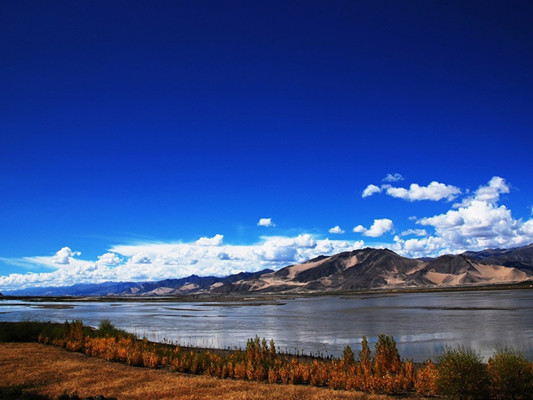
This time, the expedition will last five to 10 years and the first stop will be Serling Tso, a 2,391-square-kilometer lake that was confirmed to have replaced the Buddhist holy lake Namtso as Tibet’s largest in 2014.
In the coming month, Chinese Academy of Sciences (CAS) will take more than 100 scientists to the lake area and the origin of the Yangtze, China’s longest river. They will be divided into four groups and make a comprehensive survey of the plateau glaciers, climate change, biodiversity and ecological changes, said Yao Tandong, an academician with the CAS.
“Great changes have taken place in the plateau’s resources and environment since the first scientific expedition,” said Yao, director of the CAS Institute of Qinghai-Tibet Plateau Research. “We need further research to find out ways to cope with these changes.”
China’s first comprehensive scientific expedition to the Tibet plateau began in the 1970s and covered more than 50 disciplines including geologic structure, prehistoric life, geophysics, climate, zoology and botany.
“The scientists reported major discoveries and filled many gaps in plateau research,” said Yao.
The new round of research, he said, will focus on changes.
Zhu Liping, a CAS researcher leading the lake observation team, said the surface of Serling Tso Lake, for example, had expanded 40 percent between 1976 and 2009.
Since 1990, water in the plateau’s 1,000 lakes has increased by 100 billion cubic meters.
“The volume is equal to three times the water in Three Gorges Dam,” Zhu said. Study will measure the impact on the ecology and its potential link to flooding and drought in the low-lying eastern monsoon region.
Zhu said data will be collected by scientists using automatic boats for the first time and a topographic map will be drawn.
“The plateau climate is becoming warmer and more humid,” said Xu Baiqing, who leads another team to the glaciers. The team will drill ice cores at three major plateau glacier groups. Buried in the cold interiors of glaciers, ice cores contain well-preserved and detailed records of climate change in a century.
The impact of climatic changes would be assessed and proposals for conservation and rational development of resources formulated.
On the archaeological front, scientists will look for evidence that can prove an earlier archaeological discovery of a Paleolithic ruins in the Serling Tso suggesting that humans might have been lived on this part of the world since some 30,000 years ago.
Archaeologists will try to answer why humans came to this plateau, where did they come from, and how did they adapt to high altitude living, according to team leader Deng Tao, deputy director of Institute of Vertebrate Paleontology and Paleoanthropology, under CAS.
A fourth team will research the biological diversity on the plateau and draw up a habitat map for preservation and tourism purposes.
A national park might be set up in Serling Tso.
The expedition will also take scientists to the China-Pakistan Economic Corridor and a pass linking to south Asia.
Jun182017
China’s Ministry of Public Security (MPS) has urged police nationwide to strengthen checks and punishment on the motorists who do not give way to pedestrians.
During the past three years, 3,898 people were killed in 14,000 accidents happened on crosswalks in China, 90 percent of which involved motorists failing to give way to pedestrians, according to the Traffic Management Bureau of the MPS.
Traffic police should step up patrols and strengthen monitoring with surveillance cameras on streets, said the bureau, calling for tougher enforcement and sterner punishment.
For a safer environment for pedestrians, traffic bureaus nationwide will provide better traffic signs, install more traffic lights, and help build more underground passages or pedestrian bridges.
Beijing traffic police on Thursday began enforcing a fine of 200 yuan ($29) for motorists who fail to give way to pedestrians on crosswalks.
The violation will also result in a loss of three demerit points. When motorists loose all 12 points they must retake the driver’s license test.
The enforcement of the fine comes days after surveillance camera footage went viral showing a woman in Central China’s Henan province being hit by a taxi while on a crosswalk. Lying on the crosswalk, she was run over by a second car.