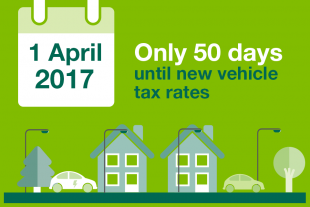
Only 50 days to go until new vehicle tax rates come into force

image_pdfimage_print

The way vehicle tax is calculated will be changing for new cars and some motorhomes from 1 April 2017. Time is flying by and we’re just 50 days away.

We’ve been busy behind the scenes and blogging regularly about what DVLA is doing to prepare for the changes internally and with our customers.  Here’s a recap of where we are:

Over the past 12 months we’ve been working closely with stakeholders to make sure they’re aware of these changes.  We’re changing the tax rules ready for 1 April and are developing a new service to register new vehicles to launch later in the year. To support the changes we set up and attended industry steering groups to hear the views of stakeholders, update progress and agree the changes.

Only 50 days to go until new vehicle tax rates.

We launched our public facing communications in November 2016 and have been informing customers about the changes.  This publicity campaign is being run across social media, blogs as well as through messages on DVLA literature. We’ve also updated GOV.UK with the facts about the changes.

DVLA’s contact centre is running an automated telephone service to quickly answer our customer’s questions.

We also hosted a webinar in January for fleet customers with commentary provided by DVLA Service Designers Helen Jones and Rhian Townsend.

We’ve been keeping a close eye on how these communications are performing and what people think.  From this we know that the most popular query amongst the public is whether these changes will affect existing vehicles. The answer?  No they don’t.  The new rates only affect cars and some motorhomes first registered with DVLA on or after 1 April 2017.

So, the countdown is well underway with only 50 days to go until the new vehicle tax rates come into force.

I’m sure this will fly by so please keep up to date with this topic and others by following DVLA on TwitterFacebook and LinkedIn and subscribing to our Digital Services Blog.

Let’s block ads! (Why?)

8.2 mln railway trips expected on Lantern Festival

image_pdfimage_print

China Railway Corp. expects 8.2 million trips to be made by rail Saturday as it is Lantern Festival, the end of the lunar new year celebrations.

The company said it had scheduled an additional 598 trains to cope with demand.

On Friday, 8.92 million trips were made by rail.

The Lunar New Year holiday was from Jan. 27 to Feb. 2 this year. The period, which is also known as Spring Festival, is known as the largest human migration in the world, as hundreds of millions of people go back to their hometowns, putting huge stress on the transportation system.

The first post-festival travel rush started toward the end of the week-long holiday. The second travel rush usually happens around Lantern Festival, when students return to start a new semester and migrant workers return to work.

China plans 50 billion yuan of investment in rural methane projects

image_pdfimage_print

China will spend 50 billion yuan (about 7.3 billion U.S. dollars) on building methane projects in rural areas as the government seeks to increase the use of clean energy.

According to a plan released by the country’s top economic planner, during the 13th Five-Year Plan (2016-2020) period, China will build 172 new biogas projects and 3,150 large-scale methane projects.

The plan aims to increase the country’s methane producing capacity by 4.9 billion cubic meters, replace the equivalent of 3.49 million tonnes of standard coal with cleaner energy and cut carbon emissions by 17.62 million tonnes.

The projects will benefit more than 230 million rural residents.

China’s fast-growing economy has seen rural energy consumption surge and the rapid expansion of the livestock breeding and agro-industries. These rural businesses create billions of tons of biomass waste annually, which can potentially be used to produce energy.

According to official estimates, China generates 1.4 billion tonnes of rural waste materials annually that could be used for methane production. This amount of waste could produce 73.6 billion cubic meters of biogas and replace 87.6 million tonnes of standard coal.

Contemporary democratic revolutions

image_pdfimage_print

There is a mood to sweep away the old centre left and centre right parties on the continent in a desperate bid to have something better . In the USA and the UK there is the wish to force change on the body politic by voting for Brexit and Donald Trump, within the traditional party structures. On both sides of the Atlantic and the Channel there is that same impatience with politics as it has been practised for the last twenty years, and anger at the way the governing corporate,civil service and Ministerial elites have behaved.

The anger is justified. The elites told us they knew best. They assured us they had the expertise. On the continent Tweedledum and Tweedledee parties alternated in government but little of substance changed. In the UK a puppet Parliament pretended to be in control whilst shovelling through thousands of pages of laws and many spending programmes that the EU required, with both parties claiming to support them without criticism or proper debate. In the UK we were made to live through the Exchange Rate Mechanism recession, the Banking Crash recession and the Euro crisis at one remove. The US was put through the Great Recession and the Iraq war. The Euro area had to endure the most economic pain with the ERM crash, the Banking Crash and the continuing Euro crisis.

People not very interested in politics, or pessimistic about their chances of changing anything for many years, have decided to take back control. In the USA Mr Trump first tossed aside all the serious professional well honed politicians of the Republican party to take their crown. He then went on to defeat the doyenne of political insiders, the darling of the elite, Hilary Clinton, who ran on a ticket of expertise and experience. The public said if it meant the expertise that had brought them the Great Recession and the Iraq war, they would rather try something new.

In the UK many groups of people with very varied political opinions united behind a campaign with the express slogan of Take Back Control. The more Remain paraded every great figure of the established governing and corporate bosses, the more the Leave case was supported. The experts who had led much of southern and western European economy into mass unemployment with their Euro currency were surprised when people did not believe their forecasts of gloom if the UK dared to vote Out. My belief Leave would win was strengthened at a big public meeting when many in the audience laughed and cried out their disbelief when the Project Fear forecasts were put before them.

If parties wish to run and support technocratic government it must at least be competent technocratic government. If they believe only they have the expertise to make the decisions and that the people just need bread and circuses, they must make sure everyone can afford the bread and get to the circus. The main reason the old establishment is being swept away is it failed to deliver.
Tomorrow I will look at the parlous light of the Conservative and Labour look alike parties on the continent.

Security Council strongly condemns continued fighting in South Sudan

image_pdfimage_print

11 February 2017 – The Security Council has strongly condemned continued fighting across South Sudan, particularly incidents in the country’s Equatoria and Upper Nile regions, and called on all parties to cease hostilities immediately.

In a Press Statement issued overnight, the Council also condemned &#8220in the strongest terms&#8221 all attacks directed against civilians and expressed serious concern, once again, about reports of killing of civilians, sexual and gender-based violence, destruction of homes, ethnic violence, and looting of livestock and property.

The Council urged the Transitional Government of National Unity to take measures to ensure that those responsible for the attacks are held accountable, and expressed deep alarm that more than 84,000 individuals have fled South Sudan since the beginning of January and that many continue to be displaced internally.

The Council stressed that there is no military solution to the conflict, and in this regard, welcomed the continued and collective commitment in the search for lasting peace, security and stability expressed by the African Union (AU), the Intergovernmental Authority on Development (IGAD), and the UN during the joint consultative meeting on South Sudan that was held in Addis Ababa, Ethiopia, on January 29, 2017.

The Council expressed deep concern that the Transitional Government of National Unity is hindering the ability of the UN Mission in South Sudan (UNMISS) to carry out its mandate to protect civilians and create conditions conducive to delivery of humanitarian assistance.

The Council reminded the transitional government of its commitment in the September 4, 2016, Joint Communique to permit freedom of movement of UNMISS.

The Council reiterated that targeting civilians may constitute war crimes and those involved could be subject to sanctions under resolution 2206 (2015).