Ministry of Tourism compiles monthly estimates of Foreign Tourist Arrivals (FTAs) & FTAs on e-Visa on the basis of Nationality-wise, Port-wise data received from Bureau of Immigration (BOI).
Feb172017
Ministry of Tourism compiles monthly estimates of Foreign Tourist Arrivals (FTAs) & FTAs on e-Visa on the basis of Nationality-wise, Port-wise data received from Bureau of Immigration (BOI).
Feb172017

Feb172017
Xu Feifei, an 11-year-old boy from Xuzhou, Jiangsu Province, suffered from a sudden acute eye disease which has almost led to blindness. The whole ailment was caused by excessive eye fatigue during the winter vacation, during which he played computer games for a continuous 10 days and nights.
|
|
|
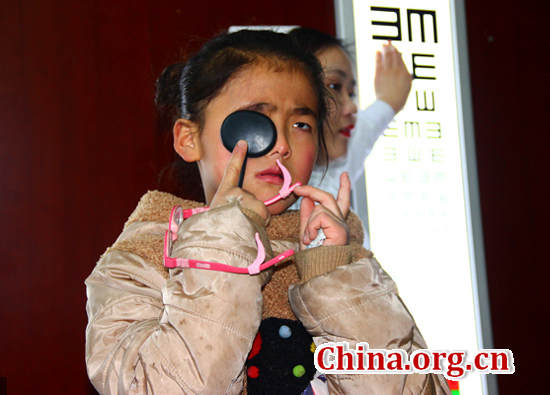
A girl, Ruru, has an eyesight test in Huaiyang County, Zhoukou in Henan Province. She and her two siblings suffer from severe nearsightedness. [Photo/China.org.cn] |
Many youngsters in China nowadays are increasingly indulged in computer games and other electronic products, and are unable to extricate themselves. This is followed by a series of health problems, with the most typical case being myopia, or nearsightedness.
According to the latest research report released by the World Health Organization (WHO), the nearsightedness rate among Chinese juveniles ranks first in the world – 70 percent of high school and college students. The rate is nearly 40 percent in primary school students, while it is only 10 percent for their peers in the United States.
The WHO research report says that the number of nearsighted people in China has reached 600 million, nearly approaching half of the country’s total population.
Experts attribute the soaring nearsightedness rate in China to the unhealthy lifestyles and learning styles which parents impose on their children.
On the one hand, to achieve high scores in exams, children spend too much time indoors studying and have not enough time outside in the sunlight. On the other hand, a growing number of high-tech products, such as smart phones and tablet PCs, make children focus their eyes and attention on fluorescent screens for long periods of time, resulting in excessive eye fatigue.
Experts suggest that youngsters maintain a proper balance between study and rest so as to protect their eyesight, and parents should play a correspondingly active role in the process.
Feb172017
More than 100 plant seeds dating back 2,000 years have been unearthed from an ancient tomb in northern China’s Inner Mongolia Autonomous Region, archaeologists said.
According to the regional institute of archaeology, the discovery was made during the excavation of a civilian tomb, dating between the middle and late Western Han Dynasty (206 B.C.- 25 A.D.) and early Eastern Han Dynasty (25 A.D. – 220 A.D.), in Dengkou County, western Inner Mongolia.
The half-moon-shaped seeds were found on the east side of the female tomb owner’s head. They gathered in a round shape with a diameter of eight centimeters.
They look like modern pomegranate seeds, but archaeologists have not concluded what they are.
A rusted bronze seal was also found in the same tomb.
Further 18 single-chamber brick tombs were also unearthed. Scattered among sand dunes, the tombs were not well preserved, with most of their tops being exposed to air.
Feb172017
Surgeon Vice Admiral AA Pawar, Director General (Organisation and Personnel), interacted with Medical Students and Interns of the top medical colleges in the city on 14 and 15 February 2017.