The curious case of the Scottish economy

image_pdfimage_print

Before the EU referendum the Scottish economy was growing far more slowly than the UK as a whole. From the 2008 crash to 2015 the Scottish economy only advanced by 4% in cash terms, compared to 23% for the UK. Since the referendum the Scottish economy has continued to underperform. On the latest figures the UK is growing around 1.2% real more per annum than Scotland, with the Scottish economy in danger of stalling.

It clearly isn’t the EU referendum doing that as a few would suggest. It is a longer term Scottish  trend. Part of the reason is the decline in oil output. The North Sea fields are in decline. As oil volumes and revenues tail off, so that has knock on effects to the supply industries and the service sector that has lived off the oil industry where it is strong.

Recent figures show disappointing results for manufacturing as a whole, and a weak balance of payments. Scotland spends more per head in the public sector than England. Scotland borrows more as a percentage of GDP to support public spending than the UK as a whole. If larger deficits and higher public spending made for more growth , Scotland would have a more successful economy than England. It does not seem to.

I would be interested in views on why Scotland has been lagging, and what the Scottish government can and should do about it. The SNP live on the fact that the Scottish average GDP per head is  not too bad compared to the UK and European averages, but this relies on the residual advantages of a declining North Sea oil sector and past achievements from pre the 2008 crash. They need to answer more of the questions about the disappointing performance over the last decade when they have been in office, and to explain why so far their approach has not even succeeded in getting Scotland back to the average growth rate for the UK as a whole. The crash of course hit the high value added financial sector whose Investment Bank activities were concentrated in London, but this has  not had the same impact on the London economy as the oil decline on the Scottish one.
Peking University to start enrollment for Oxford campus

image_pdfimage_print

China’s prestigious Peking University will start staff recruitment and student enrollment for its British campus in the city of Oxford in June, according to the dean of HSBC Business School of Peking University Sunday.

Peking University signed with the Open University in February to purchase the 15-acre campus in Oxford for 8.8 million pounds (10 million U.S. dollars). This was the first time that a Chinese university has used its own finance to set up and manage a school in a foreign country, according to Hai Wen, dean of HSBC Business School.

He said the school would enroll 100 international students when it opens in August 2018.

It will coincide with the 120th founding anniversary of the the elite Beijing university.

“The timing is monumental. In 1818, China’s first foreign-founded school, Ying Wa College, was set up by a British missionary. Now 200 years later, a Chinese university will set up its own school in Britain,” he said.

Hai said that in recent years, many foreign universities had opened schools in China. Peking University, as one of China’s top universities, should play a leading role for Chinese universities to go global.

He said HSBC Business School’s finance, management and economics courses will feature Chinese business cases to help students become better acquainted with the Chinese economy and reforms. Students will take the first year course in the Oxford campus and the second year at the school’s campus in the city of Shenzhen, southern China.

Students on the school’s Shenzhen campus will be allowed to select elective courses on the Oxford campus.

New finding about rapamycin may help slow aging

image_pdfimage_print

A study outlines a new understanding of how a compound called rapamycin works that may help address neurologic damage such as Alzheimer’s disease.

“It’s possible this could provide a new therapeutic approach to neurologic disease,” said Viviana Perez, an assistant professor in the Department of Biochemistry and Biophysics in the Oregon State University (OSU) College of Science.

In a study published in Aging Cell, the researchers said they have identified two mechanisms of action of rapamycin. One was already known. The newly-discovered mechanism is what the researchers say might help prevent neurologic damage and some related diseases.

“The value of rapamycin is clearly linked to the issue of cellular senescence, a stage cells reach where they get old, stop proliferating and begin to secrete damaging substances that lead to inflammation,” said Perez, an expert on the biological processes of aging. “Rapamycin appears to help stop that process.”

The secretion of damaging compounds creates a toxic environment called senescence-associated secretory phenotype, or SASP, disrupting the cellular microenvironment and altering the ability of adjacent cells to function properly, compromising their tissue structure and function. And this broad process is believed to be linked to aging.

“The increase in cellular senescence associated with aging, and the inflammation associated with that, can help set the stage for a wide variety of degenerative disease, including cancer, heart disease, diabetes and neurologic disease, such as dementia or Alzheimer’s,” Perez explained. “In laboratory animals when we clear out senescent cells, they live longer and have fewer diseases. And rapamycin can have similar effects.”

It had been observed, prior to this research, that there was one mechanism of action for rapamycin in this process. And it was believed that rapamycin helped to increase the action of Nrf2, a master regulator that can “turn on” up to 200 genes responsible for cell repair, detoxification of carcinogens, protein and lipid metabolism, antioxidant protection and other factors. In the process, it helped reduce levels of SASP.

The new study showed that rapamycin could also affect levels of SASP directly, separately from the Nrf2 pathway and in a way that would have impacts on neurons as well as other types of cells. “Any new approach to help protect neurons from damage could be valuable,” Perez was quoted as saying in a news release.

A natural compound first discovered from the soils of Easter Island in the South Pacific Ocean, Rapamycin has already been intensively studied because it can mimic the valuable effects of dietary restriction, which in some animals has been proven to extend their lifespan. Laboratory mice that have received rapamycin have demonstrated more fitness, less decline in activity with age, improved cognition and cardiovascular health, less cancer, and a longer life.

Through its ability to help prevent SASP-related cellular damage through two pathways, one involving Nrf2 and the other more directly, rapamycin will continue to generate significant interest in addressing issues related to aging, Perez said. However, the use of rapamycin in humans has so far been constrained by an important side effect, an increase in insulin resistance that may raise the risk of diabetes.

Beijing starts landmark medical reform

image_pdfimage_print

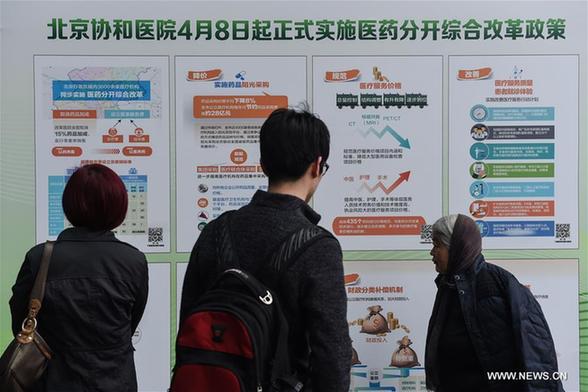
People read informations on medical reforms at Peking Union Medical College Hospital in Beijing, capital of China, April 8, 2017. Beijing started a landmark reform drive Saturday that will separate drug sales from medical treatment at public hospitals, lower medical expenses and improve services for patients. [Photo/Xinhua]

Beijing started a landmark reform drive Saturday that will separate drug sales from medical treatment at public hospitals, lower medical expenses and improve services for patients.

As of 6 am, 2,605 Beijing hospitals had switched to a new billing system, which replaced a registration and treatment fee with a higher medical service charge but scraped the previous markup on drugs, which was as high as 15 percent in the old pricing system.

The reform is applicable to more than 3,600 medical institutions citywide, while some 1,000 small village clinics are not yet equipped with computerized billing system, said Gao Xiaojun, spokesperson with Beijing health and family planning commission.

At Beijing Children’s Hospital, one of the busiest downtown hospitals, dozens of children and their parents at the emergency room shortly after midnight.

One father, surnamed Zhang, said he had paid 10 yuan under the local medical insurance program to see a doctor, five times the former fee he had to pay out of his own pocket. “But it was not a big deal,” he said. “We are quite happy that medication will be cheaper.”

A mother who was collecting a prescription for her child commented on the average drop of 10 percent in drug prices.

Price changes were also seen across 435 medical services offered at public hospitals and clinics.

The reform has reduced fees for the use of certain equipment, such as computed tomography (CT) and nuclear magnetic resonance (NMR), but increased charges for certain medical services that involve a lot of experience, expertise or staff time.

According to calculations, the overall medical costs for Beijing residents will remain balanced and there will be no increased burden on patients, said Fang Laiying, head of the Beijing municipal health and family planning commission.

“Separating treatment and drug sales will stop over-prescription and help medical practitioners provide better treatment,” said Fang.

To ensure medicine prices drop, Beijing has mandated transparent drug purchases, choosing suppliers through open bidding and requiring the full disclosure of drug and producer information.

Meanwhile, community hospitals and medical institutions have been given the same access to medicines that were once only prescribable by high-level hospitals.

More than 90 percent of Beijing’s hospitals have taken action to improve their services since the reform plan was published on March 22, said Fang.

Thunderstorms to hit central, southeast China

image_pdfimage_print

Thunderstorms and heavy rains are forecast to hit parts of central and southeast China in the next 24 hours, the national observatory warned Saturday.

From Saturday evening to Sunday evening, parts of Hubei, Anhui, Hunan, Jiangxi, Zhejiang and Fujian provinces will be lashed by thunderstorms, wild winds or hailstones, according to the National Meteorological Center (NMC).

The center issued a blue alert, the lowest in a four-tier warning system, for severe convective weather for the above-mentioned regions, predicting precipitation of 20 to 40 millimeters per hour, or even 50 millimeters per hour, in some areas.

The NMC cautioned that local governments should take emergency measures against thunderstorms, strong wind and potential disasters, including mountain floods and landslides.

China has a four-tier color-coded weather warning system, with red representing the most severe warning, followed by orange, yellow and blue.