Jul82017
Jul82017
44 dead or missing in flood-stricken Chinese county
![]() |
|
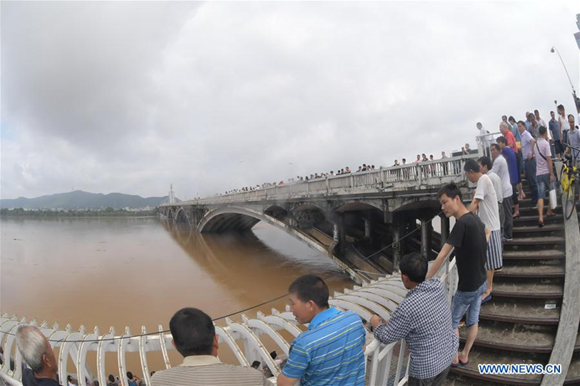
Citizens watch the flood on a bridge in Changsha, capital of central China’s Hunan Province, July 2, 2017. Days of torrential rain in Hunan Province raised the water level of the Xiangjiang River, a major tributary of Yangtze River, to exceed its record flood level Sunday morning. (Xinhua/Long Hongtao) |
A total of 44 people have died or are missing after floods hit Ningxiang County in central China’s Hunan Province, local flood control headquarters said Friday.
Heavy downpours since June 22 have led to the area’s worst natural disaster in 60 years.
About 815,000 people, or 56 percent of the county’s population, suffered property damage in the floods, it said.
In south China’s Guangxi Zhuang Autonomous Region, floods have left 26 dead and 8 missing since heavy rain started on July 1, according to the regional civil affairs department. More than 1.88 million people suffered losses in the disaster, which damaged 108,000 hectares of crops and flattened 6,102 houses. Direct economic losses have exceeded 7.8 billion yuan (1.15 billion U.S. dollars).
Torrential rain since late June has caused flooding along several tributaries of the Yangtze, China’s longest river.
The level of the Xiangjiang River, a major tributary of the Yangtze, exceeded its record level Sunday morning.
Since Saturday, reservoirs in the upper and middle reaches of the Yangtze have managed to control the flood, holding back more than 10 billion cubic meters of water, according to the Yangtze flood control and drought relief headquarters.
The efforts made by the Three Gorges Reservoir and upper reservoirs on the Jinsha River in the upper reaches of the Yangtze, and Yalong River, Jinsha’s tributary, have greatly reduced water levels of rivers and lakes in the middle and lower reaches of the Yangtze, the headquarters said.
According to the headquarters, local water authorities have spent 100 million yuan repairing 42 sections of bank along the middle and lower reaches of the Yangtze, which collapsed due to floods last year, the most severe since 1998.
Jul82017
Four dead, nine injured in east China hit-and-run
Four people were killed while nine others were injured in a string of hit-and-runs by a car in eastern China’s Jiangsu Province, local police said Saturday.
A car ploughed into several pedestrians in a neighborhood in Jingjiang city at 8:27 p.m. Friday, a police officer said. After the incident, the car did not stop but continued the rampage.
The victims were rushed to hospital where four died despite medical treatment, while the nine injured are believed to be in stable condition.
The driver was caught in nearby Taixing city. Police found that he had taken poison in an attempt to commit suicide. He is receiving emergency treatment.
The incident is under investigation.
Jul82017
Premier Li stresses innovation, business environment
Chinese Premier Li Keqiang has said that the government should attach more importance to encouraging innovation, optimizing the business environment and raising growth quality and efficiency.
Li made the remarks Thursday in a meeting with experts and entrepreneurs on current economic performance and suggestions about future economic work, according to a press release issued Friday.
After the economy stabilized in the first half, “we should not only have firm confidence, but also be well prepared for dealing with all kinds of difficulties,” Li said.
China should reduce transaction costs and streamline administration, delegate power to lower levels and improve regulation and services, Li said.
The government should also strive to create an internationally competitive business environment in which domestic and foreign companies are treated on an equal basis, the premier added.
China should continue to implement the strategy of innovation-driven development, improve the environment for entrepreneurship and innovation and upgrade the manufacturing and service sectors, Li said.
He also called for more progresses in technology, product upgrading and raising the quality and efficiency of growth.
China’s economy grew 6.9 percent year on year in the first quarter, the fastest pace in six quarters and higher than the government’s annual target of around 6.5 percent.
Q2 economic growth rate will be released on July 17.
“China should consolidate the foundation for the stable economic performance with sound growth momentum,” Li said.
The country will continue to stabilize macroeconomic policies, market expectations and the financial market, by sticking to its proactive fiscal policy and prudent monetary policy, taking forward-looking and effective macroeconomic regulation measures, and properly defusing risks, he added.
Efforts will also be made to ensure stable employment, reduce corporate burden, expand effective investment and make consumption play a larger role in economic growth.
The government should make sure that people get the benefits from development by fulfilling the promises of poverty relief, rundown area renovation and pollution control, among others, Li said.
“We should reduce the pains and difficulties in people’s lives, while increase their senses of gain and happiness,” the premier added.

Jul82017
What’s the point of a summit?
Mrs Merkel wants compromises to make the G20 “a success”. Compromises are not always a good idea. The world can accept different countries having different views and running different systems, as long as they are not threatening to another. The pictures from the summit are certainly not the ones she had in mind when she approved the substantial spending to act as host. The decision to have this meeting of the powerful in a normal city environment has placed huge strain on the German police, and has provided a worrying set of images for the easily distracted media who turn their attention to the violence on the streets rather than to the tired cliches of the communique.
There is of course an important role for personal diplomacy between national leaders. They can sometimes cut through or change the decisions and moods between countries. This is more likely to be achieved through bilateral state visits, bilateral government meetings or even by personal phone call. There are fewer cases when summits achieve this, though in the margins of the official agenda national leaders can have bilaterals to fix pressing problems. Global summits work best when there is a major issue which needs a co-ordinated or collective response. During the period of madness by the Central Banks in the western crash of 2008-9 the meeting that agreed concerted interest rate cuts despite the resistance of the so called independent central banks was an important example of political leaders using an opportunity to shift a policy for the better when their institutions were doing damage.
This summit has an agenda much like past summits. The US is unwilling to sign up to the Paris climate change targets, taking the view that if they did they would be legally bound. In contrast the EU has a history of agreeing to targets it does not enforce, and China sets targets that allow it to go on growing its CO2 output. The countries will agree to further action to tackle tax abuses, but then Mr Trump will fly home to seek to press major tax reductions through the Congress with a view to repatriating more business and profits to the USA.
The world economy on which our prosperity depends is not going to be much affected by this meeting. Crucial to its future is continuing success in China in avoiding banking problems and the hard landing China’s critics have been forecasting for several years. The extent of Mr Trump’s reflationary package and how much he can get through Congress matters a lot. The main thing to hope for is this summit does no harm to growth, sensible credit expansion, and the adoption of the new technologies that are revolutionising our work, play and social fabric.