Feb92017
Feb92017
PM’s fifth interaction with Additional Secretaries and Joint Secretaries
Feb92017
New material discovered to filter PM 2.5 particles
The latest publication of Nature has highlighted a discovery headed by Professor Wang Bo from the Beijing Institute of Technology, whose team created a membrane made from metal-organic frameworks (MOFs) to filter PM2.5 particles.
According to Wang, the porous crystallization material is a compound of organic monomers and metal ions, which can catch and dissolve the small particles, and evaporative Volatile Organic Compound (VOC).
The team has by now applied the crystallized compound to the surfaces of textiles, foam materials, plastics and steel meshes.
The material is probably the most powerful filter yet and can absorb and store more than 10 times the number of molecules as currently available filters.
It can also morph the pollutants into carbon dioxide and water when catalyzed under sunlight—a sustainable and zero polluting way—to ensure the purification of the air, with a rate as high as 99 percent.
The material can lower pollution caused by PM2.5 and PM10 to 0.5 percent, and the rate will only be affected when the temperature rises to as high as 200 degrees Celsius. It is expected to be applied to reduce the polluted particles from dust bags of vacuum cleaner, exhaust pipes of automobiles and particles produced from manufacturing bases. It can also dissolve massive VOC.
According to Wang, his team plans to apply their discoveries to air purifiers and screen windows, and to reduce industrial emissions.
Wang Xun, dean at the Chemical School of Tsinghua University, said the discovery is significant in view of the country’s efforts to reduce smog and improve air quality.
“Its application will be broad and extensive,” Wang said.
Feb92017
Police detain passengers for using phones during flight
|
|
|
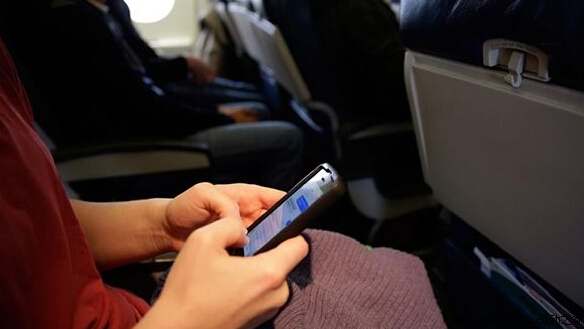
Using mobile phones during flight can lead to detention of up to five days and fines as high as 50,000 yuan (US$7,284.1). [file photo] |
Beijing police detained three passengers from Jan. 5 to Feb. 6 for allegedly using mobile phones during flights, the Civil Aviation Administration of China (CAAC) News reported Wednesday.
The first passenger surnamed Zhang was held for five days after being arrested upon landing at Beijing Capital International Airport on a flight from Harbin, Heilongjiang Province, on the evening of Jan. 5.
A flight attendant said that Zhang refused to turn off her cell phone when the plane was taking off and insisted on making calls during flight. When she was arrested and taken to airport police station after landing, she refused to cooperate.
The second passenger, surnamed Niu, was detained for three days when her plane was landing at Beijing airport from Nanchang, Jiangxi Province, on the afternoon of Feb. 5.
The third passenger, surnamed Wang, was taken for five days after landing at Beijing from Mudanjiang, Heilongjiang Province, at noon on Feb. 6. Wang was punished for allegedly listening to music on cell phone during takeoff and landing.
According to China’s civil air safety regulations, using mobile phones and other communication tools during flight may threaten public security and can lead to detention for up to five days. For those cases of gross violation, passengers can be fined as much as 50,000 yuan (US$7,284.1) and be given criminal sanctions.
Feb92017
Beijing to stamp out toxic school racetracks
Beijing will issue new standards on the quality of synthetic racetracks in primary and high schools in 2017 after children reportedly fell sick from exposure to toxic running tracks last year.
Construction of new synthetic running tracks will be suspended until the enforcement of the new standards, which have been given priority by the Beijing Municipal Education Commission this year.
Makeshift racetracks, such as water permeable brick or concrete ones, will be adopted with the new standards.
Zhang Yongkai from the commission said the new standards would require extensive tests on chemical substances, and that the entire construction process, including raw material purchase and processing, would be under strict inspection.
Last year, pupils in a primary school in downtown Beijing reported nosebleeds, dizzy spells and coughs after alleged exposure to the newly renovated tracks. Tests on the tracks in mid-June, nine months after they were put into use, showed excessive amounts of benzene substances and formaldehyde.
Similar cases were also reported in other provincial regions, such as Jiangsu and Guangdong.
Media reports said some of the racetracks were made of industrial waste, such as scrap tires and cables, and were built with substandard glue.