Experts: US missions ‘root cause of accidents’ in S. China Sea

image_pdfimage_print

The United States conducting frequent and large-scale reconnaissance missions in the South China Sea is the root cause of accidents between US and Chinese militaries, experts said.

Therefore, China and US militaries should enhance communication and strengthen mutual trust to nip potential accidents in the bud, they added.

A US Navy plane approached a Chinese military aircraft on Wednesday in the airspace near Huangyan Island, one of China’s islands in the South China Sea, an official close to China’s Defense Ministry said on Friday. The Chinese plane, which was conducting routine training in the region, reacted professionally and adhered to law.

“We hope the US will take the big picture of Sino-US military relations into account, and take practical measures to remove the root cause of accidents between the two countries in air and on sea,” the official added.

This was the first time US and Chinese military planes met in 2017. The last two incidents were on May 17 and June 7. A US official told Reuters that the incident was rare and inadvertent.

Ma Gang, a professor from the People’s Liberation Army National Defense University, said the US has been conducting frequent and large-scale reconnaissance missions in the South China Sea for decades, and “this is the root cause for the accidents.”

“If the US still views China as an obstacle, then similar accidents are still likely to occur,” he said. “Accident prevention requires the US to keep an open mind about China and remain honest in dialogue.”

The US government will remain committed to the one-China policy, and develop “a constructive relationship that benefits both the US and China,” according to a White House news release on US President Donald Trump’s first phone call with his Chinese counterpart Xi Jinping on Thursday, which described the call as “extremely cordial”

Last week, US Defense Secretary James Mattis suggested that diplomacy should be the priority in the South China Sea, and the US saw no need for “dramatic military moves” at this time.

Fu Mengzi, the vice-president of the China Institutes of Contemporary International Relations, said it is a good sign that China and the US are having positive interactions, and the US should build mutual trust and respect China’s stance on principle issues like national sovereignty and territorial integrity.

Veteran held in India for 54 years allowed to return

image_pdfimage_print

Wang Qi in the early 1960s and today. [Photo/China Daily]

After being held in India for 54 years, Chinese veteran Wang Qi was ready to make his long-awaited trip back home on Saturday.

According to the Chinese embassy in India, 77-year-old Wang had left his home in central India’s Madhya Pradesh and arrived in New Delhi on Friday afternoon.

He was eager to return to hometown in Shaanxi province and would start the journey as early as Saturday, said the embassy.

In 1963, Wang, a Chinese army surveyor, got lost, crossed the border and was captured by Indian authorities. He was moved from one jail to another for nearly seven years

When he was finally released in 1969, police escorted him to the remote village of Tirodi in Madhya Pradesh and told him to start a life there. He married a local woman, and they had three children and grandchildren.

Foreign Ministry spokesman Lu Kang said on Monday that China had been “pushing India” to complete procedures to return the veteran. In 2013, the Chinese embassy in India issued him a 10-year Chinese passport and a living allowance every year since then, Lu said.

Vikas Swarup, the Indian External Affairs Ministry’s spokesman, said on Thursday, “The ministry is helping Wang and his family members-including his son Vishnu Wang, daughter Anita Wankhede, daughter-in-law Neha Wang and grandson Khanak Wang-to visit China to meet his extended family.”

“We are working with the Chinese embassy in Delhi and the Indian embassy in Beijing to ensure that all formalities are completed and arrangements are in place,” he said.

A China Central Television report on Friday said that Wang is eager to taste noodles, a local specialty in Shaanxi, after arriving home.

Wang’s plight was highlighted last month in a special report by the BBC.

On Feb 4, Luo Zhaohui, China’s ambassador to India, spoke by telephone with Wang and expressed sympathy over his suffering over the years. Yan Xiaoce, a counselor at the Chinese embassy in India, visited Wang’s village on the same day, according to the embassy.

Liu Shurong, another Chinese veteran, underwent the same plight as Wang and lives in the same village. But Liu said he had no intention to return to China because he no longer has family there, the embassy said.

Man detained for arson on HK metro, 17 injured

image_pdfimage_print

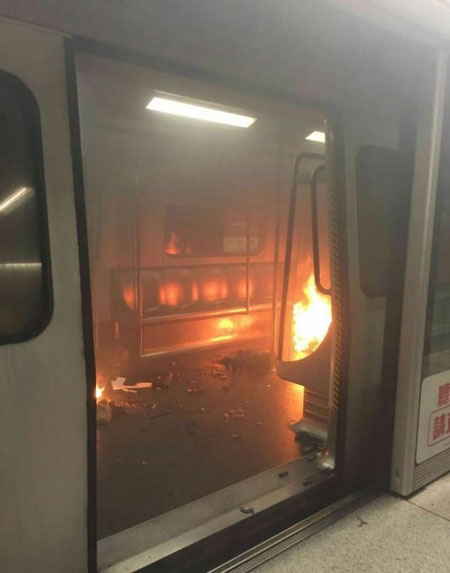
A fire is seen in an MTR train in Hong Kong on Feb 10, 2017. [Photo from Facebook]

A fire broke out on Friday inside a Hong Kong underground train near a busy station, with at least 17 people being injured and a man being detained after claiming that he has set fire with a Molotov cocktail.

The fire broke out at around 7:00 local time inside an underground train crossing the Vitoria Harbor for the busy Tsim Sha Tsui station, forcing the train to stop at the station and all the passengers to be evacuated, public broadcaster RTHK reported.

Footages from social media show flame and smoke from inside the train and several people burned.

The injured, two of whom in severe condition, were sent to nearby hospitals.

A man at the age of around 60 claimed that he set the fire with a Molotov cocktail. The police has detained the man and has been investigating his motive,a police officer told media outside the station, which has been temporarily closed.

The counter-terrorism response unit has been deployed at the scene.

Press release: Extracurricular cyber clubs to inspire and identify tomorrow’s cyber security professionals

image_pdfimage_print

The Cyber Schools Programme aims to support and encourage schoolchildren to develop some of the key skills they would need to work in the growing cyber security sector and help defend the nation’s businesses against online threats.

Up to £20m is available to deliver an extracurricular school programme which will see an army of expert external instructors teaching, testing and training teenagers selected for the programme, with a comprehensive cyber curriculum expected to mix classroom and online teaching with real-world challenges and hands-on work experience.

The Cyber Schools Programme, led by the Department for Culture, Media and Sport (DCMS), is aimed at those aged between 14 and 18, with a target for at least 5,700 teenagers to be trained by 2021.

This programme is for students with the aptitude and enthusiasm for the subject. It aims to appeal to children from all backgrounds, including those currently underrepresented in cyber security jobs.

Cyber security is an exciting industry with strong job prospects. Recent figures from the Tech Partnership show there are already 58,000 cyber security specialists in a growing sector worth £22bn a year to the economy. This is part of the Government’s commitment to prepare Britain for the challenges it faces now and in the future.

Minister of State for Digital and Culture Matt Hancock said:

This forward-thinking programme will see thousands of the best and brightest young minds given the opportunity to learn cutting-edge cyber security skills alongside their secondary school studies. We are determined to prepare Britain for the challenges it faces now and in the future and these extracurricular clubs will help identify and inspire future talent.

Students will be expected to commit to four hours a week. This will include classroom-based and online-teaching with flexibility around exams and busier study periods.

The aim is for students to start aged 14 and complete a four-year programme. It will be delivered in modules, meaning older students can join at any point providing they meet the right criteria. The provider will have the flexibility to decide the most appropriate way to deliver the programme, and the pilot, to begin in September 2017, will be monitored and reviewed after the first year.

The programme is all part of the Government’s National Cyber Security Programme to find, finesse and fast-track tomorrow’s online security experts.

It includes the recently announced CyberFirst bursary funding scheme, which offers grants of up to £4,000 for up to 1,000 students by 2020 to study a relevant degree, do a placement or attend a summer school and, depending on meeting requirements, the chance to work in national security on graduation.

There are 2,500 free places on CyberFirst in 2017 and an additional CyberFirst Girls Competition, where teams of 13-to-15-year-old young women can pit their wits against one another to crack a series of online puzzles.

DCMS is also supporting leading employers in critical energy and transport infrastructure to train and recruit up to 50 highly skilled apprentices aged 16 and over to help defend essential services against cyber attacks. The Cyber Security Apprenticeships for Critical Sectors Scheme is open now for applications for those with a natural flair for problem solving and who are passionate about technology.

A Cyber Retraining Academy, launched in January, is also helping more than 50 high-aptitude people fast-track into the cyber security industry with a ten-week intensive training course.

Notes to Editors

  • Media enquiries – please contact the DCMS News and Communications team on 020 7211 2210 or out of hours on 07699 751153.
  • DCMS are seeking providers to deliver this prestigious new schools programme. Bids close on the 13th March 2017.

Press release: 50 days to go until new vehicle tax rates come into force

image_pdfimage_print

DVLA is reminding motorists that there are just 50 days to go until new vehicle tax rates come into force for all cars and some motor homes that are first registered from 1 April 2017.

Rohan Gye, DVLA Vehicle Service Manager, said:

These changes won’t affect any vehicles that are registered before 1 April 2017. So, for anyone who already owns a car or is thinking of buying a used car the rates of vehicle tax will not be changing. However, anyone considering buying a new car that will be first registered from 1 April should check the vehicle tax rates table on GOV.UK to find out how much they’ll pay.

Under the changes, vehicle tax for the first year will continue to be based on CO2 emissions. After the first year, the amount of tax to pay will depend on the type of vehicle. The new rates are:

  • £140 a year for petrol or diesel vehicles
  • £130 a year for alternative fuel vehicles (hybrids, bioethanol and LPG)
  • £0 a year for vehicles with zero CO2 emissions

In addition, for vehicles with a list price of more than £40,000, the rate of tax is based on CO2 emissions for the first year. After the first year, the rate depends on the type of vehicle (petrol, diesel, zero emission etc) and an additional rate of £310 a year for the next 5 years. After those 5 years, the vehicle will then be taxed at one of the standard rates (£140, £130 or £0) depending on the vehicle.

There is also further information available on the changes.