Press Releases: Respecting Religious Freedom in Russia


Press Statement

Heather Nauert

Department Spokesperson

Washington, DC

July 19, 2017


The Russian Supreme Court’s decision this week against the Jehovah’s Witnesses is the latest in a disturbing trend of persecution of religious minorities in Russia. We urge the Russian authorities to lift the ban on Jehovah’s Witnesses’ activities in Russia, to reverse the closing of the Jehovah’s Witnesses Administrative Center, and to release any members of religious minorities that continue to be unjustly detained for so-called “extremist” activities.

We further urge Russia to respect the right of all to exercise the freedom of thought, conscience, religion or belief. All religious minorities should be able to enjoy freedom of religion and assembly without interference, as guaranteed by the Russian Federation’s constitution.


Press release: Foreign Secretary arrives in Japan for strategic dialogue

Foreign Secretary Boris Johnson arrives in Tokyo today (Thursday 20 July 2017) for talks on regional security and the continuing strength of UK-Japan trade.

During the two-day visit he will:

  • Take part in a strategic dialogue with Japan’s Foreign Minister, Fumio Kishida, and other senior politicians to consider increased foreign and security policy cooperation to tackle threats to regional stability.

  • Hold talks on increased co-operation on cyber safety, and visit Japan’s NEC ‘Innovation World’, a public technology centre

  • Meet Japanese business leaders and investors, along with representatives from British businesses, to discuss the future of the strong UK-Japan trading and investment relationship.

  • Meet with Japanese Olympics Minister Tamayo Marukawa to share UK expertise for their preparations for the Tokyo Olympic and Paralympic Games in 2020. He will also meet Tokyo Governor Yuriko Koike and visit the British Olympic sailing team in Hayama City.

  • Visit Waseda University’s robotics centre, where robots have been developed to help in disaster situations and healthcare. The university works closely with the University of Birmingham in the UK and has a co-operation agreement on robotics, sharing knowledge and skills.

Foreign Secretary Boris Johnson said:

I have come to Japan to build on our historic relationship, which is based on common values, support for democracy, human rights and free and open markets. Japanese companies invest more than £40 billion in the UK and our commercial relationship is stronger than ever. We do great work together on everything from defence and security to education, research and innovation.

As London Mayor I had the privilege and honour to see up close how dramatically the Olympic and Paralympic Games unified and lifted our great capital, and I am excited for the people of Tokyo that they will soon experience the magic that the Olympics brings. I’m proud that our world-leading expertise in staging major events will help to forge an even stronger UK-Japan partnership ahead of the 2020 Olympic Games.

Following the visit to Japan, the Foreign Secretary will travel to New Zealand for talks on trade and security, before moving on to Australia next week.

Notes to editors:

  • The UK has developed a status as an expert in staging major international events, following the success of London 2012. British companies were integral to the success of last year’s Rio Olympics, with more than 100 experts from the London 2012 games working closely with Brazilian officials in the four years leading up to the Rio Games. Many will be working again with the Tokyo organisers.

Further information

Xi calls for world-class military research, educational institutions

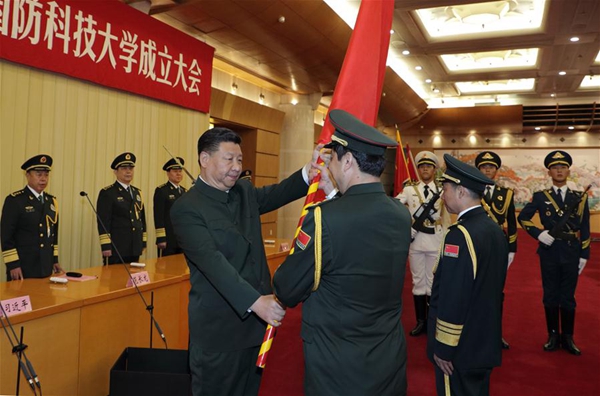
Chinese President Xi Jinping, also general secretary of the Communist Party of China (CPC) Central Committee and chairman of the Central Military Commission (CMC), presents the heads of the People’s Liberation Army (PLA) Academy of Military Science with the military flag in Beijing, capital of China, July 19, 2017. [Photo/Xinhua]

Chinese President Xi Jinping has called on the country’s major military research and educational institutions to cultivate more talent for the armed forces, and to build world-class military research and educational institutions.

Xi, also general secretary of the Communist Party of China (CPC) Central Committee and chairman of the Central Military Commission (CMC), made the remarks while addressing heads of major military research and educational institutions Wednesday.

After presenting the heads of the three institutions with the military flag at a ceremony that marked the reshuffling of the institutions, Xi called the reshuffling a vital decision made by the CPC Central Committee and the CMC to realize the Chinese Dream and build a stronger army.

In order to build a world-leading first-class military research institution, the People’s Liberation Army (PLA) Academy of Military Science, as the leading force of scientific research in the military, should meet the new demands of military research and further combine military theories and technologies, he continued.

Xi further stressed that the National Defense University of the PLA is a significant base to cultivate talent for joint operations as well as PLA officers, and should push forward innovation in its education, research and management to become a top comprehensive college on unified command.

As for the National University of Defense Technology, it must follow the worldwide trends of the development of military science, and work harder to make key technological breakthroughs, in order to build a world-class institution of higher education, according to Xi.

Also on Wednesday, Xi attended a symposium with the current chief officers of military education, research and training institutions.

“It takes first-class military talent, theory, and science and technology to build the PLA into a world-leading military,” Xi said.

“Science and technology is the core fighting capacity in modern warfare,” he noted.

China must make greater efforts to build stronger armed forces and boost fighting capability through science and technology innovations to gain a competitive initiative, Xi said, stressing military education, research and training institutions must assume this responsibility.

Xi ordered the chief officers to stick to the correct political direction by safeguarding the authority and the centralized and unified leadership of the CPC Central Committee, conforming to the CPC Central Committee, and upholding CPC’s absolute leadership over the military.

In addition, he stressed efforts to ensure implementation of reform tasks, and improve capability and innovation in fostering military expertise and scientific research.

The president also urged the institutions to cultivate good work and fighting styles, be strict with their education and training, and promote the spirit of science and dedication.

The Chinese military authority has just reshuffled its military education institutions as part of an ongoing military reform in recent years to build a stronger military and boost real-combat capability.

As a result, there are now 43 military education institutions, including two — the National Defense University of PLA and the National University of Defense Technology — directly under the CMC, 35 specialized in specific armed services, and six of armed police forces.
Sleeping capsules shut down over fire risk

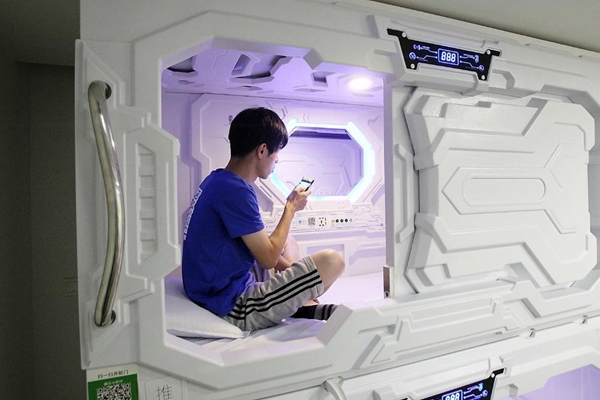
A man is sitting at a sleeping capsule in Beijing. [File photo]

Authorities in Shanghai have shut down newly opened sleeping capsules in office buildings, citing fire hazards and other reasons.

Similar to capsule hotels in Japan, the sleeping capsules showed up in three office buildings in Shanghai and in buildings in several other cities. They are designed to offer white-collar workers a space to take a break, day or night.

The clampdown in Shanghai came after suspensions of the service in Beijing and Chengdu, Sichuan province.

“Sleeping capsules are usually in a narrow space, where injuries or even death can easily result if a fire breaks out,” said Li Min, an engineer in the firefighting division of Pudong New Area who helped inspect capsules in the New Shanghai International Tower on Monday.

“Smoke and poison gases can gather faster in these spaces. Sitting or lying down on the bed in the capsule could result in a relatively slow response to an emergency,” she said. “It contributes to the difficulty of a fire evacuation.”

Shanghai police also said the service was suspended because it did not get permission from fire departments or a license to run a hotel.

The capsules, developed by Beijing tech company Xiangshui Space, are equipped with electrical accessories including a lamp, fan and power sockets. People can get disposable bedding free, including sheets, pillowcases and blankets. Earplugs are also available.

Anyone can pay for a capsule by scanning its QR code. The capsules in Shanghai offer 24-hour service at 10 yuan (US$1.50) for every half-hour during peak hours (11 a.m. to 2 p.m.) and 6 yuan per half-hour at other times. The upper limit is 58 yuan per day.

Xiangshui Space’s website was out of service on Wednesday, citing “system upgrading”.

CEO Dai Jiangong told Beijing News on Wednesday that the company was “recalling” its products for an upgrade at the request of authorities in different cities. He was also quoted as saying that the company was not penalized.

The capsules were introduced as the sharing economy has boomed in China through products such as bicycles, umbrellas, chargers, cars and even basketballs.

In the case of the sleeping capsules, many netizens expressed concerns about hygiene, not fire hazards.

“I don’t think it would meet health standards if no one tidied it up after it was used,” one netizen wrote.

Another wrote, “High quality management is the prerequisite for the sharing business.”

Chinese cities see fewer ‘good air’ days in H1

Chinese cities have reported fewer days with “good air” in the first half (H1) of 2017, with the Beijing-Tianjin-Hebei area suffering from higher density of key pollutants, official data showed.

The 338 cities monitored by the Ministry of Environmental Protection (MEP) enjoyed good or excellent air quality on 74.1 percent of the days in H1, down 2.6 percentage points year on year, according to Liu Zhiquan, head of the environmental monitoring department at the MEP.

During the same period, the density of hazardous fine particle matter PM2.5 remained unchanged from a year ago while the density of PM 10 was down 2.2 percent.

Air quality in 13 cities in the Beijing-Tianjin-Hebei area was rated good or excellent on 50.7 percent of the days in H1, down 7.1 percentage points year on year. In June, the ratio was only 34.1 percent, 14.2 percentage points lower than a year ago.

The density of PM2.5 and PM10 in these regions also climbed 14.3 percent and 13.2 percent, respectively, indicating worsened air quality.

Of the country’s 74 major cities, Haikou in southern China’s Hainan Province had the best air quality while Handan in northern China’s Hebei Province was the most polluted, MEP data showed.

The worsened air quality came despite the government’s strengthened oversight of environmental violations.

In H1, China investigated and dealt with 17,169 violations of environmental protection laws and regulations, previous MEP data showed.

Over 610 million yuan (about 90.44 million U.S. dollars) in fines were issued in 503 cases where violators must pay daily fines until they address their wrongdoings, up 131 percent and 64 percent year on year respectively