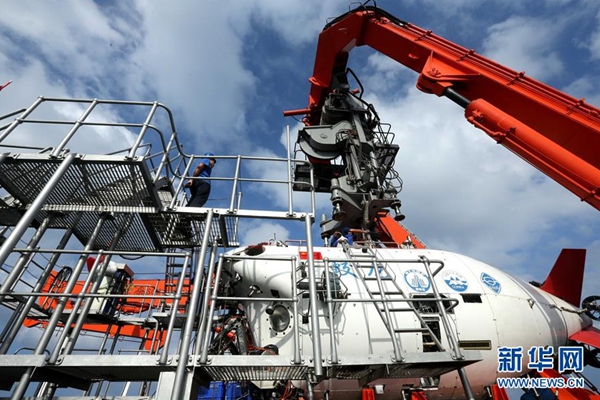
Submersible Jiaolong completes 4th dive in S. China Sea

image_pdfimage_print

Chinese submersible Jiaolong completed four dives in the South China Sea within five days. [Photo/Xinhua]

Jiaolong, China’s manned submersible, conducted its fourth dive Sunday around the Zhenbei Seamount in the South China Sea.

Jiaolong stayed underwater for eight hours in its fourth dive in the second stage of China’s 38th ocean scientific expedition, which will last until May 13, authorities said Monday.

The maximum depth of the dive was 1,101 meters beneath the sea surface, where it retrieved a number of basalt samples.

In the meantime, it collected a 0.7-kilogram sample of foraminifer grit at the depth of 630 meters, and brought back samples of sediments and seawater near the seabed as well as high-definition photos and video footages.

“We have also caught sight of corals, sea lilies, anemones, and large fishes like sharks above 420 meters,” said Yang Gang, a senior engineer on board the submersible. Yang said that the new discoveries could shed new light on the study of the South China Sea’s formation and evolution, biodiversity, and the cause of the seamount chain in the area.

Instead of using trawling as a sampling method, Jiaolong is able to conduct refined sampling mission and obtain ample samples, said Shi Xuefa, a researcher with the State Oceanic Administration.

Jiaolong has completed four dives in the South China Sea within five days. The submersible has went through full maintenance on Monday, including its propelling and electrical systems.

“The 38th ocean scientific expedition will be the furthest and longest voyage for Jiaolong in terms of distance and time,” said Wu Changbin, general commander of the second stage of the expedition. “Jiaolong will also complete the largest number of tasks since its operation.”

The 38th oceanic scientific expedition started on Feb. 6. Jiaolong completed a dive in the northwestern Indian Ocean earlier this year in the mission’s first stage. It will also conduct surveys in the Yap Trench and the Mariana Trench in the third stage.

Named after a mythical dragon, Jiaolong reached its deepest depth of 7,062 meters in the Mariana Trench in June 2012.

Drones will help Xinjiang fight terror

image_pdfimage_print

Border guards in the Xinjiang Uygur antonomous region direct a drone to patrol border areas in the region recently.

The Xinjiang Uygur autonomous region plans to deploy drones to patrol its borders as it further tightens security this year, a senior official said.

“Xinjiang will deploy drones, set up barbed wire and install surveillance cameras along the border to prevent people crossing the border illegally,” Jerla Isamudin, deputy chairman of the region, said in an interview. Xinjiang needs to further enhance cooperation in exchanging terrorism-related intelligence with neighboring countries, he said.

The region has been working on connecting People’s Liberation Army border control units to the power grids since 2014 to provide an efficient electrical supply to high-tech equipment. In 2017, 29 more frontier defense companies in Xinjiang will have electricity and will not have to rely on unstable solar energy and diesel generators, PLA Daily reported in March.

Northwest China’s Xinjiang neighbors eight countries, including Pakistan and Afghanistan, and it has a border of more than 5,600 kilometers. It has been China’s main battleground in the fight against terrorism.

Many terrorists who carried out attacks in the region in recent years received training abroad and then entered illegally, and some also fled across the border, according to the regional police authority. Chinese authorities believe the penetration of religious extremism from abroad has prompted people to carry out violent attacks in Xinjiang and other parts of the country in recent years.

Shohrat Zakir, the region’s chairman, said in January that Xinjiang would impose tighter entry-exit measures in 2017.

In 2016, the regional legislature passed a regulation on border control, which took effect in December. The regulation requires people living along border areas to report strangers to public security authorities within 24 hours. Also, those who damage surveillance equipment along the borders will be punished in accordance with the regulation.

Nayim Yassen, director of the Xinjiang People’s Congress Standing Committee, the regional legislature, said the committee will examine the works on border control and give suggestions for improvements later this year. Xinjiang sees keeping the region stable as a priority.

Chen Quanguo, the region’s Party chief, has said the local security situation is an important index in evaluating officials.

BCC election manifesto: Brexit and Beyond

image_pdfimage_print

The British Chambers of Commerce (BCC) has today (Tuesday) launched ‘Brexit and Beyond’, the Chamber Network manifesto for General Election 2017.

The Chamber manifesto calls for the new government, which will be responsible for negotiating the terms of the UK’s departure from the European Union, to provide business communities with clear answers to the pragmatic and practical questions around how Brexit will affect their day-to-day operations, including hiring, customs procedures and regulation.

However, business communities across the UK send a very strong message that the election cannot – and must not – be about Brexit alone.

The next government must deliver a bold and clear strategy to support economic growth across all regions and nations of the UK. Action is needed on a range of domestic fronts, including improving the competitiveness of the UK’s business environment, upgrading physical and digital infrastructure across the country, and supporting local growth.

Chamber business communities across the UK will judge the next government against five key criteria:

  • Business Environment – deliver a globally competitive business environment. Ensure the best business environment possible with a relentless drive to improve the skills set of tomorrow’s workforce, without clobbering firms with ever-higher upfront costs.
  • Local Growth – unlock the potential of local business communities. Deliver clarity on future devolution deals – ensuring a strong local business community voice and maintain the place-based focus of the Industrial Strategy to ensure growth across the whole of the UK.
  • Infrastructure – revolutionise the UK’s physical and digital infrastructure. Ensure that the whole of the UK has access to super-fast broadband, better mobile connectivity, and delivering investments in the strategic schemes that will unlock the economic potential of the regions and nations.
  • Trade – support UK exporters to drive economic growth. Expand trade support programmes, secure continued access to existing Free Trade Agreements, develop trade policy with business, and leverage Chambers of Commerce, which are best placed to provide stable export support in all regions of the UK.
  • Brexit – work with businesses to secure the best possible deal with the EU. Protect the status of EU nationals in the UK, develop future customs procedures in partnership with business, create a future UK immigration system that is responsive to economic needs and skills shortages at all levels, and ensure that there is no hard border between Northern Ireland and the Republic of Ireland.

Dr Adam Marshall, Director General of the British Chambers of Commerce, said:

“While businesses all across the UK want a good Brexit deal, they are very clear that decisions taken here at home matter as much – if not more – to our future growth prospects.  The best possible Brexit deal won’t be worth the paper it’s written on if firms cannot recruit and train the right people, get decent digital connectivity, or get their goods to their market.

“At this election, business communities want a clear commitment from all parties to create the best possible conditions for growth, in every region and nation of the UK. Westminster must stop and reverse the relentless increases in the up-front cost of doing business in Britain, and give firms the confidence to drive investment, job growth and exports through the Brexit transition and beyond.”

The Chamber Network’s priorities for the next UK government include:

  • Deliver frictionless future trade arrangements with the EU, and ensure that business continue to benefit from existing Free Trade Agreements (FTAs).
  • No new upfront taxes on businesses for the duration of the next Parliament.
  • Develop a new UK regional funding system with maximum local autonomy, a strong voice for business and focus on economic growth.
  • Deliver promised investment in road and rail infrastructure, and ensure businesses in all parts of the UK have access to world-class digital infrastructure.

Dr Marshall continued:  

“The key to a successful Brexit – and future economic growth – is to do everything to unlock the growth potential in our towns, cities and counties. Implementing an Industrial Strategy which harnesses the power of local areas should be a priority for the new government, alongside a commitment to secure the appropriate support and funding for its implementation.”

Ends


Notes to editors:

The British Chambers of Commerce (BCC) sits at the heart of a powerful network of 52 Accredited Chambers of Commerce across the UK, representing thousands of businesses of all sizes and within all sectors. Our Global Business Network connects exporters with nearly 40 markets around the world. For more information, visit: www.britishchambers.org.uk

Media contacts:

Allan Williams – Senior Press Manager

020 7654 5812 / 07920583381

Orla Hennessy – Press and Communications Officer

020 7654 5813 / 07825746812

Online assessments set to replace paper for national reading and numeracy tests

image_pdfimage_print

National reading and numeracy tests in Welsh schools are set to replace paper with innovative online assessments that adapt to a pupil’s abilities, Education Secretary Kirsty Williams announced today (Tues 2nd May).

Monday 01 May 2017

Currently the tests, taken by all pupils in years two to nine, are carried out on paper.  They aim to find out about pupils’ reading and numeracy skills in order to identify what each child needs to focus upon to progress.

The paper tests will be replaced with new personalised assessments to be taken online that have been specifically designed for use in Wales. The new assessments will automatically adjust the level of the questions to match the individual taking the test, providing an appropriate level of challenge for each learner.  

The change to online tests will reduce marking time and administration.

Benefits include:

  • Assessments tailored to individual pupils.
  • More detailed information on a child’s performance.
  • A reduction in feedback times to teachers and learners.
  • Schools will be able to test classes, small groups or individuals according to their facilities and at a time that works for them and their learners.
The new tests will be phased in over three years, starting from the 2018/19 academic year.

Kirsty Williams said:

“These tests are about raising standards by showing the next steps that children need to take in their learning. The move to online personalised assessments for reading and numeracy will benefit pupils, parents and teachers.

“Pupils will be taking assessments that will adapt to their needs and skills. They will have the benefits of automatic marking and schools will have feedback faster than before, giving them a better picture of how they can help all their learners to move on.

“This approach is tailor made for Wales. It shows how we are investing in our schools to continue our national mission of education reform to drive up standards and make sure every pupil in Wales, whatever their background, has the opportunity to fulfil their potential.”


May 2017
M T W T F S S
<< Apr    
1 2 3 4 5 6 7
8 9 10 11 12 13 14
15 16 17 18 19 20 21
22 23 24 25 26 27 28
29 30 31        

Syria: UN concerned over worsening security, humanitarian situation in Damascus suburbs

image_pdfimage_print

1 May 2017 – The United Nations today said that it remains deeply concerned by the deteriorating security and humanitarian situation in the eastern part of Syria’s Ghouta, where some 400,000 people are trapped.

“The UN has not reached any part of eastern Ghouta since October last year,” said Stéphane Dujarric, Spokesman for the Secretary-General, in the daily briefing at UN Headquarters in New York.

He said that the UN stands ready to immediately deliver life-saving assistance to those in need of assistance in eastern Ghouta, located in the suburbs of Damascus, should the pause be established and abided by all parties to the conflict.

The spokesperson said the UN remains concerned about reports of intensified fighting among non-State armed groups in the enclave over the past few days.

With commercial and humanitarian supplies continue to be blocked, prices of basic staple goods have gone up significantly, he said, noting that civilian infrastructure, including medical facilities and schools, continue to be affected by the tight restrictions and reports of shelling, airstrikes, and ground fighting.

Mr. Dujarric also announced that UN World Food Programme (WFP) Executive Director David Beasley is visiting Lebanon and Syria through 3 May – his first visit since taking office last month. Mr. Beasley is expected to meet Syrians affected by the ongoing crisis to witness the profound humanitarian crisis first-hand.