BCC: Anaemic economic growth reinforces case for action on business environment

Today the BCC releases its Economic Forecast for Q2 2017.

26 June 2017 

The British Chambers of Commerce (BCC) has today slightly upgraded its UK growth forecast for 2017 from 1.4% to 1.5%. Its expectations for growth in 2018 and 2019 remain unchanged at 1.3% and 1.5% respectively.

Despite the slight upgrade to our outlook for 2017, growth over the next few years is forecast to remainanaemic – and well below historical averages.

Despite slower than expected growth in Q1 2017, the leading business group has slightly upgraded its growth forecast for 2017 as a whole – mainly as a result of stronger global outlook growth, including in key markets for UK businesses. While lower sterling has had mixed results of late, it remains likely to boost short-term export activity this year.

Rising inflation is anticipated to remain a key concern for businesses and consumers, and is forecast to peak at 3.4% this year – a five year high. Our new forecast is that the first increase in UK official interest rates, to 0.5%, will occur in Q1 2018. This is three quarters earlier than predicted in our Q1 forecast.

With inflation rising and average earnings growth is expected to hold steady, wage growth in real terms is expected to remain negative over the next few years. As a consequence, consumer spending, a key driver of UK growth, is forecast to remain persistently weak over the next few years.     

Economic growth is expected to remain well below historical averages through the forecast period, which reinforces the need to focus on creating the conditions for growth in the UK economy. Following an inconclusive General Election, the Chamber Network is calling for a cross-party focus on supporting business in all parts of the United Kingdom over the crucial months and years ahead.

Key points in the forecast:

  • UK GDP growth forecast for 2017 is upgraded to 1.5% and is expected to slow to 1.3% in 2018, before rising to 1.5% in 2019. GDP Growth of 0.4% expected in Q2 2017
  • GDP growth forecast for 2018 remains unchanged at 1.3%, and for 2019 at 1.5%
  • Inflation of 2.9% is forecast for this year, peaking at 3.4% in Q4 2017. Inflation is expected to slow to 2.8% in 2018 and 2.5% in 2019. The previous forecasts were for 2.4%, 2.7% and 2.5% respectively
  • First increase in official interest rates, to 0.5%, is expected in Q1 2018 –  earlier than the prediction of Q4 2018 in our previous forecast
  • Consumer spending growth has been downgraded for 2017 from 1.6% to 1.3%, and is expected to slow to 0.9% in 2018 and 1.2% in 2019 as real wages are eroded by inflationary pressures
  • Business investment growth has been revised upward from -0.5% to 0.3% in 2017, driven by a strong first quarter, but we forecast that it will remain muted at 0.5% in 2018 before growing by 1.2% in 2019
  • Export growth for 2017 has been upgraded from 2.7% to 3.1% but is forecast to slow to 2.9% in 2018 and 2.8% in 2019
  • Looking at sectors, construction has been upgraded from 0.4% to 1.1% in 2017 and is expected to grow by 0.7% in 2018 and 1.2% in 2019. The services sector is expected to grow by 1.7% in 2017, 1.3% in 2018 and 1.6% in 2019. Manufacturing is to grow by 1.2%, 0.6% and 1.2% respectively

Dr Adam Marshall, Director General of the British Chambers of Commerce, said:

“Over recent months, many of the businesses I speak to have expressed cautious optimism for their own prospects, but remain wary about the growth prospects of the UK economy as a whole.

“In the wake of an inconclusive General Election, that wariness is set to increase – as is the sense that the UK economy is merely treading water. With inflationary pressures expected to intensify and consumer spending forecast to slow, this outlook is likely to persist in the near term.

“While the recent election campaign had almost no focus on supporting business, action to boost business confidence and growth remains urgent. A cross-party consensus must be sought in Westminster in order to create a UK business environment that supports sustained growth and job creation, even as the new government works to secure the best possible Brexit deal with the EU.

“The cost of doing business in the UK is too high – and weighs on the investment, recruitment and growth capabilities of our firms. Companies are faced with significant currency fluctuations and rising upfront costs, and their growth efforts are hampered by skills shortages and poor physical and digital connectivity. Westminster must come together to tackle these issues, which together with a pragmatic and economy-focused Brexit deal, will give business communities the best opportunity to foster lasting growth across the UK.”

Suren Thiru, Head of Economics at the BCC, said:

“While we have slightly upgraded our outlook for 2017, our current forecast points to several years of subdued activity in the UK economy, with economic growth under-performing its historic average. Higher inflation is likely weigh significantly on the UK’s near-term growth prospects. We expect inflation to rise further over the course of this year as the rising cost of imported raw materials continues to filter through supply chains.

“Consumer spending, a key driver of UK economic growth, is expected to slow considerably as inflation erodes real wages. Business investment is likely to remain relatively subdued as rising inflation and the escalating burden of upfront business costs weigh on investment intentions. On the upside, 2017 may prove the sweet spot for exporters as they are boosted by the persistent weakness in the value of sterling and an improving outlook for the global economy.

“Although the UK’s growth prospects over the long-term remain highly uncertain, the risks are shifting to the downside. Increased uncertainty in the aftermath of the General Election and around the Brexit negotiations could result in more muted growth.

“An earlier than required tightening in monetary policy could destabilise consumer and business confidence and push UK growth materially lower, particularly during this period of political instability. While interest rates need to rise at some point, it should be done slowly and steadily so as not to harm the UK’s growth prospects.”

Ends

Notes to editors:

The British Chambers of Commerce (BCC) sits at the heart of a powerful network of 52 Accredited Chambers of Commerce across the UK, representing thousands of businesses of all sizes and within all sectors. Our Global Business Network connects exporters with nearly 40 markets around the world. For more information, visit: www.britishchambers.org.uk

Media contacts:

Allan Williams – Senior Press Manager

020 7654 5812 / 07920583381

Orla Hennessy – Press and Communications Officer

020 7654 5813 / 07825746812

Press release: CMA helps microbusinesses combat energy overpricing

During its 2-year investigation into the energy market, the Competition and Markets Authority (CMA) found that about 45% of microbusinesses across Great Britain were stuck on their supplier’s expensive ‘default’ tariffs. The study concluded that it was difficult for owners to shop around and switch to cheaper deals, as energy price information was not easily available. In some cases, microbusinesses also found themselves being ‘rolled over’ onto these contracts, with limited opportunities to switch, when their original deal ended. It is hoped these remedies will help microbusinesses save up to £180 million a year.

The CMA ordered suppliers to stop locking these small firms into automatic rollover contracts and make it easier for microbusinesses to compare the cheapest energy prices, by making information clearly available on their website, or via a link to a price comparison website. They were given until today to make these changes, and from now on are required to comply with these requirements.

Roger Witcomb, Chairman of the Energy Market Investigation, said:

Small businesses rely on keeping overheads down to survive, so to find that nearly half of the microbusinesses across the country were on pricey default deals was worrying.

That’s why the CMA ordered energy suppliers to stop automatically rolling small business customers onto fixed-term tariffs and to help their customers more easily find information on the deals available. These, alongside 30 other measures resulting from the investigation, will help energy customers make sure they are on the most competitive deal in future.

Dermot Nolan, Ofgem Chief Executive, said:

The requirement on suppliers to clearly display their prices online to microbusinesses will make it much easier for these businesses to compare prices and shop around. This is a big change in the way the market works. Microbusinesses will also be able to leave more expensive auto-rollover default tariffs without paying an exit fee, freeing them to switch to a better deal.

We’ll be working closely with suppliers to make sure they give microbusinesses clear information on the prices they offer in line with the regulation. We are considering what further steps could be taken to protect and help these businesses customers engage in the market as part of our wider programme to make sure all consumers – business and domestic – get a better deal.

Mike Cherry, National Chairman at the Federation of Small Businesses (FSB), said:

For too long, many small businesses have had a raw deal in the energy market. These CMA remedies are a step in the right direction. Published prices and a ban on unfair auto-rollover terms should bring some much-needed fairness and transparency to the energy market for microbusinesses.

Mike Spicer, Director of Economics at the British Chambers of Commerce (BCC), said:

Energy is a major cost for many companies so it’s important they understand what flexibility there is when it comes to managing these expenses. Businesses, like residential users, can save significant amounts by testing the market for their energy. The remedies announced by the CMA, particularly the halt on automatically rolling companies onto fixed-term tariffs will help ensure that fewer are paying more than they should.

In June 2016 the CMA published its full report following a comprehensive investigation of the energy market. As well as identifying that householders could save around £300 a year if they moved to the best available deal, it also found a disparity with the way suppliers treated business customers.

Energy suppliers only published a full list of available tariffs for domestic customers, so it was more difficult for microbusinesses to compare and switch energy deals than for households. Automatic rollover clauses meant that if a fixed-term contract was not terminated or renegotiated before its end date, then some contracts would automatically continue, often at a higher tariff and with termination fees and no-exit clauses that made it expensive to switch.

Taken together the CMA’s measures will not only drive down bills, they will also make it easier for microbusinesses to switch suppliers once their initial contract has ended. Microbusinesses will only need to add 2 relevant pieces of information, their post code and rate of consumption, to get a personalised quote.

The order and all other information published in relation to the investigation are available on the energy market investigation case page. A short overview of the investigation is also available, along with a summary of the changes for microbusinesses.

Notes for editors

  1. The CMA is the UK’s primary competition and consumer authority. It is an independent non-ministerial government department with responsibility for carrying out investigations into mergers, markets and the regulated industries and enforcing competition and consumer law.

  2. Roger Witcomb recently delivered a speech setting out progress in implementing the investigation’s remedies, one year on.

  3. For more information on the CMA see our homepage, or follow us on Twitter @CMAgovuk, Flickr, LinkedIn and like our Facebook page. Sign up to our email alerts to receive updates on markets cases.

  4. Media enquiries should be directed to Beatrice Cole (beatrice.cole@cma.gsi.gov.uk, 020 3738 6472 or 07774 134 814).

State aid: How the EU rules apply to banks with a capital shortfall – Factsheet

1. How can banks address capital shortfalls in line with EU state-aid rules?

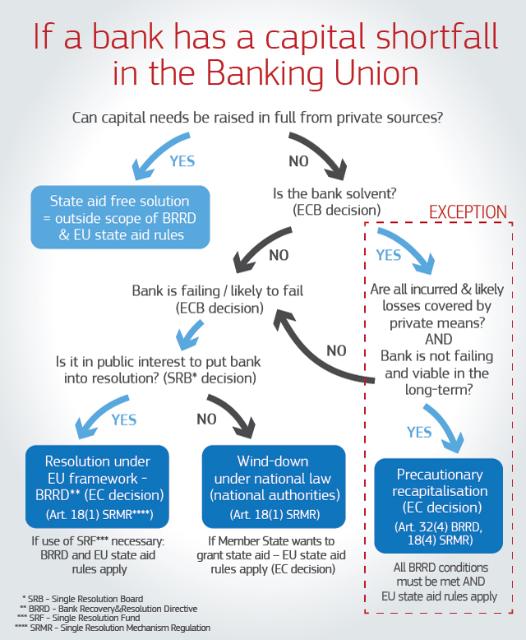
If a bank needs capital, it does not necessarily mean that it is failing or about to fail. There may be a number of options for banks to address their capital shortfall without triggering resolution and in line with EU state aid rules. Whether an option is available in a specific case depends in particular on the bank’s financial position, the market interest, decisions by the Member State concerned as well as by responsible supervisory and resolution authorities

a) A bank can raise capital on the market or from other private sources. This falls outside the scope of the EU bank resolution framework and state aid control.

For example, in February 2017, shareholders of the Italian bank UniCredit approved a recapitalisation of €13 billion from private sources.

b) A Member State can decide to intervene in line with market conditions. This also falls outside the scope of the EU bank resolution framework and state aid control. A state intervention is in line with market conditions if a private economic investor would carry it out on the same terms.

For example, thePortuguese recapitalisation of the fully state-owned bank Caixa Geral de Depósitos in March 2017 was carried out on market terms and therefore did not involve state aid in favour of the bank.

c) The EU bank resolution framework[1] also foresees the exceptional possibility of a precautionary recapitalisation, which allows the use of public funding subject to strict conditions and in compliance with state-aid rules. For example, in 2015 the Commission approved Greece’s precautionary recapitalisation of two Greek banks, Piraeus Bank and National Bank of Greece, under EU rules. The Commission has also reached an agreement in principle with Italian authorities to enable a precautionary recapitalisation of Italian Monte dei Paschi di Siena in June 2017.

(See more details under Question 2.)

However, the responsible supervisor, i.e. the European Central Bank (ECB) in the Banking Union, will declare a bank failing or likely to fail when it infringes or is likely to either i) infringe the requirements for continuing authorisation, ii) when the assets of the bank are or are likely in the near future to be less than its liabilities, iii) when the bank is or is likely in the near future to be unable to pay its debts as they fall due, or iv) when the bank needs public support unless special conditions are met such as for precautionary recapitalisation (Article 32(4) of the BRRD).

If the ECB declares a bank failing or likely to fail, the responsible resolution authority, i.e. the Single Resolution Board (SRB) in the Banking Union has to decide whether it is in the public interest to put the bank into resolution via the Single Resolution Mechanism (for example, the resolution of the Spanish Banco Popular in June 2017), or whether a bank could be wound down under national insolvency law (for example, the liquidation of Italian Banco Popolare di Vicenza and Banca Veneta in June 2017 and Italian Banca Romagna in July 2015). Here, resolution should be the exception to the rule of national insolvency and the question of whether there is a public interest in applying that exception will be determined by the SRB with respect to the question whether certain resolution objectives set out in Banking Union rules can be fulfilled better in resolution than in national insolvency.

(See more details under Question 3.)

2. What are the conditions of a precautionary recapitalisation?

For banks that are solvent and not failing or likely to fail, the BRRD contains the possibility of providing State aid. This is called precautionary recapitalisation. It is subject to strict conditions under the EU banking framework, respectively, to ensure that the aid is indeed provided on a precautionary basis, and conditional on final approval under EU State rules.

The EU banking framework requires that State aid in this context can only be granted as a precaution (to prepare for possible capital needs of a bank that would materialise if economic conditions were to worsen significantly) and is therefore reserved for banks that are solvent and not failing or likely to fail. The option of precautionary recapitalisations for solvent banks under the EU banking framework was agreed between co-legislators in the European Parliament and the Council to have strict conditions.

The main conditions for a precautionary recapitalisation are:

  1. the ECB needs to declare that the bank is solvent;

  2. the State support shall not be used to offset losses that the institution has incurred or is likely to incur in the future,

  3. the State support is temporary (i.e. the State should be able to recover the aid in the short to medium term), and

  4. the State support has received final approval under EU State aid rules.

In particular, the State aid crisis rules on banking (2013 Banking Communication) require that:

  1. the use of taxpayer money is limited through appropriate burden-sharing measures (shareholders and subordinated debt holders contribute). Depositors and senior creditors are not required to contribute under State aid rules,

  2. a credible and effective restructuring plan to ensure the bank is viable in the long-term without further need for State support,

  3. distortions of competition are limited through proportionate remedies.

3. What happens if a bank is failing / likely to fail?

If the responsible supervisor declares a bank failing or likely to fail, it is for the responsible resolution authority to decide whether it is in the public interestto put a bank into resolution.

Resolution under the Single Resolution Mechanism

In the Banking Union, if the SRB considers that it is in the public interest, based on the resolution objectives, the bank is put into resolution in line with the Single Resolution Mechanism Regulation (SRMR).

Resolution measures taken by the SRB require a resolution decision by the Commission under the SRMR.

The SRMR requires that the bank’s losses will have to be covered by the bail-in of shareholders and creditors (at least 8% of the bank’s liabilities) before the Single Resolution Fund can be accessed. This may also require bailing-in senior debt and, where necessary, uncovered deposits. 

If the Single Resolution Fund is used, the Commission will also have to make an assessment to authorise its use under EU State aid rules (just as it would for interventions of National Resolution Funds of Member States that do not participate in the Banking Union).

National insolvency law

If the SRB considers that resolution action is not warranted in the public interest, EU law stipulates that the bank is wound down in line with national insolvency law. It is the responsibility of the national authorities to apply national insolvency law.

If the Member State considers it necessary to grant State aid in the context of such national insolvency proceedings, it has to notify such measures to the Commission under EU State aid rules. Burden-sharing requirements apply, i.e. shareholders and holders of subordinated instruments have to contribute in full to the cost of the measures. Depositors and senior creditors are not required to contribute.
 infographic

4. Why do EU rules allow state aid to banks in liquidation?

While the winding up of smaller banks may not affect the European financial system, their market exit may still have effects in the regions where such banks are most active. Therefore, outside the European banking resolution framework, it is for Member States to decide whether they consider a bank exit to have a serious impact on the regional economy, e.g. on the financing of small and medium enterprises in the regional economy, and whether they wish to use national funds to mitigate these effects. EU state aid rules, in particular the 2013 Banking Communication, foresee this possibility, subject, amongst other things, to burden-sharing rules and clear commitments that the entities effectively exit the market to ensure that competition distortions are minimised. 

5. What are the conditions that need to be met for state aid to banks in liquidation to be approved?

It is the responsibility of the national authorities to apply national insolvency law and to decide, where a possibility for a sale of the bank’s activities is foreseen in the law, whether to make use of it. Should the national authorities envisage to grant public support to such an operation under insolvency law, EU State aid rules require that the cost be reduced by a sales process that is competitive, open and fair, to make sure that the activities are sold to the best bid available so that there is no aid to the buyer. They also require burden-sharing of shareholders and junior creditors.

Winding up a failing bank protects the healthy competitors in the market; therefore if a Member State would deem State aid necessary to facilitate the liquidation of a bank by a sale of assets and liabilities, these activities should be restructured and downsized by the buyer to ensure that distortions to competition from the aid are limited.

6. What is the role of the Commission and other institutions?

The European Commission does not supervise banks or take decisions on how to recapitalise banks. In the Banking Union, this is the role of responsible national authorities and/or the ECB and the SRB. The Commission applies EU rules in a consistent and equal manner, irrespective of the Member States and the banks involved. In applying EU rules, the Commission’s objective is to ensure fair competition between banks in the EU’s Single Market.

In the Banking Union:

  • Whether a bank is in need of regulatory capital, is the assessment of the ECB. Such an assessment may be made on the basis of an asset quality review and/or a stress test.

  • Whether a bank is failing or likely to fail is the decision of the ECB and the SRB.

  • If a bank is declared failing or likely to fail, it is the decision of the SRB whether resolution action is warranted in the public interest, or whether a failing bank can be put into insolvency proceedings.

  • In case the SRB considers it to be in the public interest, it will then put the bank in resolution and determine the resolution strategy and the tools according to the resolution objectives. It is also for the SRB to decide whether the use of the Single Resolution Fund (SRF) is necessary.

  • The Commission has to endorse the SRB’s resolution scheme under EU banking resolution framework, and in case the SRF is accessed, the Commission needs to authorise it under EU State aid rules.

  • In case a failing bank is put into insolvency under national rules, this proceeds according to the national legal order.

  • Whenever aid is notified by the competent authorities in any of these circumstances, the Commission’s mandate is to verify that the planned state intervention comply with EU rules, in particular the SRMR / BRRD and EU state aid rules.

Outside the Banking Union the same rules apply but are enforced by national counterparts.

7. What about retail investors who were mis-sold?

Retail investors should be adequately informed about potential risks when they decide to invest in a financial instrument (as required under the EU Markets in Financial Instruments Directive (MiFID 1) and implemented into national law). If a bank fails to do so, in principle, the responsibility of addressing the consequences of mis-selling lies with the bank itself. Such compensation is an entirely separate consideration to burden-sharing under EU State aid rules. 

There are different ways to allow retail investors who have been mis-sold to be compensated. This is a decision for the responsible national authorities and/or the bank to take.

In situations where banks that have mis-sold financial instruments have left the market, it is up to Member States to decide whether to take exceptional measures to address social consequences of mis-selling as a matter of social policy. This falls outside the remit of State Aid rules.

For example, Italy set up a scheme to compensate retail investors who were victims of mis-selling of junior bonds by four Italian banks that were resolved in November 2015 (Banca delle Marche, Banca Popolare dell’Etruria e del Lazio, Cassa di Risparmio di Ferrara and Cassa di Risparmio della Provincia di Chieti).

8. How did EU rules for state aid to banks evolve?

The applicable EU rules were updated a number of times, in consultation with all EU Member States and the European Parliament, to adapt to the evolution of the financial crisis and reflect the lessons learnt. The rules in force on State aid to banks are based on an exceptional rule of the Treaty, 107(3)(b). As set out in point 93 of the 2013 Banking Communication, the Commission will review the Communication as deemed appropriate, in particular so as to cater for changes in market conditions or in the regulatory environment which may affect the rules it sets out.

Depending on when Member States choose to address problems of their banks and to come forward with solutions to restore their viability, different rules might apply:

The period between 13 October 2008 and 31 July 2013 – Throughout 2008 and 2009, the Commission adopted a comprehensive framework for state aid to the financial sector during the crisis. This included the 2008 Banking Communication and different Communications with specific guidance on recapitalisations, impaired assets and bank restructuring. They were prolonged in 2010 and 2011. Given the great uncertainty about the banks’ problems in the early stages of the financial crisis and the need for quick action, the Commission allowed “rescue aid“. This means that state aid could be approved on a temporary basis. Member States had to submit a restructuring plan for banks receiving rescue aid within six months for final approval by the Commission.

From 1 August 2013 – The Commission adopted a new Banking Communication (see Memo, full text here), which is in force today. It replaces the 2008 Banking Communication and supplements the specific guidance on recapitalisations, impaired assets and bank restructuring. In consultation with the Member States, these rules introduced a more effective restructuring process for aided banks and strengthened burden-sharing requirements, asking shareholders and subordinated debtholders to contribute before aid could be granted. As Member States should be able to anticipate the problems of banks better, state aid can no longer be approved on a temporary basis but only on the basis of an agreed restructuring plan and after all private capital-raising measures have been exhausted.

From 1 January 2015 – The Bank Resolution and Recovery Directive entered into force as part of the EU’s Banking Union. This Directive introduced the default option for failing banks to go into normal insolvency proceedings. Only if the resolution authority decides that it is in the public interest to do so, can a bank be resolved in line with the Bank Resolution and Recovery Directive. The Bank Resolution and Recovery Directive also required that state aid to failing banks notified to the Commission after 1 January 2015 can only be granted if the bank is put into resolution. The only exception is a so-called “precautionary recapitalisation”, allowing state aid outside of resolution in narrowly defined circumstances. EU State aid rules continue to apply in full in parallel.

From 1 January 2016 – The bail-in requirements for banks in resolution under the Bank Resolution and Recovery Directive entered into force in all Member States that had not already implemented them in 2015. This means that in resolution contributions from the Single Resolution Fund can only be made after a bail-in of at least 8% of the bank’s total liabilities. This may also require converting senior debt and uncovered deposits. Any contribution of the Fund is subject to a State Aid Decision by the Commission. EU State aid rules continue to apply in full in parallel.

Under the new rules, the resolution process is managed by a resolution authority – national or the Single Resolution Board for the euro area countries.

[1]         Within the Banking Union, “EU banking framework” refers to the Bank Recovery and Resolution Directive (BRRD) and the Single Resolution Mechanism Regulation (SRMR).

State aid: Commission approves aid for market exit of Banca Popolare di Vicenza and Veneto Banca under Italian insolvency law, involving sale of some parts to Intesa Sanpaolo

This announcement follows the declaration by the European Central Bank (ECB), in its capacity as supervisory authority, of 23 June 2017 that Banca Popolare di Vicenza (BPVI) and Veneto Banca were failing or likely to fail and the decisions by the Single Resolution Board (SRB), the competent resolution authority, that resolution action is not warranted in the public interest in either case. EU law foresees that, in such circumstances, national insolvency rules apply and it is for the responsible national authorities to wind up the institution under national insolvency law. In this context, if Member States consider public support necessary to mitigate the effects of a bank’s market exit, EU State aid rules apply, in particular the 2013 Banking Communication, requiring that shareholders and subordinated bondholders fully contribute to the costs (so-called “burden-sharing”) and competition distortions are limited. Senior bondholders do not have to contribute and depositors remain fully protected in line with EU rules.

Commissioner in charge of competition policy, Margrethe Vestager, said: “Italy considers that State aid is necessary to avoid an economic disturbance in the Veneto region as a result of the liquidation of BPVI and Veneto Banca, who are exiting the market after a long period of serious financial difficulties. The Commission decision allows Italy to take measures tofacilitate the liquidation of the two banks: Italy will support the sale and integration of some activities andthe transfer of employeesto Intesa Sanpaolo. Shareholders and junior creditors have fully contributed, reducing the costs to the Italian State, whilst depositors remain fully protected. These measures will also remove €18 billion in non-performing loans from the Italian banking sector and contribute to its consolidation.“

The SRB has concluded that resolution action is not warranted in the public interest for either BPVI or Veneto Banca, which means that Italian authorities have to wind-down the banks under Italian national insolvency procedures. In this context, Italy has determined that the winding up of these banks has a serious impact on the real economy in the regions where they are most active. Outside the European banking resolution framework, EU rules foresee a possibility for Italy to seek Commission approval for the use of national funds to facilitate the liquidation by mitigating such regional economic effects. As the aided banks exit the market there should be no distortion of competition in European banking markets.

On 24 June 2017, Italy notified to the Commission its plans to grant State aid to wind-down BPVI and Veneto Banca. The measures will enable the sale of parts of the two banks’ activities to Intesa, including the transfer of employees. Italy selected Intesa Sanpaolo (Intesa) as the buyer in an open, fair and transparent sales procedure: The measures will also enable the wind down of the remaining liquidation mass, financed by loans provided by Intesa.

In particular, the Italian State will grant the following measures:

  • Cash injections of about €4.785 billion; and

  • State guarantees of a maximum of about €12 billion, notably on Intesa’s financing of the liquidation mass. The State guarantees would be called upon notably, if the liquidation mass is insufficient to pay back Intesa for its financing of the liquidation mass.

Both guarantees and cash injections are backed up by the Italian State’s senior claims on the assets in the liquidation mass. Correspondingly, the net costs to the Italian State will be much lower than the nominal amounts of the measures provided.

The Commission found these measures to be in line with EU State aid rules, in particular the 2013 Banking Communication. Existing shareholders and subordinated debt holders have fully contributed to the costs, reducing the cost of the intervention for the Italian State. Both aid recipients, BPVI and Banca Veneto, will be wound up in an orderly fashion and exit the market, while the transferred activities will be restructured and significantly downsized by Intesa, which in combination will limit distortions of competition arising from the aid.

The subsequent deep integration by Intesa will return the sold parts to viability. The Commission also confirmed that the measures do not constitute aid to Intesa, because it was selected after an open, fair and transparent sales process, fully managed by Italian authorities, ensuring that the activities were sold at the best offer available.

Background

Banca Popolare di Vicenza is a small Italian commercial bank, located in the Veneto Region, which mainly operates in the north-eastern regions of Italy. As of 31 December 2016, Banca Popolare di Vicenza had around 500 branches and a market share in Italy of around 1% in terms of deposits and around 1.5% in terms of loans. As of December 2016 the bank had total assets of slightly below €35 billion.

Veneto Banca is a small Italian commercial bank, located in the Veneto Region, which mainly operates in the North of the country. As of 31 December 2016, Veneto Banca had around 400 branches and a market share in Italy of around 1% in terms of deposits and in terms of loans. As of December 2016 the bank had €28 billion of total assets.

In March 2017, BPVI and Veneto Banca made requests to the Italian State for a “precautionary recapitalisation” to address their capital shortfalls, which were then subject to discussion between the Commission and the Italian authorities. The EU banking framework [1] foresees that this exceptional possibility is subject to strict conditions, including that the State support is temporary and cannot be used to offset losses that the bank has incurred or is likely to incur in the future. A bank that is declared as failing or likely to fail by the ECB is not eligible for a precautionary recapitalisation.

Both BPVI and Veneto Banca have a very high amount of non-performing loans (37% compared to Italian average of 18%) and high operating costs. They have been loss-making for a number of years. The 2014 ECB comprehensive assessment identified capital shortfalls, following which the two banks were put under monitoring by the ECB. In 2016, the Atlante fund invested approximately €3.5 billion in BPVI and Veneto Banca. However, the financial position of the two banks deteriorated further in 2017, and the measures were insufficient to overcome the long-lasting structural problems. Furthermore, BPVI and Veneto Banca have not yet completed the process of adjusting their balance sheet to the requirements of the BRRD, which are aimed among other things at limiting the impact of resolution or orderly liquidation on the economy.

As a result of their financial difficulties, over the last two years, the banks suffered from continuous outflow of deposits (between June 2015 and March 2017 the banks lost 44% of their deposit base). To stabilise the liquidity situation, Italy requested liquidity support measures in the form of State guarantees, amounting to about €10 billion, approved by the Commission in January 2017 and April 2017.

Procedural Background

Under EU rules, a failing bank should in principle be liquidated under normal insolvency proceedings, except in cases where the SRB considers that there is a public interest in placing the institution under resolution because liquidation under normal insolvency proceedings might jeopardise financial stability, interrupt the provision of critical functions, and affect the protection of depositors (see recital 45 of the BRRD).

If in the context of such national insolvency proceedings, Member States consider public support necessary to mitigate the effects of a bank’s market exit, EU State aid rules apply, in particular the 2013 Banking Communication. These rules are temporary crisis rules, based on an exceptional rule of the Treaty on the Functioning of the European Union, Article 107(3)(b).

The non-confidential version of the decision will be made available under the case number SA.45664 in the State Aid Register on the competition website once any confidentiality issues have been resolved. New publications of state aid decisions on the internet and in the Official Journal are listed in the State Aid Weekly e-News.

[1]         Within the Banking Union, “EU banking framework” refers to the Bank Recovery and Resolution Directive (BRRD) and the Single Resolution Mechanism Regulation (SRMR).

Declarația cu ocazia Zilei Internaționale pentru Sprijinirea Vic

On the International Day in Support of Victims of Torture we call once again to stop torture in all its form and to respond the plight of all those that have been exposed to this terrible and inhumane practice, and of their families and loved ones. Our thoughts also go to all those who engage tirelessly in combatting torture, raising awareness and caring for its victims, sometimes putting their own safety and lives at risk. Listening to the victims of torture makes us understand better how to fight it. 

Torture is unequivocally prohibited under international law, under all circumstances and without exceptions. Still the fight to eradicate it is far from won. The EU’s firm commitment to fight torture and ill-treatment wherever it occurs is enshrined in the Charter of Fundamental Rights and reconfirmed and outlined in the EU Action Plan on Human Rights and Democracy of 2015-2019. To achieve this objective, the EU is actively building coalitions with partners and civil society. Only Last December we marked Human Rights Day organizing the 2016 EU-NGO Human Rights Forum with a focus on preventing, prohibiting, and redressing torture globally. 

Fighting torture is not only about raising awareness, it is about effective action. The EU continues to work towards promoting victims’ right to rehabilitation and to other means of redress; introducing safeguards at all stages of deprivation of freedom, opening up all places where people are detained for monitoring; investigating allegations of torture effectively and independently and bringing perpetrators to justice. The European Instrument for Democracy and Human Rights (EIDHR) is a leading source of funding for rehabilitation of victims and the prevention of torture worldwide. In 2017, it will finance several new civil society projects devoted to the fight against torture and ill-treatment for an overall amount of EUR 13.5 million. 

Today, we also want to express the EU support for the work done by the UN Voluntary Fund for Victims of Torture, by the UN Special Rapporteur and the Council of Europe’s Committee for the Prevention of Torture and urge partners to contribute to their work. The EU promotes the objective of the Convention against Torture Initiative to achieve global ratification and implementation of the UN Convention against torture by 2024, aiming at the full eradication of torture. 

It’s our conviction that respect for fundamental freedoms and rights, promotion of inclusive societies and support to open and vibrant civil societies is the only way to guarantee sustainable stability and security.  The EU will continue to work together with our international and regional partners to make torture a thing of the past and to be at the forefront of the global and united efforts to eradicate torture.