Chinese scientists make quantum leap in computing

image_pdfimage_print

Chinese scientists have built world’s first quantum computing machine that goes beyond the early classical — or conventional — computers, paving the way to the ultimate realization of quantum computing beating classical computers.

Chinese scientists have built world’s first quantum computing machine that goes beyond the early classical computers. [Photo / chinagate.cn]

Scientists announced their achievement at a press conference in the Shanghai Institute for Advanced Studies of University of Science and Technology of China on Wednesday.

Many scientists believe quantum computing could in some ways dwarf the processing power of today’s supercomputers. The manipulation of multi-particle entanglement is the core of quantum computing technology and has been the focus of international competition in quantum computing research.

Recently, Chinese leading quantum physicist Pan Jianwei, an academician of the Chinese Academy of Sciences and his colleagues — Lu Chaoyang and Zhu Xiaobo, of the University of Science and Technology of China, and Wang Haohua, of Zhejiang University — set two international records in quantum control of the maximal numbers of entangled photonic quantum bits and entangled superconducting quantum bits.

Pan said quantum computers could, in principle, solve certain problems faster than classical computers. Despite substantial progress in the past two decades, building quantum machines that can actually outperform classical computers in some specific tasks — an important milestone termed “quantum supremacy” — remains challenging.

In the quest for quantum supremacy, Boson sampling, an intermediate (that is, non-universal) quantum computer model has received considerable attention, as it requires fewer physical resources than building universal optical quantum computers, Pan said.

Last year, Pan and Lu Chaoyang developed the world’s best single photon source based on semiconductor quantum dots. Now, they are using the high-performance single photon source and electronically programmable photonic circuit to build a multi-photon quantum computing prototype to run the Boson sampling task.

The test results show the sampling rate of this prototype is at least 24,000 times faster than international counterparts, according to Pan’s team.

At the same time, the prototype quantum computing machine is 10 to 100 times faster than the first electronic computer, ENIAC, and the first transistor computer, TRADIC, in running the classical algorithm, Pan said.

It is the first quantum computing machine based on single photons that goes beyond the early classical computer, and ultimately paves the way to a quantum computer that can beat classical computers. This achievement was published online in the latest issue of Nature Photonics this week.

Key component of world’s longest cross-sea bridge installed

image_pdfimage_print
Key component of world's longest cross-sea bridge installed

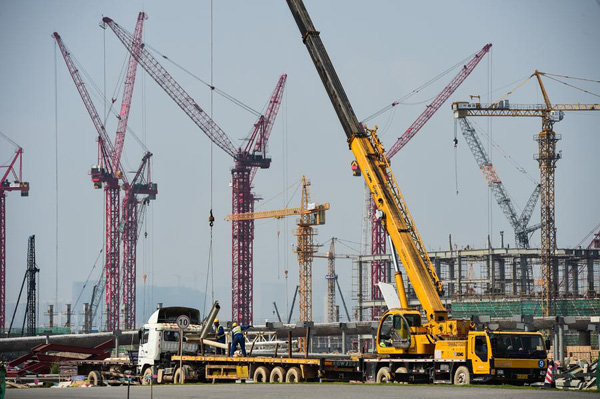
The 55-kilometer bridge connecting Zhuhai in Guangdong province with Hong Kong and Macao is under construction on April 29, 2017. [Photo/Xinhua]

Chinese engineers installed a 6,000-ton key structure of the world’s longest cross-sea bridge linking Hong Kong, Zhuhai and Macao.

The wedge, 12-meter-long and weighing more than 25 Airbus A380 jets, was lowered to connect the immersed tubes of the underground tunnel of the bridge, said Lin Ming, chief engineer of the island and tunnel section of the bridge.

The 55-kilometer bridge connects Zhuhai in Guangdong Province with Hong Kong and Macao. It includes a 22.9-km bridge and 6.7-km underground tunnel.

Before the wedge was installed on Tuesday, 33 immersed tubes, each 180 meters long and weighing 80,000 tons, had been installed.

“There is only one wedge for a tunnel, and we cannot afford to fail in its installation. It took two years to prepare for today,” said Chen Yue, director of the engineers’ office of the bridge’s island and tunnel section. The installation procedure took about six hours.

“The margin of error for the wedge is 1.5 centimeters. We have to measure precisely the influence of wind, current and buoyancy force,” said Lin.

“It is like putting a needle through a hole — a truly unprecedented event in the history of transportation,” Lin said.

A gigantic crane, which was transformed from a tanker, was used to hoist the wedge, lowering it to the desired destination between the underwater tubes.

The wedge will be welded and finished by June, Lin said.

By the end of the year, the bridge will be open to traffic, said Zhu Yongling, director of the bridge management bureau.

Construction began in December of 2009 at Zhuhai. The Y-shaped bridge starts from Lantau Island in Hong Kong with branches to Zhuhai and Macao.

The bridge will cut travel time from Hong Kong to both Zhuhai and Macao from three hours on the road to a 30-minute drive.

New rules will keep patients’ info secret

image_pdfimage_print

A nurse at the China-Japan Friendship Hospital cares for an inpatient. [Photo/China Daily]

As more hospitals mine big data to improve services and tackle illnesses, the central government has vowed to safeguard patients’ personal information with a new regulation on h

Interview with David Koch, Sunrise

image_pdfimage_print

DAVID KOCH:

Prime Minister Malcolm Turnbull joins me now, good to see you.

PRIME MINISTER:

Good to see you, Kochie.

DAVID KOCH:

Sort of a little bit of smoke and mirrors here isn’t it? You’re giving back a bit of what you’ve already cut.

PRIME MINISTER:

No what we’re doing is we’re providing a substantial additional amount of funding. I mean Labor had –

DAVID KOCH:

From what you promised.

PRIME MINISTER:

Well yeah, from what we had previously.

You see what we’re doing is we’re actually fulfilling David Gonski’s vision. David Gonski’s big idea – which the Labor Party did not follow – was that every student, every school student in Australia, should be given Government funding to their school, based on their need and it should be consistent across the states and consistent across government and non-government schools.

Now that’s what we’re delivering.

And you saw, David Gonski was there with us yesterday – he’s welcomed it, he’s supported it.

DAVID KOCH:

But it’s not as much as Gonski originally recommended though is it? It’s less than that.

PRIME MINISTER:

No, hang on, no, that’s not right. Gonski did not recommend a specific amount of money.

What the Labor Party did was they entered into 27 conflicting deals. So you had students in, a same student with the same needs in one state, would get less money than a student in another state.

They created a mishmash of conflicting deals.

That’s why so many people have welcomed what we have come out with today, particularly the independent schools and primary school and state school organisations, parents organisations because they can see the clarity and the equity of what we are delivering.

DAVID KOCH:

Yep.

PRIME MINISTER:

We are delivering consistency and fairness right across the country.

DAVID KOCH:

The experts I talk to say ‘less funding, but way better distributed.’ So it is going to be a better playing field. But, yes, they may have done all these conflicting deals, but New South Wales for example, Rob Stokes, the Education Minister there, saying: ‘I don’t like your plan, I like the old Labor Party one, because I am going to get more!’ He’s talking about taking you to court over this!

PRIME MINISTER:

Well, let me just say this to you-

DAVID KOCH:

And he is a friendly government, a conservative.

PRIME MINISTER:

Look, let’s be clear though, the Labor Party never had the money.

What they proposed, I mean Colin Barnett, who was the West Australian Premier at the time, called it out. He said at the time, it was obvious they didn’t have the money. It was Monopoly money.

What we’re proposing here, what we are setting out is fully funded and you are right, what you’ve been told is right – it is consistent, it is fair.

DAVID KOCH:

Yeah.

PRIME MINISTER:

This is Gonski the vision.

DAVID KOCH:

So rich schools are going to get less? Have you rung your old school Sydney Grammar and said: ‘fellas, I’m going to cut your funding’?

(Laughter)

PRIME MINISTER:

No, just to be clear, there are only about 24 schools, it’s estimated that actually receive less, and not a lot less-

DAVID KOCH:

And they are rich private schools, aren’t they?

PRIME MINISTER:

Yes, that’s right, independent, they’re non-government schools. They will receive less per student, not a lot less, and the reason for that is that the goal is to get everybody being treated equitably and consistently. 

And because of the way Labor handled it, some schools were getting funding well ahead of others, some were behind.

DAVID KOCH:

Yep.

PRIME MINISTER:

It was all over the place.

Now under Labor’s proposed plan – even with the supposed extra money, which was Monopoly money I might add – but even with that it would have taken 150 years to get the consistency and the fairness that Gonski proposed. So we’re delivering that.

Now what David Gonski is doing, the Gonski 2.0 is not about funding, because we believe we’ve got the dollars right – and so does David. What the real question now is, how do we ensure that with all of that money, we get better schools, better teachers and better results?

DAVID KOCH:

And it’s fairer.

PRIME MINISTER:

Yeah and that’s the critical bit. We need to get better outcomes. We owe that to our kids.

DAVID KOCH:

Alright, a couple of quick ones. Victorians aren’t too happy today – the Herald Sun is saying that you and Bill Shorten are favoring New South Wales over Victoria with new railways and new airports. Fair comment?

PRIME MINISTER:

No it’s not fair. We are spending 20 per cent of our total budget on road funding in Victoria.

I mean the real problem in Victoria, Kochie, is the state government. Remember, they payed $1.2 billion not to build the East West Link. They tore up that contract and blasted away over $1 billion in compensation and costs for doing that.

DAVID KOCH:

Yep.

PRIME MINISTER:

We are putting real money into the Western Freeway. Real money into the M80 Ring Road, the western road there. And we are prepared to look at commitments to other big projects in Victoria. We’re putting money into regional rail, into Murray Basin rail-

DAVID KOCH:

Okay – so you still love Victoria?

PRIME MINISTER:

We adore Victoria. Love Victoria.

DAVID KOCH:

Okay.

PRIME MINISTER:

Love Victoria. Marvelous Melbourne. 

DAVID KOCH:

You love everyone, we know.

PRIME MINISTER:

I love trams.

(Laughter)

DAVID KOCH:

Give em’ a big kiss

Alright. News Corp columnist Miranda Devine reckons you should appoint Tony Abbott Governor-General. What do you think of that? Fair idea? We’ve had former Prime Ministers as Governor General before and they’ve done alright.

PRIME MINISTER:

Is that right? Have we had former-

DAVID KOCH:

Bill?

PRIME MINISTER:

Well, Bill was a former Foreign Minister, but yeah, I don’t think we have ever had a former Prime Minister. Well, you never speculate on Vice-Regal matters, but it just proves that Miranda Devine is as original and creative as ever.

DAVID KOCH:

So do you think it’s got merit? It’d keep him quiet.

PRIME MINISTER:

Oh look, you can’t, you never ever speculate or comment on vice regal matters, even if it’s as fascinating a suggestion as Miranda has made.

DAVID KOCH:

Alright. You are off to New York to meet ‘the Donald’.

PRIME MINISTER:

That’s true.

DAVID KOCH:

You’ve got to be back for the budget next week, so it’s a quick trip.

PRIME MINISTER:

It’s a flying visit.

DAVID KOCH:

What are you going to talk to him about?

PRIME MINISTER:

We’ll talk about the wide range of security and economic issues. But top of the list obviously at the moment is North Korea-

DAVID KOCH:

Yeah.

PRIME MINISTER:

And the situation in the Middle East.

DAVID KOCH:

Are you a bit nervous because the last phone call wasn’t great? He was a bit grumpy with you.

PRIME MINISTER:

Oh, the reports were pretty exaggerated. It was a very frank, courteous and forthright call and I’m sure we’ll get on very well–

DAVID KOCH:

But his team leaked it, didn’t they?

PRIME MINISTER:

Oh I don’t know. The so-called leak – which I said was inaccurate in many respects – was in The Washington Post.

DAVID KOCH:

Yeah but it was his people that leaked it?

PRIME MINISTER:

I don’t know who leaked it.

DAVID KOCH:

Right. Will you take him a present? Sort of housewarming?

(Laughter)

PRIME MINISTER:

I am sure we will exchange courtesies. We don’t need to be bringing big gifts, but we will have something to commemorate-

DAVID KOCH:

A tea towel or something like that?

PRIME MINISTER:

A mulga wood ashtray, perhaps? You see they’re out of date nowadays – no-one smokes anymore.

(Laughter)

DAVID KOCH:

Alright, that’s original. Well done Prime Minister.

(Laughter)

PRIME MINISTER:

But I’d just say this about the Coral Sea commemoration, which is what it’s all about.

DAVID KOCH:

Yeah – it’s really important.

PRIME MINISTER:

Can I just say this was the turning point in the Second World War. This was the first time the Japanese advance was reversed.

DAVID KOCH:

Yep.

PRIME MINISTER:

An invasion fleet headed to Port Moresby – which would have taken Port Moresby – was stopped and it was stopped by a combined effort of the Australian Navy and the US Navy, fighting together, side-by-side for the first time.

DAVID KOCH:

It was extraordinary. Amazing bit of history.

PRIME MINISTER:

A great moment in history 75 years ago.

DAVID KOCH:

Alright, enjoy the trip. Safe travels.

PRIME MINISTER:

We will. Thank you.

[ENDS]

Radio interview with Jonesy and Amanda, 101.7 WSFM Pure Gold

image_pdfimage_print

AMANDA KELLER:

Prime Minister Malcolm Turnbull – hello.

PRIME MINISTER:

Hey, great to be with you!

AMANDA KELLER:

And nice to have you on our programme, thank you.

75 per cent increase in school funding over the next decade – that’s a wonderful thing. There are some complaints I know this morning people saying will it be distributed where its most needed and People saying people in most need might dip out. How can you guarantee it’s going to be fair for those who need it?

PRIME MINISTER:

Oh, that’s exactly the commitment and we are delivering on the vision that David Gonski set out all those years ago which is that government funding for schools, whether they are within the government system, or the non-government system should be needs-based, so it should be focused on the needs of the student and it should be consistent and fair across Australia.

And so that is what we are delivering on. The Federal Government funding will be needs-based, it will be consistent across Australia and that is our commitment.

It is a massive increase in funding but above all it is going to ensure that the kids that need the most funding get the most funding and so forth. It is a very, very equitable. It is the Gonski vision and we are delivering on that.

What Labor had, you know, they ran around talking about Gonski this and Gonski that – they were not delivering on that. They had 27 different deals, Amanda, which were all contradictory.

This is going to be consistent, national, needs-based and fair.

AMANDA KELLER:

Because Australian kids, when you look at the figures have been slipping against international standards – is this the hope that this will lift the standard for Australian schools?

PRIME MINISTER:

Yes, well it is – that’s why we are doing Gonski 2.0.

See, what David Gonski did the first time, back in 2011, was the talk about funding, and that he said then that the next bit of work needs to be looking at how we ensure that we get the best schools, the best teachers and the best outcomes for our children and grandchildren in our schools.

And so that’s the work that the new review will do, focusing on ensuring that we lift those standards because you’re right, I mean, we’ve been spending more but by international comparisons we’ve been slipping backwards, particularly in mathematics and reading.

BRENDAN ‘JONESY’ JONES:

So you’re off to the US of A on Thursday to meet with Donald Trump. I hope your people have got you in premium economy, that’s a long flight!

(Laughter)

PRIME MINISTER:

That’s right. Yes. I’ll be flying over the courtesy of the Royal Australian Air Force.

We’ll get there late on Wednesday night New York time and we’ll be there for Thursday and be back in Australia late on Saturday night our time.

BRENDAN ‘JONESY’ JONES:

Are you worried it might be a little bit awkward because, you know, for what the media would report that the last time you guys chatted on the phone it was kind of awkward? So how are you going to go face-to-face?

PRIME MINISTER:

Look, I’m sure we’ll be fine. The reports of that telephone conversation were not accurate – they were very exaggerated in fact and it was, we had, the President and I had a frank, forthright and courteous call. We are both people with a long background in business and I think, I’ve got no doubt that we’ll get on fine.

AMANDA KELLER:

Considering that he’s invited the President of the Philippines, who is rather notorious, to visit the White House and he says he’d be honoured to meet Kim Jong-un – if he doesn’t roll out the red carpet for you I think there is something wrong!

(Laughter)

PRIME MINISTER:

Well as you know it is a great event that we are both going to be attending. It is on the Intrepid, the aircraft carrier in New York and it is the 75th Anniversary of the Battle of the Coral Sea and there will be both Australian and American veterans.

And this was the sea battle in 1942 which was the first time the Japanese were turned back and defeated. They had an invasion force that was going to, that would have unquestionably had it got through taken Port Moresby. It would have isolated Australia from the United States. And this was a momentous battle, a momentous battle where the Royal Australian Navy and the US Navy fought side-by-side.

It was the first sea battle which was fought by aircraft alone where the ships, the two navies, the two combatants didn’t actually see each other. It was really critical turning point in the war.

You know, 1942 was so bleak.

BRENDAN ‘JONESY’ JONES:

Yep!

PRIME MINISTER:

Singapore had been lost. Our Army was either in the Middle East or captured by the Japanese. The Japanese had swept through South East Asia. I mean, it looked, Australia was fearful of and expecting an invasion and so this was a great, a great turning point in the war. So it is really a time to celebrate that, to commemorate that and honour that rock solid alliance between Australia and the United States.

BRENDAN ‘JONESY’ JONES:

Do you know what I learnt about Donald Trump? He suffers from bathmophobia and that’s a phobia of walking down stairs or slopes and that is why Theresa May was holding his hand when he was going down some stairs when she visited him.

AMANDA KELLER:

You might have to help then!

(Laughter)

PRIME MINISTER:

That’s all news-

BRENDAN ‘JONESY’ JONES:

I’m just giving you a heads up!

(Laughter)

PRIME MINISTER:

Thank you!

BRENDAN ‘JONESY’ JONES:

Just grab his hand, instantly grab his hand and say you’re with me now!

PRIME MINISTER:

Okay, thanks for the heads up.

AMANDA KELLER:

I look forward to Sean Spicer explaining it all to us in future days!

(Laughter)

BRENDAN ‘JONESY’ JONES:

What? Why the Australian Prime Minister is holding our President’s hand?

(Laughter)

PRIME MINISTER:

Yes, right okay, I’ll bear all that in mind!

(Laughter)

BRENDAN ‘JONESY’ JONES:

Just a simple thank you, Malcolm – that would be fine.

PRIME MINISTER:

Thank you, thank you!

AMANDA KELLER:

And you know what? In ten years’ time you might be flying out of Badgerys Creek, you never know.

BRENDAN ‘JONESY’ JONES:

Exactly!

PRIME MINISTER:

Yeah, I know, isn’t that exciting?

AMANDA KELLER:

About time.

PRIME MINISTER:

We are going to build that airport. It is going to be a catalyst for growth and jobs and investment and opportunities in Western Sydney. It’s long overdue.

AMANDA KELLER:

Absolutely.

PRIME MINISTER:

And my Government is going to build it.

BRENDAN ‘JONESY’ JONES:

Yep. I’m a bit dirty about the skate park because I was looking forward to grinding my axle a little bit later on but you can’t have it all.

(Laughter)

AMANDA KELLER:

Can’t please everyone Malcolm – you just can’t.

PRIME MINISTER:

Okay, well it was great to talk to you both.

AMANDA KELLER:

Safe travels – thanks Prime Minister.

BRENDAN ‘JONESY’ JONES:

Thank you Prime Minister – good luck.

PRIME MINISTER:

Thank you.

[ENDS]