Xi stresses rule of law, cultivating legal talent

image_pdfimage_print

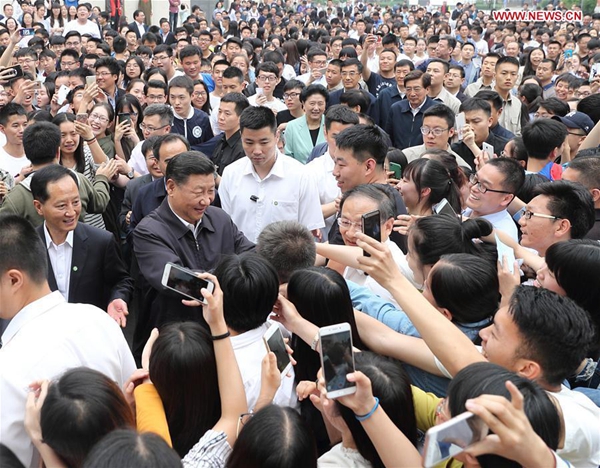
Chinese President Xi Jinping shakes hands with teachers and students while inspecting China University of Political Science and Law in Beijing, capital of China, May 3, 2017. [Photo/Xinhua]


President Xi Jinping on Wednesday called for more efforts in promoting rule of law and cultivating talent for the cause.

Xi, who is also general secretary of the Communist Party of China (CPC) Central Committee and chairman of the Central Military Commission, made the remarks on a visit to China University of Political Science and Law ahead of Youth Day on May 4.

Fully implementing the rule of law is essential and an important measure in adhering to and developing socialism with Chinese characteristics, said Xi, while talking with senior law professors and students.

Implementation of the rule of law is impossible without a high-quality legal work force, said Xi.

Xi called on the country’s law schools to enhance their research on basic issues in rule of law and related areas and provide theoretical support for socialist rule of law with Chinese characteristics.

“We should have confidence in developing our own legal disciplines and contribute to global rule of law with Chinese wisdom and practice,” Xi said.

China should take successful legal practices worldwide as reference, but not simply copy them, he said.

Xi also called for more exchange between scholars and legal professionals.

In cultivating legal talent, Xi highlighted training of students’ virtue in addition to teaching legal knowledge.

He also told the country’s officials at all levels to take the lead in studying and observing the law and promoting the respect of virtue and law among society.

On behalf of the CPC Central Committee, Xi extended greetings to young people, education workers, youth workers and those working for the rule of law nationwide.

The future of China and the Chinese nation belongs to the young, Xi said, noting that the younger generation’s belief, spirit and quality matter to the country’s development, vigor and core competitiveness.

He called on Chinese youth to uphold the belief in the country’s “two centenary goals” and the Chinese dream of national rejuvenation and take their responsibilities in the cause.

He also expressed wishes that the youth would study hard and grow healthily.

While talking with the university’s students, Xi called on them to follow the Party’s leadership and make use of their talent to serve the country and the people after graduation.

“The youth period is a key period to foster one’s scientific thinking,” Xi said, noting that the students should integrate their thinking with their study, observation and practices.

He also called on young people to fully use their creative spirit and be courageous in exploring and seeking the truth.

“During one’s growth and endeavor, the young may gain success and joy, but may also face difficulties and pressure,” the president said. “One should treat the success and failure at the moment with a correct attitude, not slouch in prosperity and not be frustrated in adversity.”

Xi also ordered Party organizations in colleges and universities to perform their duties in both Party governance and school management and to pay attention to both ideological issues and Party building, urging them to solve practical problems of the teachers and students in their work, research, study and employment.

Interview with Daniela Ritorto, SBS

image_pdfimage_print

DANIELA RITORTO:

Prime Minister, thank you for your time. Here we are a couple of days before the Budget and you’re about to board a plane to New York. Is this face-to-face meeting with Donald Trump that important you have to go now?

PRIME MINISTER:

Look it is very important. The US Alliance is the absolute bedrock of Australia’s security and we have a lot of big issues to discuss.

North Korea – you understand the enormous risks that are being brought to bear by the reckless and dangerous conduct of the North Korean Government. There is a lot at stake.

And of course, in the Middle East we have over 1,700 personnel, Australian Defence Force personnel between the Iraq and Afghanistan – working there, side-by-side with the United States.

DANIELA RITORTO:

Are you a little bit worried though it might be awkward – he did give you that ear bashing on the phone. This is the same President who refused to shake the hand of the German Chancellor, an ally. He’s unpredictable. It could all go pear shaped. Surely you’re a bit nervous?

PRIME MINISTER:

I think the reports of that telephone conversation have been greatly exaggerated. I can say that it was, and indeed have been inaccurate – it was a frank, forthright and it was courteous. I look forward to a very valuable discussion and a first meeting in person with the President.

DANIELA RITORTO:

I made the point though about the President’s unpredictability to make a more serious wider point. How does Australia chart a foreign policy course when you do get mixed messages from the President? Take North Korea – on the one hand we are talking about a military threat from the United States, on the next hand the President is talking about it would be an honour to meet Kim Jong-un.

PRIME MINISTER:

Well I think the message is very clear that all parties, all nations should aim to resolve differences diplomatically.

The important thing is that the dangerous, reckless threatening conduct by North Korea comes to an end. Now that is going to require a concerted effort by the nations with the most leverage over North Korea and of course nobody has more leverage than China. That is why I have said and I know the President has echoed this, that the eyes of the world are on Beijing because Beijing has that very, has the overwhelming economic relationship with North Korea.

DANIELA RITORTO:

Paul Keating had some free advice for you last week. He said Australia needs to stop bowing down to the United States and chart a proper independent foreign policy course.

PRIME MINISTER:

Well I don’t accept the premise of his remark. Australia stands up for Australian values and Australian interests. But we always speak our mind. Australian Prime Ministers should always and I always do and I believe every Australian Prime Minister has done is speak up for Australia’s interest and act in Australia’s national interest. But our interests and those of the United States are very consistent.

DANIELA RITORTO:

Do you have a message for President Trump or are you there very much to listen over the next 48-hours?

PRIME MINISTER:

It will be a discussion and it will be a discussion and a meeting and an engagement and I have had several calls with him already, but we, you know, we have a very strong alliance.

I cannot, and you know, I understand why these relationships get put into the context of personalities but the Alliance between Australia and the United States is not only of more than 60 years longstanding in a formal sense – nearly a century in reality – but it is built on millions of people-to-people links. Family links, business links, shared values, shared cultural values, a shared history.

And so our national interests have been coinciding, working together in freedom’s cause for all that time and Presidents and Prime Ministers have a very important role to play. Of course we do. But this is like a great tide, always, Australia and the United States, shared values and a shared destiny.

DANIELA RITORTO:

Okay, you said the relationship is not influenced by personally but surely President Trump is already having an influence on Australian policy. Suddenly we’ve got crack downs on foreign workers. We are making harder, you’ve announced it is going to be harder for Australians to become citizens. Is that sort of the Trump-era, the Trump-effect taking hold here?

PRIME MINISTER:

Not at all.

You know, you’ve made an assertion that I don’t accept. What I said about Australian values and Australian citizenship reflects views that I have held for many years. In fact, I made exactly those points when I was Chairman of the Republican Movement all those years ago. It is not the colour of your skin or your face or your ethnic background – we do not define our national identity by reference to race, religion, ethnicity. It is a truly political commitment of shared values.

And so what we are doing I think is paying greater respect to citizenship and is it unreasonable to say that people should have a competent understanding and ability to read and write and speak English to become an Australian citizen? How can you succeed? How can you progress effectively in Australia without English?

DANIELA RITORTO:

It takes time. Do you accept that? Some of the most successful people in this country came to this country without English skills.

PRIME MINISTER:

Well, of course. Very successful people did come to Australia without English skills but they acquired them.

This is an empowering decision. It is an empowering policy. It is enabling people to do their best and succeed in Australia as citizens of this remarkable multicultural society. The most successful in the world.

[ENDS]

Entries open for Prime Minister’s Literary Awards

image_pdfimage_print

Entries are now open for the 2017 Prime Minister’s Literary Awards which celebrate great Australian literature.

The Turnbull Government is proud to support the literary arts and these awards recognise outstanding contemporary Australian literature and history. Our authors, poets, illustrators and historians foster our culture and help to form our national identity.

The Awards acknowledge writing talent across six categories: fiction, poetry, non-fiction, Australian history, young adult fiction and children’s fiction. The Australian history category is open to a range of media including journals, magazines, film, radio and online content.

Expert judges will assess the entries and make recommendations to the Prime Minister. The winner of each category will be awarded $80,000 in prize money and shortlisted authors will receive $5,000 in prize money.

Australian authors, publishers and producers are invited to enter the Awards which will close on Friday 2 June.

Entries must have been published, produced or broadcast between 1 January 2016 and 31 December 2016.

Entry forms and eligibility guidelines are available at: www.arts.gov.au/pm-literary-awards

News story: Pauline Mary report and flyer published

image_pdfimage_print

Fatal man overboard from the fishing vessel Pauline Mary while east of Hartlepool.

MAIB’s report on the fatal man overboard from the potting fishing vessel Pauline Mary, east of Hartlepool on 2 September 2016 is now published.

The report contains details of what happened, subsequent actions taken, and recommendations made:

A safety flyer for the fishing industry summarising the accident and detailing the safety lessons learned has also been produced.

FEATURE: ‘Overwhelming majority’ of women experience some form of harassment, sexual violence in their daily journeys

image_pdfimage_print

3 May 2017 – From rude comments and unwanted touching and groping to rape and murder, sexual violence and harassment has reached pandemic proportions, according to the United Nations Entity for Gender Equality and the Empowerment of Women (UN Women), which recently launched a campaign in Mexico City to tackle the issue on public transport.

Studies show that a large majority of women worldwide have been victims of sexual harassment and other forms of sexual violence in public spaces; in Mexico City, a recent national survey found that nearly 90 per cent of women feel unsafe on buses and on the subway.

These behaviours have been so normalized and naturalized within societies that women themselves don’t often consider it important enough to report

For Ana Güezmes, UN Women’s representative in Mexico, the figures point to nothing less than an epidemic. “From a very young age women experience sexual violence and harassment in public spaces, in transport, walking on the streets, and it consists of anything from rude words, unwanted touching, obscene glares, to rapes, murders and feminicide.”

The alarming data prompted UN Women, in partnership with the local government, to launch the campaign #NoEsDeHombres, which translates to “this is not what being a man is about.” The campaign promotes what the agency says is a more respectful form of masculinity.

Yeliz Osman, Safe Cities and Safe Public Spaces Programme Coordinator at UN Women in Mexico, notes that the capital is no different to other cities around the world. “The overwhelming majority of women who participated in focus groups said that they experience some form of sexual harassment in their daily journeys.”

“These behaviours have been so normalized and naturalized within societies that women themselves don’t often consider it important enough to report and men don’t even realize in many cases that this is actually a form of violence and the impact that it has on women and girls.”

VIDEO: Responding to sexual harassment and other forms of sexual violence against women and girls in public spaces

According to a survey on the issue carried out by the National Institute for Statistics and Geography, the forms of violence that were most frequently reported were offensive or sexualized comments (74 per cent), unwanted touching and groping (58 per cent) and fear of being assaulted or abused (14 per cent).

Example of the campaign. Click for large. Photo: UN Women

The fear women and girls feel ends up changing the way they live, Ms. Osman continued. “Women’s perceptions of their safety in Mexico City, as in many cities in the world, has an impact on decisions to go out at night or to take part in leisure activities; also women have to change the way they dress, they need to go out accompanied by other people, and that’s simply not acceptable.

“Women should be free to move around, to go to work, to go to school, free from constant harassment and violence,” she stressed.

The campaign targets men between the ages of 20 and 50 that use public transport on a daily basis, and was divided into two stages.

During the first stage, the Mexico City Metro was strategically used to undertake social experiments that were filmed and made into two videos which challenge the normalization of sexual violence by placing men in situations that give them an idea of what women experience in their daily lives.

The videos were then released with the goal of generating empathy and creating change in male attitudes and behaviours. To date, the videos have been viewed more than 10 million times on social network platforms, reaching more than 108 million users on Twitter with the hashtag #NoEsDeHombres.

The second stage consists of posters that aim to raise awareness of the sexual violence experienced by women and girls on public transport every day and seek to deter men from committing these acts by informing them of the possible sanctions for sexual violence. At the same time, women were encouraged to report incidents. The posters were placed in different public spaces including the metro, buses and under bridges.

This is the first time that UN Women and Mexico City have implemented such an innovative campaign that targets men, the objective of which is to create relationships between men and women that are more equal and free of violence.

VIDEO: Encouraging innovative, locally owned and sustainable approaches to prevent and respond to sexual harassment and other forms of violence against women in public spaces.

“Sexual harassment is almost considered a natural part of male behaviour and we need to transform the notion that it’s natural,” stated Ms. Osman. “It’s not natural and not all men harass women, not all men are violent. We don’t want to perpetuate stereotypes about what is to be a man or a woman.

Sexual harassment is almost considered a natural part of male behaviour and we need to transform the notion that it’s natural

“However, what we are trying to say is that there are forms of masculinity that are less harmful, more positive, more respectful towards women, and more equal. That’s what we are trying to promote: a masculinity that is based on women’s rights and equality.”

While the campaign #NoEsDeHombres was created specifically for Mexico, UN Women’s global flagship initiative “Safe Cities and Safe Public Spaces,” which was launched in 2010 with the goal of preventing and responding to sexual violence against women and girls in public spaces, has a growing list of champion cities.  

These include Cairo, New Delhi, Kigali, Port Moresby, Quito, Cape Town, Rabat, Marrakech, Quezon City, Guatemala City, Medellin, Dushanbe, Maputo, Tegucigalpa, Dublin, Winnipeg, Reykjavik, Sakai, New York, and Brussels.

According to UN Women, studies showed that 43 per cent of young women in London experienced some form of street harassment in 2011; over 90 per cent of women and girls in Port Moresby have experienced some form of sexual violence when accessing public transportation; and 55 per cent of women in Kigali reported that they were concerned about going to educational institutions after dark.

As part of the “Safe Cities and Safe Public Spaces” initiative, cities commit to identify gender-responsive, locally relevant and owned interventions; to develop and implement laws and policies to prevent and respond to the issue of sexual violence in public spaces; to invest in the safety and economic viability of public spaces and to change attitudes and behaviours to promote women’s and girls’ rights to enjoy public spaces free from violence.

AUDIO: What is life like for women and girls in Mexico’s most populous city? Yeliz Osman, Safe Cities and Safe Public Spaces Programme Coordinator at UN Women in Mexico, speaks with UN News.