Press release: Universal broadband to reach every part of the UK

BT has put forward an offer to voluntarily provide this service across the country, which would largely be delivered by Openreach. The offer has been received after the government committed to introduce a Universal Service Obligation (USO) through regulation to give every home and business in the UK the right to request a high speed connection of at least 10 Megabits per second (Mbps). That’s the speed that will meet the typical needs of a family for them to be able to stream films, carry out video conferencing and browse the web at the same time.

The BT proposal would mean many premises will receive substantially more than 10Mbps – homes and businesses are also expected receive connections more quickly than could be delivered under a regulatory approach. The Government will now consider this offer alongside a consultation on the regulatory USO – which is being launched today.

Culture Secretary Karen Bradley said:

The government is taking action to ensure that people everywhere in the UK can get a decent broadband connection as soon as possible. We warmly welcome BT’s offer and now will look at whether this or a regulatory approach works better for homes and businesses.

Whichever of the two approaches we go with in the end, the driving force behind our decision making will be making sure we get the best deal for consumers.

The communications regulator, Ofcom, has advised that 10Mbps, with quality requirements to limit delays and support uploading content as well as downloading it, meeting the needs of a typical household. It will also provide improved connectivity for many small businesses. A regulatory USO would provide a safety net, meaning that fast and reliable broadband was available to everyone, regardless of where they lived. The consultation being launched today outlines detailed proposals for how this new right to request a connection would work in practice.

This will help Government take a decision on the best way to get better broadband in hard to reach areas. No decision has been taken, and the Government will carefully weigh the merits of the two approaches. Unlike under a regulatory USO, the proposal from BT is to proactively build the necessary network infrastructure to connect the majority of households and businesses rather than wait for this to be done on request.

It is also proposed that BT would fund this investment and recover its costs through the charges for products providing access to its local access networks. The approach to recovering these costs will be considered in Ofcom’s current wholesale local access review.

BT Chief Executive Gavin Patterson said:

We are pleased to make a voluntary offer to deliver the Government’s goal for universal broadband access at minimum speeds of 10Mbps.

This would involve an estimated investment of £450m – £600m depending on the final technology solution.

This investment will reinforce the UK’s status as the leading digital economy in the G20. We already expect 95% of homes and businesses to have access to superfast broadband speeds of 24Mbps or faster by the end of 2017. Our latest initiative aims to ensure that all UK premises can get faster broadband, even in the hardest to reach parts of the UK.

The Government will now work with BT over the coming months to develop the proposal – which, if it is accepted, will be legally-binding. The Government will make a decision following its consultation on the regulatory USO.

Notes to editors:

  1. BT proposes to use a range of technologies to deliver this, including fibre to the cabinet, fibre to the home and fixed wireless. Fixed wireless will be made available at an affordable price for hard to reach premises.
  2. They would use these technologies to take the UK’s 10Mbps coverage to around 99 per cent by 2020. All of these technologies will come with quality standards including a minimum 1Mbps upload speeds, and requirements to minimise delays from contention and latency.
  3. Fixed coverage would be made available to as many premises as possible. BT expects to complete the build of this fixed network by either December 2021 or December 2022 depending on the mix of technologies used, some of which are subject to trial and industry consultation.
  4. The number of premises that will only have satellite as an option is expected to be 0.3% by the end of 2022.
  5. Today, over 93 per cent of UK homes and businesses can already get superfast broadband (24 Mbps+), and as a direct result of the Government’s Superfast Broadband Programme, this will increase to 95 per cent by the end of this year.
News story: Foreign Secretary condemns missile test by North Korea

The Foreign Secretary, Boris Johnson, said:

The UK strongly condemns North Korea’s second test of an intercontinental ballistic missile and calls on the regime to immediately stop all activity that breaches UN Security Council resolutions.

The UK will stand alongside our allies and partners as we confront the growing threat North Korea poses to regional and international security. Once again North Korea shows no regard for its international obligations.

We urge the DPRK regime to put the well-being of its own people ahead of the illegal pursuit of nuclear and ballistic missile programmes.

European Commission launches infringement against Poland over measures affecting the judiciary

The Polish authorities have one month to reply to the Letter of Formal Notice.

The Commission’s key legal concern identified in the law on the organisation of ordinary courts relates to the discrimination on the basis of gender due to the introduction of a different retirement age for female judges (60 years) and male judges (65 years). This is contrary to Article 157 Treaty on the Functioning of the European Union (TFEU) and Directive 2006/54 on gender equality in employment. In the Letter of Formal Notice, the Commission also raises concerns that by giving the Minister of Justice the discretionary power to prolong the mandate of judges who have reached retirement age, as well as to dismiss and appoint Court Presidents, the independence of Polish courts will be undermined (see Article 19(1) of the Treaty on European Union (TEU) in combination with Article 47 of the EU Charter of Fundamental Rights). The new rules allow the Minister of Justice to exert influence on individual ordinary judges though, in particular, the vague criteria for the prolongation of their mandates thereby undermining the principle of irremovability of judges. While decreasing the retirement age, the law allows judges to have their mandate extended by the Minister of Justice for up to ten years for female judges and five years for male judges. Also, there is no time-frame for the Minister of Justice to make a decision on the extension of the mandate, allowing him to retain influence over the judges concerned for the remaining time of their judicial mandate.

In addition, First Vice-President Frans Timmermans sent a letter yesterday to the Polish Minister of Foreign Affairs reiterating the invitation to him and the Polish Minister of Justice for a meeting in Brussels at their earliest convenience in order to relaunch the dialogue. As he said in the context of the Rule of Law dialogue: “The Commission’s hand is still extended to the Polish authorities, in the hope of a constructive dialogue.”

Next steps

The Commission’s Letter of Formal Notice requests the Polish Government to reply within one month. After examining Poland’s reply, or if no observations have been submitted within the prescribed time-limit, the Commission may issue a Reasoned Opinion, the second stage of the infringement procedure.

Background

The College of Commissioners decided on Wednesday 26 July to launch this infringement procedure as soon as the Law on the Ordinary Courts Composition was published. The publication took place on 28 July.

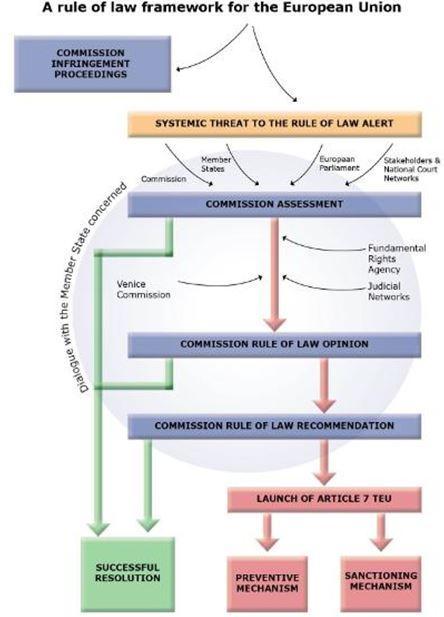
The infringement comes in addition to the ongoing Rule of Law Dialogue launched by the Commission in January 2016 and the complementary Rule of Law Recommendation issued on 26 July. The rule of law is one of the common values upon which the European Union is founded. It is enshrined in Article 2 of the Treaty on European Union. The European Commission, together with the European Parliament and the Council, is responsible under the Treaties for guaranteeing the respect of the rule of law as a fundamental value of our Union and making sure that EU law, values and principles are respected. Events in Poland led the European Commission to open a dialogue with the Polish Government in January 2016 under the Rule of Law Framework. The Framework – introduced by the Commission on 11 March 2014 – has three stages (see graphic in Annex 1). The entire process is based on a continuous dialogue between the Commission and the Member State concerned. The Commission keeps the European Parliament and Council regularly and closely informed.

Annex I – Rule of Law Framework

&

Annex II – Article 7 Treaty on European Union

1.   On a reasoned proposal by one third of the Member States, by the European Parliament or by the European Commission, the Council, acting by a majority of four fifths of its members after obtaining the consent of the European Parliament, may determine that there is a clear risk of a serious breach by a Member State of the values referred to in Article 2. Before making such a determination, the Council shall hear the Member State in question and may address recommendations to it, acting in accordance with the same procedure.

The Council shall regularly verify that the grounds on which such a determination was made continue to apply.

2.   The European Council, acting by unanimity on a proposal by one third of the Member States or by the Commission and after obtaining the consent of the European Parliament, may determine the existence of a serious and persistent breach by a Member State of the values referred to in Article 2, after inviting the Member State in question to submit its observations.

3.   Where a determination under paragraph 2 has been made, the Council, acting by a qualified majority, may decide to suspend certain of the rights deriving from the application of the Treaties to the Member State in question, including the voting rights of the representative of the government of that Member State in the Council. In doing so, the Council shall take into account the possible consequences of such a suspension on the rights and obligations of natural and legal persons.

The obligations of the Member State in question under the Treaties shall in any case continue to be binding on that State.

4.   The Council, acting by a qualified majority, may decide subsequently to vary or revoke measures taken under paragraph 3 in response to changes in the situation which led to their being imposed.

5.   The voting arrangements applying to the European Parliament, the European Council and the Council for the purposes of this Article are laid down in Article 354 of the Treaty on the Functioning of the European Union.

Sabine Lautenschläger: Interview with Mannheimer Morgen

IKB, a German Mittelstandsbank*, was facing a serious crisis at the end of July ten years ago. Do you remember that?

The problems with subprime securities, i.e. risky home loans packaged together in bonds, started to appear in April 2007 in a US company. We already had an uneasy feeling in the spring, but we didn’t think that it would send the banking systems into a tailspin.

Many people thought that it was a one-off event. Did you have a premonition of what September 2008 might bring and of what might follow?

Nobody foresaw the extent of what would happen between summer 2007 and summer 2009, even though in late summer 2007 it was becoming clearer that the turbulence could intensify.

Could such a financial and banking crisis happen again?

I would never say that there could be no recurrence of a financial and banking crisis. 100% protection does not exist. However, supervision is today in a much better position. We can intervene much more decisively and also in a more preventive way. Before 2009 supervisors in Germany could only take action if they could clearly demonstrate that banks were at risk and that damage would soon be inflicted. Supervisors can now demand much higher capital requirements for risks at a much earlier stage. A comprehensive new regulatory framework has greatly strengthened supervision.

So, banks and savings banks are now safer than ten years ago.

All credit institutions have significantly more capital and significantly higher liquidity today. The requirements have been increased, including in respect of a bank’s risk management. The management board of a large bank must, for example, include a chief risk officer with wide-ranging powers who has equal status with the other board members.

Banks only need to hold 3% of their balance sheet total as capital. In Germany, measured against the risks on the balance sheets, the figure is now on average around 12%. That seems small when you look at the capital ratios of small and medium-sized enterprises, for instance.

The 3% relates to each and every bank transaction, whether it is risky or not. It is a sort of basic provision. Besides, the quality of capital is very carefully monitored. Is it immediately available to cover risks? Or is there only a commitment that the capital would be available in the event of a crisis? Supervisors closely scrutinise the risks posed by assets, loans and trading activities. The greater the risks of such deals, the more capital the bank must hold. A German government bond, for example, does not represent a risk when calculating the capital ratio, unlike securitised loans. So the average figure of 12% is only indicative.

So you take a close look at banks’ books?

Yes. And in the end the capital ratio for one business segment may be much higher than the average. On average three times as much capital has been put aside for the trading activities of banks as in 2008. But we also need to strike the right balance between capital requirements and risk. After all, banks should always be able to issue loans to businesses and consumers and to support the real economy, to assist with mergers and acquisitions, and to organise initial public offerings on the stock market.

Savings banks and credit unions are complaining about the costs of regulation and about supervisors going too far.

Generally speaking, the same risks must be subject to the same rules. Nevertheless, a systemically important bank must today meet considerably more stringent requirements and is monitored much more closely than a savings bank or a credit union. The key point is that a major bank in difficulty is more likely to pose a threat to financial stability than a small bank, and if that is the case, distinctions are called for in some, but not all, rules. And after ten years, we should check whether the new rules are also having the intended effect.

In the United States there are plans to relax the rules for banks.

I don’t believe in returning now to deregulation or to purely national rules. That would be a big mistake. We need globally consistent rules for the activities of large banks, of banks which are important for the financial system. The crisis should have taught us that. Banks are not only highly interconnected with each other but also with financial markets, and only global rules can protect us from chain reactions and regulatory arbitrage, i.e. exploiting differences in regulatory standards.

There is now a European resolution authority for ailing banks, but recently it didn’t intervene in several credit institutions in Italy. Again, the taxpayer is being asked to cough up. You can’t have liked that.

We have taken some enormous steps forward with the European resolution authority and our banking supervision. But we haven’t yet reached our goal. For instance, European banking supervision is still lacking some tried and tested tools to be able to act more quickly and effectively. Take the moratorium tool, for example: if a bank gets into trouble, all cash outflows can initially be stopped. That tool exists in Germany but not in Spain.

But banking supervision is in any case in a state of flux because there are constant innovations. Just think of the fintechs.

Yes, there are always new developments in the banking business – but there’s no need to react to every innovation with a new tool. After all, you don’t buy a new screwdriver every time you buy a new shelf, regardless of whether you bought it from a Swedish furniture store or from an exclusive manufacturer.

Are credit institutions earning enough money? Banks are complaining about low interest rates and the resulting lower interest margin.

The low interest rate environment is certainly a challenge in the long run. But the earnings performance of quite a few banks was already critical when interest rates were high. That’s because, among other things, we have a very large number of banks in Germany, around 1,600. There are, in fact, too many of them. They maintain a large and very costly network of branches. And because competition is fierce, the banks’ margins are low. Loans are cheap, some of them too cheap, and some banking services are being provided free of charge. That eats away at earnings.

So we need more mergers.

Consolidation is necessary. Some banks have already been moving in that direction, such as in the cooperative sector. There are now fewer than 1,000 cooperative banks; 15 years ago there were several hundred more. But banks must continue to squeeze costs and open up new sources of revenue.

So prices are set to rise for customers?

Not all banking services can remain as favourable as they are now. We see aggressive rates in some areas. While the supervisor doesn’t determine prices, generally speaking good services should command fair prices. Such services can’t be free forever.

Do you understand why German savers are complaining about low interest rates?

Yes, I understand why, but every saver is an employee or a business person, and sometimes also a borrower. There are, for instance, many young families who can build their own home because interest rates are very low. An expansionary monetary policy helps in the medium and long term, also because, as a result of growth, jobs are created, which in turn generate income. Only that makes it possible for people to buy property or to save or invest.

You approach monetary policy as a member of the ECB’s Executive Board and Governing Council. When will the ECB start to unwind its monetary policy?

The expansionary monetary policy has both advantages and side effects. As time passes, the positive effects get weaker and the risks increase. So it’s important to prepare for the exit in good time. What’s crucial in that context is a stable trend in the rate of inflation towards our objective of just under 2%. It’s not quite there yet. Still, we need to address the issue: how should the return to normal monetary policy be arranged? What will be the time frame, what will be the tools and what will be the sequence? What steps are to be taken and when should we start to wind down the bond purchases?

That’s likely to be a long process.

That’s why we on the ECB’s Governing Council should now answer the questions I just asked.

___

* A Mittelstandsbank serves small and medium-sized enterprises.