China issues report on US human rights

image_pdfimage_print

China published a report on the United States’ human rights situation on Thursday.

The report, titled “The Human Rights Record of the United States in 2016,” was released by the Information Office of the State Council, China’s cabinet, in response to “the Country Reports on Human Rights Practices for 2016” issued by the U.S. State Department on March 3 local time.

China’s report says that the United States poses once again as “the judge of human rights”.

“Wielding ‘the baton of human rights,’ it pointed fingers and cast blame on the human rights situation in many countries while paying no attention to its own terrible human rights problems,” it says.

“With the gunshots lingering in people’s ears behind the Statue of Liberty, worsening racial discrimination and the election farce dominated by money politics, the self-proclaimed human rights defender has exposed its human rights ‘myth’ with its own deeds,” it added.

Concrete facts show that the United States saw continued deterioration in some key aspects of its existent human rights issues last year, according to the report.

The United States had the second highest prisoner rate, with 693 prisoners per 100,000 of the national population, the report says.

Roughly 2.2 million people were incarcerated in the United States in 2014. And there had been 70 million Americans incarcerated – that’s almost one in three adults – with some form of criminal record, the report cites media reports as saying.

Occurrence of gun-related crimes also sustained a high level, according to the report.

There were a total of 58,125 gun violence incidents, including 385 mass shootings, in the United States in 2016, leaving 15,039 killed and 30,589 injured, says the report, citing figures from a toll report by the Gun Violence Archive.

In 2016, the U.S. social polarization became more serious, with the proportion of adults who had full-time jobs hitting a new low since 1983, income gaps continuing to widen, the size of middle class reaching a turning point and beginning to shrink, and living conditions of the lower class deteriorating, the report says.

According to consulting firm Gallup, the percentage of Americans who said they were in the middle or upper-middle class had fallen by 10 percentage points, from an average of 61 percent between 2000 and 2008 to 51 percent in 2016.

“That drop meant 25 million people in the United States fared much worse in economic terms,” it says.

Besides, one in seven Americans, or at least 45 million people, lived in poverty, the report quotes the Daily Mail as saying.
4 grave robbers killed by poison

image_pdfimage_print

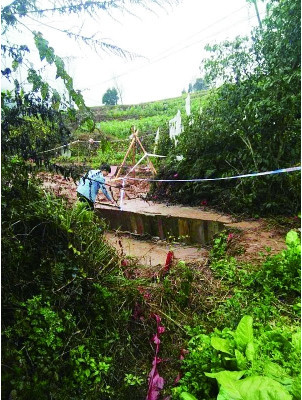
The crime scene. [Photo/gywb.cn] 

Four of 10 grave robbers who managed to break into a tomb built during the Song Dynasty (960-1297) died from the poisonous air wafting from below the graveyard in Xishui Town, Guizhou Province, on March 7, 2017.

The grave they attempted to loot has been preserved as a county-level cultural heritage relic.

Around 1:00 am last Monday, a man brought to a local hospital claimed he’d inhaled deadly gas while working underground in a mining area. However, when the doctors tried to rescue the man as he fell into coma, three of his friends outside the emergency room collapsed.

Realizing the complexities of the issue, the doctors called police.

Until the arrival of the police and local officials, the men who were still conscious admitted that they tried to break into an ancient tomb with the help of an old generator, the emission of which had made them feel uncomfortable. They rushed to the hospital after several fainted inside the grave.

According to the local government, three of the 10 men involved in the grave robbery died inside the mausoleum, while another died after being hospitalized. Four were in stable condition and two were arrested.

A cave going eight meters deep into the grave has been capped and restored. It is highly assumed that the robbers who tried to reach the mausoleum were obstructed by rocks, so they switched on the generator hoping to break their way through. But when attempting to mitigate the noise of the rumbling machine, they covered the entrance with quilts and caused the poisonous air to condense.

Americas region adopts ‘historic’ disaster risk reduction plan at UN-backed forum in Montreal

image_pdfimage_print

9 March 2017 – Around 50 countries and territories of the Americas at a United Nations-supported conference in Montreal, Canada, agreed a Regional Action Plan today to better protect their citizens from the destruction caused by natural and man-made disasters.

The plan, which is the centerpiece of the Montreal Declaration outcome document, marks the end of three days of deliberation and discussion by close to 1,000 government delegations and officials; non-governmental organizations (NGOs), civil society and other representatives, under the umbrella of the UN-backed Fifth Regional Platform for Disaster Risk Reduction in the Americas.

The conference, supported by the UN Office for Disaster Risk Reduction (UNISDR), aimed to put into action the principles and priorities agreed by more than 180 countries across the world in the 2015 Sendai Framework on disaster risk reduction, named after the Japanese city in which it was adopted.

That enshrined the same priorities outlined by the Canadian Minister of Public Safety and Emergency Preparedness, Ralph Goodale, who chaired and hosted the Montreal Conference, when he summarized the thrust of Thursday’s Regional Action Plan.

He said there were 16 &#8220specific actions&#8221 arising, covering four key areas, namely understanding risk better; improving governance when it comes to dealing with disasters; improving on resilience at all levels regarding risk reduction efforts, and finally, better preparedness.

According to UNISDR, while disaster deaths have gradually fallen around the world &#8211 expect in anomalous years marked by mega-disasters such as the 2004 Indian Ocean tsunami or the 2010 Haiti earthquake &#8211 economic impacts have skyrocketed and are now estimated at $500 billion a year.

Hurricane Matthew alone caused damage estimated at $15 billion when it ripped across Haiti, Cuba, the Dominican Republic, the Bahamas, the United States and the Canadian Maritimes last October.

UNISDR chief Robert Glasser gave UN News more details of the 16-point action plan, saying “there are things like cooperating on science and technology research; on developing early warning and building back better after disasters; on embedding risk in core economic planning, on building coherence between disaster risk, climate risk and sustainable development more broadly.&#8221

Mr. Glasser said the Montreal Declaration was an &#8220historic&#8221 moment for the Americas, and marked the first time that Member States in the region had come together and agreed a collective plan to make the Sendai Framework a reality.

&#8220This is the number one an issue that effects both less developed and highly developed countries alike. It is an issue that results in huge loss of life each year and that is causing at least $500 billion a year in economic losses that is all money that could be used to fight poverty, increase access to education or healthcare or promote economic development.”

&#8220So this is not a hypothetical subject. It is a subject that is a matter of life and death and prosperity,&#8221 added Mr Glasser.

The Regional Action Plan now goes forward to the Global Platform on Disaster Risk Reduction, taking place in Cancun, Mexico, in May.

UN agriculture agency warns of water scarcity in North Africa and Near East

image_pdfimage_print

9 March 2017 – Accessible fresh water in North Africa and the Middle East has fallen by two-thirds over the past 40 years, posing a huge challenge requiring &#8220an urgent and massive response,&#8221 the head of the United Nations agriculture agency said today.

Access to water is a fundamental need for food security, human health and agriculture, and sustainable water use for agriculture requires transforming food systems and diets, said Jose Graziano da Silva, the Director-General of the Food and Agriculture Organization (FAO), in a news release on his visit to Egypt.

Per capita availability of fresh water in the region is now 10 times less than the world average, he said, underscoring the need for a significant overhaul of farming systems.

A recent FAO study showed that higher temperatures may shorten growing seasons in the region by 18 days and reduce agricultural yields a further 27 per cent to 55 per cent less by the end of this century.

The rising sea level in the Nile Delta is exposing Egypt to the danger of losing substantial parts of the most productive agriculture land due to salinization.

Moreover, &#8220competition between water-usage sectors will only intensify in the future between agriculture, energy, industrial production and household needs,&#8221 he said.

Mr. Graziano da Silva attended a high-level meeting on FAO’s collaboration with Egypt on the &#391.5 million feddan initiative,’ the Government’s plan to reclaim eventually up to two million hectares of desert land for agricultural and other uses.

Policy advice and best practice ideas on the governance of irrigation schemes is a key offering in FAO’s Near East and North Africa Water Scarcity Initiative, backed now by a network of more than 30 national and international organizations.

The initiative has gained momentum, buoyed by its endorsement by the League of Arab States as well as donor support, Mr. Graziano da Silva said, noting that urgent actions supporting it include measures aimed at reducing food loss and waste and bolstering the resilience of smallholders and family farmers.

UN agriculture agency warns of water scarcity in North Africa and Near East

image_pdfimage_print

9 March 2017 – Accessible fresh water in North Africa and the Middle East has fallen by two-thirds over the past 40 years, posing a huge challenge requiring &#8220an urgent and massive response,&#8221 the head of the United Nations agriculture agency said today.

Access to water is a fundamental need for food security, human health and agriculture, and sustainable water use for agriculture requires transforming food systems and diets, said Jose Graziano da Silva, the Director-General of the Food and Agriculture Organization (FAO), in a news release on his visit to Egypt.

Per capita availability of fresh water in the region is now 10 times less than the world average, he said, underscoring the need for a significant overhaul of farming systems.

A recent FAO study showed that higher temperatures may shorten growing seasons in the region by 18 days and reduce agricultural yields a further 27 per cent to 55 per cent less by the end of this century.

The rising sea level in the Nile Delta is exposing Egypt to the danger of losing substantial parts of the most productive agriculture land due to salinization.

Moreover, &#8220competition between water-usage sectors will only intensify in the future between agriculture, energy, industrial production and household needs,&#8221 he said.

Mr. Graziano da Silva attended a high-level meeting on FAO’s collaboration with Egypt on the &#391.5 million feddan initiative,’ the Government’s plan to reclaim eventually up to two million hectares of desert land for agricultural and other uses.

Policy advice and best practice ideas on the governance of irrigation schemes is a key offering in FAO’s Near East and North Africa Water Scarcity Initiative, backed now by a network of more than 30 national and international organizations.

The initiative has gained momentum, buoyed by its endorsement by the League of Arab States as well as donor support, Mr. Graziano da Silva said, noting that urgent actions supporting it include measures aimed at reducing food loss and waste and bolstering the resilience of smallholders and family farmers.