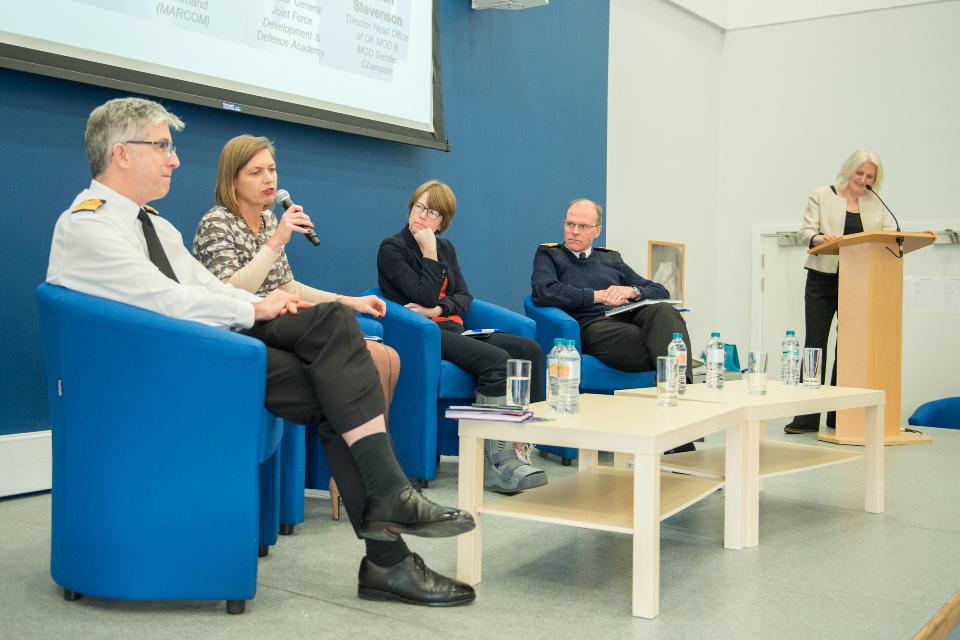
News story: Joint Forces Command celebrates International Women’s Day

image_pdfimage_print

The special guest and keynote speaker for the event was Ambassador Marriet Schuurman, NATO Special Representative for Women, Peace, and Security.

JFC, which develops and manages the supporting frameworks for successful operations for joint forces in the UK and across the world, jointly hosted the event with NATO on Monday 6 March at its headquarters in Northwood, Middlesex.

The event was attended by approximately 100 people ranging from UK military, civil servants and defence contractors to military from NATO member countries. The key theme of the day was transformational management and leadership.

During her keynote speech, Ambassador Marriet Schuurman spoke about the importance of gender equality. She said:

Gender equality for NATO is not optional; it is fundamental. It allows us to respond smarter and better to today’s security challenges. Mixed teams perform better and smarter. Diversity is our strength.

The ambassador also referenced the United Nations Security Council Resolution (UNSCR) 1325, which recognises the disproportionate impact that war and conflict has on women and children. She said:

Resolution 1325 is an agenda for change, an agenda for sustainable peace and security by being inclusive.

She continued:

Every change process requires great leadership. Change always faces challenge and resistance. We must promote gender equality as a matter of effectiveness, and make it relevant for the security challenges of today.

Two panel discussions were also held to explore the themes of how leadership can be transformed and leadership challenges in a diverse culture with representatives from JFC, MOD and Foreign and Commonwealth Office leading the discussions.

A panel discussion at JFC's International Women’s Day event on Monday 6 March 2017. Crown copyright. All rights reserved
A panel discussion at JFC‘s International Women’s Day event on Monday 6 March 2017. Crown copyright. All rights reserved

Speaking during one of the panels, Vice Admiral Duncan Potts CB, Director General Joint Force Development and Defence Academy said:

Diversity and inclusion are very important because without a balanced number of women in our forces, we risk missing out on the skills and expertise of 50% of the population. It’s really important that we get the right people into our services. And it’s crucial that we reflect the values of the society we protect.

Andy Helliwell, Director of Resources and Policy, JFC said:

I am very proud that JFC is the first part of the MOD that has a more than 50% female civil servant workforce. We must strive to ensure that this continues and that we promote the benefits of diversity and inclusion to the wider MOD and indeed beyond other government departments.

Royal Air Force Support to the swearing in of the Lieutenant Governor of Jersey

image_pdfimage_print

The Royal Air Force
supported the swearing in of the new Lieutenant Governor of Jersey.

On Monday 13 March
2017, former Chief of the Air Staff, Air Chief Marshal Sir Stephen Dalton, was
sworn in as Lieutenant Governor of Jersey. The occasion was marked by a
ceremony at the Royal Court and then a church service at the Parish Church of
Saint Helier. Personnel from the Queen’s Colour Squadron (63 Squadron Royal Air
Force Regiment), LXX Squadron Royal Air Force, and Royal Air Force Music
Services travelled to Jersey to support the event.

20170314-NHT-1

The Queen’s Colour
Squadron provided a Lining Party in Royal Square for the new Lieutenant
Governor as he made his way from the Royal Court to the Parish Church of Saint
Helier. In the evening, the Queen’s Colour Squadron performed a Continuity
Drill Display followed by a Sunset Ceremony. A flypast was conducted by LXX
Squadron in an A400M Atlas aircraft as the Union Flag was lowered. Guests were
afterwards hosted for dinner by the Lieutenant Governor in Government House
with the Royal Air Force Salon Orchestra providing an ensemble of music. Flight
Lieutenant Matt Bowerman, Queen’s Colour Squadron Second-in-Command, was the
Parade Commander and the Lieutenant Governor took the salute.

20170314-NHT-3

The Lieutenant Governor
is appointed by Her Majesty the Queen, for a five year term, to be her personal
representative and impartial adviser. His responsibilities include representing
the Queen on ceremonial occasions, hosting royal, ambassadorial and VIP visits
and being a point of contact between the Island’s authorities and the UK
government. Air Chief Marshal Dalton’s appointment to the role was announced on
20 December 2016 following the end of General Sir John McColl’s tenure.

The Queen’s Colour
Squadron (63 Squadron Royal Air Force Regiment), based at Royal Air Force
Northolt, are the Royal Air Force’s only ceremonial unit. Custodians of the
Queen’s Colour for the RAF in the United Kingdom, they are responsible for
representing the Royal Air Force at the highest profile ceremonial occasions;
providing Guards of Honour for our own Royal Family, as well as visiting
royalty, heads of state and dignitaries. The Squadron also has an operational
role as 63 Squadron, Royal Air Force Regiment. The RAF Regiment are responsible
for providing Force Protection to deployed airmen and aircraft. Air Chief
Marshal Dalton is the current Honorary Air Commodore of the Royal Air Force
Regiment, which is celebrating its 75th anniversary this year.

20170314-NHT-2

The Airbus A400M
Atlas, flown by LXX Squadron based at Royal Air Force Brize Norton, has been in
service in the Royal Air Force since November 2014. Capable of carrying a load
of 25 tonnes over a range of 2000 nautical miles, the A400M supports the
deployment of the Joint Rapid Reaction Force and gives the RAF a tactical and
strategic-airlift aircraft capable of supporting all three services and is
interoperable with other nations.

Editor: Flt Lt Doug McCorkindale

© MOD Crown Copyright 2017

Let’s block ads! (Why?)

Guidance: Groundwater protection position statements

image_pdfimage_print

Updated: Updated The Environment Agency’s approach to groundwater protection.

These position statements describe the Environment Agency’s approach to managing and protecting groundwater. They update Groundwater protection: principles and practice (GP3).

This document helps anyone whose current or proposed activities have an impact on, or are affected by groundwater such as:

  • developers
  • planners
  • environmental permit applicants and holders
  • water abstractors

Many of the approaches set out in the position statements are not statutory but may be included in, or referenced by, statutory guidance and legislation.

Environment Agency staff use these position statements as a framework to make decisions on activities that could impact on groundwater. This clear approach aims to remove uncertainty and potentially inconsistent decision-making.

SNP’s new separation plans have ‘unravelled within 24 hours’

image_pdfimage_print

14 Mar 2017

Ruth1

The SNP’s independence plans have “unravelled within 24 hours”, the Scottish Conservatives have said today – amid total confusion over the SNP’s stance on EU membership.

In interviews this morning, SNP ministers failed to spell out whether an independent Scotland would seek membership of the European Union.

It comes after Nicola Sturgeon was also unable to say whether an independent Scotland would apply for full EU membership in her press conference yesterday.

The Scottish Conservatives said the confusion only serves to underline the “reckless” proposal for a rushed referendum – which would force people to vote on “a pig in a poke”.

It comes after senior EU figures made it clear yesterday that an independent Scotland would have to apply to become a member – even if an independence referendum was held before Britain left the EU.

This is also the view of leading experts who have said that an independent Scotland would have to apply as a new country to get into the EU after independence.

Scottish Conservative leader Ruth Davidson said:

“The SNP’s plans to impose a referendum on independence on Scotland have unravelled within 24 hours.

“Nicola Sturgeon is demanding that people are forced to make another choice on their future in as little as 18 months. And yet faced with reasonable questions about what independence means, she and her ministers cannot answer.

“We know Scotland will leave the EU along with the rest of the United Kingdom in 2019. Yet the SNP can’t say whether an independent Scotland would then seek full membership of the EU or not.

“This is the opposite of the informed choice proposed by Nicola Sturgeon. The truth is she wants people to vote blind because she calculates this is the best way to increase support for separation.

“The First Minister is proposing the opposite of a fair, democratic vote – she is demanding that people across Scotland vote on a pig in a poke.

“The SNP is trying to have it both ways.

“It is demanding a referendum because of our decision to leave the European Union. But, in order to keep Leave voters on board, it won’t say whether Scotland would seek to get back in.”​


Below are transcripts from various SNP ministers on radio this morning:

Studio: You talk about clarity being very clear on that. How would an independent Scotland for example if it were to go that way, continue this relationship with Europe? Because that would surely mean a whole re-negotiation.

Fiona Hyslop MSP: Well, we have already set out a very comprehensive, technically detailed paper, how all of the UK could have a continuing relationship even outside the EU but continuing our relationship with the single market, so that is indeed possible. But in terms of the EU relationship future, much of course will depend on the views and opinions of our colleagues in the capitals and indeed the institutions of Europe. The European institutions are flexible and indeed the single market, the sheer size of that single market, means that a continued relationship is really important. The idea of having your very expensive customs tariffs in relation to our goods and services will be a problem for not just for Scottish business but for UK business. We want to make sure we can continue to trade with the biggest single market in the world and that is very important to us.

Studio: How would you continue that relationship? Presumably, you are imagining doing it, correct me if I am wrong, as an independent Scotland which would, as the rules are at the moment, mean a renegotiation.

Fiona Hyslop MSP: We are in a period of complete and utter renegotiation under Brexit. We do not know the terms of that. You are anticipating that I will know and anticipate what the exact details will be of our independence position, when we have the referendum, now that’s sometime off and we want to make sure there’s clarity on our independence position and our future relationship with the EU. A lot of it will depend on what state, what will be the state of the transition, if we get a transition from the UK Government in relation to exiting the EU, what will be the position of Scotland at the time the UK leaves? We want to make sure there is a choice before the UK leaves the EU and that is why we have that window of opportunity between autumn 2018 and spring 2019 but this has to be about choice. And that’s what we want to offer the people of Scotland. We’ll perhaps be the only part of the United Kingdom that can have a choice about whether this hard BREXIT deal is what we want or not

Nicola Sturgeon answer to Brian Taylor yesterday….

Question (non-verbatim) – are you assuming you can continue Scottish membership of the EU? If not, are you saying you’d definitely seek to re-join Scotland to full membership?

Nicola Sturgeon: What I’m saying today very clearly is that for Scotland to be in a position to negotiate in a timely fashion our own relationship with Europe, it’s important that we indicate that desire and intention, before the UK leaves, or at the very least within a short timeframe after they do so. To leave it any longer than that would make that process more difficult. I do accept that that will be a process of discussion. In terms of the second clause of your question, the SNP’s long standing policy and commitment has been to membership of the European Union. Obviously we are in different circumstances now than we have been in the past, but that has been and remains our position. But on this issue, as on all of the many other issues that people will want to consider in advance of a choice, I’ve said very clearly that we will set out our proposition in advance of that choice so that it is an informed choice.

Question (non-verbatim) – What reassurances do you have from other EU members that Scotland can be in or re-join?

Nicola Sturgeon: We have over the past 9 months been working very hard to influence the UK Government’s negotiating position, and that has been partly as a result of some of the advice and feedback we’ve had from other countries across Europe, that if we wanted to seek a differential arrangement for Scotland then Europe would be open to that, but it had to come through the track of the UK Article 50 negotiations. So that has been our focus. Clearly we will continue to discuss with the other countries of the European Union and indeed with the institutions of the European Union. I know from my own experience across Europe that there is an incredible warmth of feeling towards Scotland, an incredible support, and a feeling that should Scotland democratically choose to be an independent country, then that is something that the EU would accept and respect and these discussions will continue no doubt in the months to come.

Green Party Animal spokesperson welcomes vote to #EndTheCageAge for caged rabbits

image_pdfimage_print

14 March 2017

Keith Taylor MEP: “This is great news for millions of rabbits across Europe and a great example of how the EU can take a lead on animal welfare. Greens have always opposed factory farming and I wholeheartedly welcome the result of today’s vote.”

Green Party Animals spokesperson Keith Taylor MEP is welcoming the vote to #EndTheCageAge for farmed rabbits across Europe. The MEP for the South East was among a majority of MEPs who voted to support a report calling for the practice to be outlawed at the European Parliament plenary session in Strasbourg this afternoon. More than 4,000 people across the South East had contacted their MEPs calling for action.

Rabbits are the fourth most farmed animal in the world. An estimated 340 million rabbits are slaughtered annually after a life kept in barren wire cages where their natural behaviour is severely restricted. Many scientists have called for the cage system to be urgently replaced by one which allows for the natural needs of rabbits to be better taken into account.

The report adopted by MEPs calls for higher welfare standards for rabbits and concrete legislation that would ban the use of cages. Responding to the result, Keith said:

“This is great news for millions of rabbits across Europe and a great example of how the EU can take a lead on animal welfare. Greens have always opposed factory farming and as the Green Party’s Animals spokesperson I wholeheartedly welcome the result of today’s vote. The report prioritises putting an end to the inhumane conditions in which rabbits are kept and eradicating the other problems associated intensive rabbit rearing. The current system leads to the spread of disease and the subsequent overuse of antibiotics.”

“Rabbit farming is relatively small-scale in the UK, but the fact that the European Parliament has voted to end the cage age serves to highlight the key role EU membership has played and continues to play in raising the welfare of millions of farm animals in Britain and across the EU.”

“The closer the relationship the UK maintains with the EU, retaining animal welfare and wildlife protections through single market membership, the better the outcome for British animals. Animal advocates across the UK must continue lobbying the UK government to ensure the current legal protections, for all species, offered by European Union membership are maintained and strengthened.”

Back to main news page

Let’s block ads! (Why?)