For a fee, students can fake their internships

As junior students in Chinese colleges take on summer internships, some unscrupulous businesses can’t wait to make deals – like selling them fake internship certificates online.

For many students, internships are part of their course work and are directly connected with school credits. In 2015, the Ministry of Education issued a notice requiring that internships should account for at least 30 percent of all credit hours. Schools typically ask students to take up internships for a few months to prepare for future careers.

But if the students don’t go along, there is an easy way out. For just 200 yuan ($30) or less, you can get whatever internship certificate you like online. The business is obviously illegal, but it exists nevertheless.

On e-commerce website Taobao, one can find many items by searching “internship certificate”. Most are labeled “internship reports” and “designing internship certificates for college students”. Some even tout “tailor-made” internship certificates “providing all necessary stamps of any company of your choice”.

Xinhua reporters spoke to “Yibaifen”, an agent whose details were on Taobao, and tried to buy an internship certificate. The agent later said via WeChat that a certificate would cost about 50 yuan.

“You can choose any type of company in any city,” the agent said. The agent then sent the stamp of a well-known Beijing-based IT company and claimed it was real because he “has connections”.

“I can give you a discount if you buy two,” the agent said.

On Taobao, one agent has sold more than 100 fake certificates in the past month, according to a Tianjin newspaper.

To make the fake certificates appear authentic, some agents even promise to take follow-up calls from schools.

On Tencent’s instant messaging service QQ, an agent said that he is “on call 24/7”.

“I put my own phone number on the certificates, so if your teachers call about your internship, I can handle them,” the agent said.

Another agent claimed to have an authentic stamp of a Beijing advertising company. He declined to say whether or not he is an employee of the company, but he did say he “cooperates” with the company, and pays some “commission” to it for each stamp he puts on certificates.

But the general manager of the company denied any knowledge of the scam, saying the company has strict procedures about using its stamp, and that the agent’s stamp must be fake.

Under China’s Criminal Law, fabricating the stamps of government organs and companies could be a crime. Despite potential punishment, however, the business thrives, partly because of demand from college students.

Xiao Mo, an undergraduate at a college in Xuzhou, Jiangsu province, bought a fake internship certificate online. She said her college has “strict demands” with respect to its internship requirement, but she does not have time because she needs to prepare for graduate school.

“I really don’t have time for an internship,” she said. “Besides, my teachers probably won’t check the authenticity of the certificate, so it should be no problem.”

But a student surnamed Zhang from a Beijing college disagrees. Zhang, who has been working as an intern at a company the entire summer, said buying fake certificates is unacceptable.

“Internships are more about strengthening your ability than obtaining a piece of paper,” he said. “Buying fake certificates is unfair to the students who work hard.”

The phenomenon has fired up an angry discussion online.

“Internships are meant to prepare students for their future jobs, but buying fake certificates only damages their credibility,” read one comment.

“It is necessary to get tougher on the businesses, and colleges need to reevaluate their assessment methods for students,” said another.

Li Jiaxing, deputy head of the University of International Relations, said buying fake internship certificates is immoral.

“Colleges need to be credible,” Li said. “Anyone caught purchasing fake certificates should be regarded as cheating and be punished accordingly.”

Qu Wenyong of Heilongjiang University said providing fake internship certificates could be a violation of the law, and that the government should deal with the agents.

“E-commerce websites are also to blame for providing platforms for illegal businesses,” he said.

Lung cancer rising, but not from smoking

Chinese health authorities are trying to figure out the reason for the rapid rise in a form of lung cancer that develops deep in the lung and is not associated with smoking.

China has seen a sharp increase in the disease over the past 10 to 15 years, hitting groups traditionally not susceptible such as women and nonsmokers, said Xue Qi, deputy director of thoracic surgery at the Cancer Hospital Chinese Academy of Medical Sciences, also the country’s National Cancer Institute.

“It might be related to the long-term exposure to air pollution, particularly PM2.5,” he said, referring to particulate matter with a diameter of 2.5 microns or less.

China’s top health authority has been watching people’s health in relation to air pollution since 2013, said Mao Qun’an, spokesman for the National Health and Family Planning Commission.

“We need more research over a longer time to figure out the long-term health effects of air pollution,” he said. “Cancer is developed over a long period, not overnight.”

Latest cancer statistics from the government showed China recorded nearly 4.3 million new cancer patients in 2015, and more than 730,000 of them had lung cancer, accounting for nearly 36 percent of the world’s total.

There are two major types of lung cancer – lung adenocarcinoma and squamous cell carcinoma, experts said. The latter is closely associated with smoking.

Of newly detected lung cancer patients each year, the cases of adenocarcinoma – involving more females and nonsmokers have exceeded that of smoking-related carcinoma, even though the smoking rate in China has not declined, Xue said, citing figures from the nation’s cancer registry.

Ten to 15 years ago, squamous cell carcinoma took the lion’s share of all lung cancer cases, roughly 60 percent, he said. “At that time, most of the sufferers were smoking males, who are at high risk.”

The incidence of lung cancer has surged in recent decades.

For instance, in the 1960s the incidence of lung cancer in Guangzhou, Guangdong province, stood at 7 per 100,000 people. That surged to 70 per 100,000 in 2005, according to local health data.

Some lung disease experts suspect the rise might be related to PM2.5, but more research is needed to know for sure.

Xue said more government research funding and projects in the field are needed.

Internationally, small-scale studies have associated air pollution exposure with lung cancer, but a direct link has not yet been confirmed with large, long-term studies, he added.

Industrialized countries saw a rise in the proportion of adenocarcinoma before China, according to Xue, who said lung adenocarcinoma is now the most common type of lung cancer.

Squamous cell carcinoma has decreased over recent decades in Western countries due to an ever decreasing smoking population, he added.

China allocates 180 mln yuan for post-quake relief

The central government has allocated 180 million yuan (27.1 million U.S. dollars) for relief work after two major earthquakes hit northwest and southwest China.

Tourists gather their belongings at a hotel parking lot as they prepare to leave the mountainous earthquake zone on Wednesday, August 9, 2017. [File Photo: Xinhua]

Tourists gather their belongings at a hotel parking lot as they prepare to leave the mountainous earthquake zone on Wednesday, August 9, 2017. [File Photo: Xinhua]

A total of 80 million yuan has been given to Xinjiang Uygur Autonomous Region and Xinjiang Production and Construction Corps to support relocation of disaster-hit people and renovation of their houses, according to the Ministry of Finance.

Another 100 million yuan has been allocated to Sichuan Province for similar purposes.

A 7.0-magnitude earthquake struck Jiuzhaigou, a UNESCO nature reserve and popular tourist destination in Sichuan Province, at 9:19 p.m. Tuesday, leaving 20 people dead and over 400 injured so far.

Thirty-two people were injured and more than 1,000 houses damaged in a 6.6-magnitude earthquake that struck Jinghe County in Bortala Mongolian Autonomous Prefecture in Xinjiang on Wednesday morning.

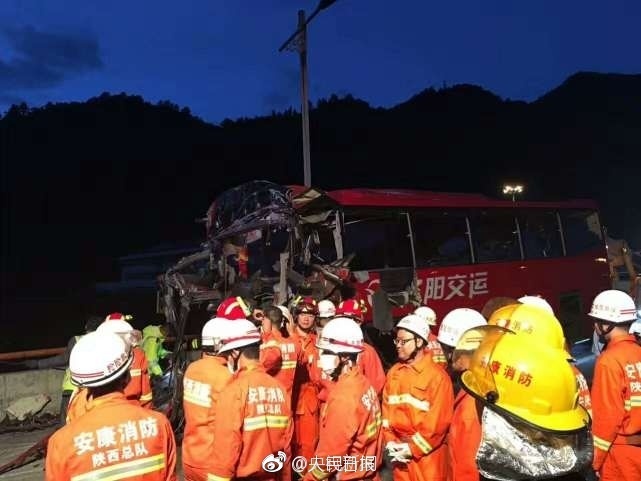
36 dead, 13 injured in NW China road accident

At least 36 people were killed and 13 others injured in an expressway accident in northwest China’s Shaanxi Province Thursday night, local authorities said Friday morning.

At least 36 people were killed and 13 others injured in an expressway accident in northwest China's Shaanxi Province Thursday night, local authorities said Friday morning.

At least 36 people were killed and 13 others injured in an expressway accident in northwest China’s Shaanxi Province Thursday night, local authorities said Friday morning.

The accident occurred at around 11:34 p.m. when a coach hit the wall of the Qinling tunnel of the Xi’an-Hanzhong Expressway, according to the public security department of Shaanxi.

The coach was en route to Luoyang City, central China’s Henan Province, from Chengdu City, capital of southwest China’s Sichuan Province.

The injured have been rushed to the hospital.

Rescue work is underway.

Press release: Mandatory CCTV in all slaughterhouses under new animal welfare plans

CCTV will be mandatory in all slaughterhouses in England under new plans announced today (11 August 2017) by Environment Secretary Michael Gove, as he outlined a series of measures to cement the UK’s position as a global leader on animal welfare.

The proposals will deliver a manifesto commitment for CCTV to be required in every slaughterhouse in England in all areas where live animals are present, with unrestricted access to footage for Official Vets – reassuring consumers that high welfare standards are being effectively enforced.

The Government has also confirmed it will raise standards for farm animals and domestic pets by modernising statutory animal welfare codes to reflect enhancements in medicines, technology and the latest research and advice from vets. The codes will remain enshrined in law and the first to be updated will cover chickens bred for meat.

Environment Secretary Michael Gove said:

We have some of the highest animal welfare standards in the world and the actions I am setting out today will reinforce our status as a global leader.

As we prepare to leave the EU, these measures provide a further demonstration to consumers around the world that our food is produced to the very highest standards.

Consultations on both proposals will be accessible online from 9am on 11 August 2017.

Under the new plans for CCTV, footage would be accessible to the Food Standards Agency’s (FSA) Official Veterinarians (OVs), who monitor and enforce animal welfare standards in the slaughterhouse. The FSA has strict processes in place for the approval of slaughterhouses, and specially trained vets carry out checks to make sure the welfare of animals is protected throughout their time in the slaughterhouse. If breaches are found, a slaughterhouse can be given a welfare enforcement notice, have its staff’s licences suspended or revoked, or be referred for a criminal investigation.

Welcoming the Government’s plans, British Veterinary Association President Gudrun Ravetz said:

Mandatory CCTV in all areas of slaughterhouses will provide an essential tool in fostering a culture of compassion that could help safeguard animal welfare and we are particularly pleased to see a commitment to Official Veterinarians having unrestricted access to footage, which BVA has been calling for. Vets’ independence and unique qualifications help ensure that the UK will continue to have the highest standards of animal health, welfare and food safety.

Heather Hancock, Chairman of the Food Standards Agency, said:

The Food Standards Agency takes a zero tolerance approach to any breaches of animal welfare standards in slaughterhouses. Last year, we concluded that it was time to make CCTV compulsory in slaughterhouses, progress on voluntary adoption having plateaued.

I and the Board of the FSA warmly welcome Defra’s consultation about making CCTV mandatory. We look forward to the introduction of a comprehensive requirement for using, accessing and retaining footage from CCTV in abattoirs. We see CCTV as an invaluable management tool for business owners to help with compliance with official controls and to improve animal welfare standards across the industry.

Updates to the meat chicken welfare code have been developed to reflect the most up-to-date best practice on poultry farms across the country. Welfare codes on laying hens, pigs, dogs, cats and horses are expected to be updated over the next year.