News story: CNC officers return to their Mission

image_pdfimage_print

All Civil Nuclear Constabulary (CNC) officers are now back to their home sites after Operation Temperer concluded and are fulfilling their Mission of protecting civil nuclear sites and nuclear material while in transit.

CNC Authorised Firearms Officers (AFOs) were deployed from every one of the 10 nuclear sites we protect, as well as from our training division. They were sent to eight different force areas and carried out a wide range of roles, including patrolling transport hubs like airports and train stations; joining Home Office AFO colleagues on patrol in Armed Response Vehicles; and protecting public events ranging from concerts to sports matches. While they were away supporting the national Op Temperer deployment, a large number of our AFOs remained protecting nuclear sites, with the support of the UK Armed Forces.

Chief Constable Mike Griffiths said: “Our officers were deployed to eight different force areas and couldn’t have received a warmer welcome from their Home Office counterparts.

“As a national Counter Terrorism police force, our officers are highly skilled and patrol within 5km of their nuclear sites on a daily basis, however they really enjoyed the opportunity to interact with members of the public in situations they wouldn’t ordinarily experience – such as patrolling in busy city centres, protecting iconic sites and providing a visible armed presence at concerts and sporting events, including the Liverpool and Manchester marathons at the weekend.

“As well as supporting the national operation, we carried on with business as usual at our sites, ensuring nuclear facilities and materials were as secure as they always are with the support of military personnel.

“I have nothing but admiration for all of the officers and members of the UK police forces who came together to protect the public in the wake of the horrific attack in Manchester last week and our thoughts remain with those who have lost loved ones or sustained injuries in the attack. As a force, we were proud to support the national policing effort and have been humbled by the messages of support we received from the public and our policing partners thanks to the role we played.”

Press Statement with His Excellency Lee Hsien Loong, Prime Minister of the Republic of Singapore

image_pdfimage_print

PRIME MINISTER OF THE REPUBLIC OF SINGAPORE:

Mr Turnbull, Ministers, ladies and gentleman of the press. I would like to welcome Prime Minister Turnbull to Singapore for his first official visit, reciprocating his warm hospitality for my visit to Canberra last October.

This visit is the second Annual Singapore Australia Leaders’ Summit and our Comprehensive Strategic Partnership, or CSP.

We had very good discussions this morning on a wide range of issues, regional and economic. We exchanged views on developments in the United States, in Europe, in Asia, as well as our concerns over the recent terrorist attacks in the West and in our part of the world.

Singapore and Australia are both outward-oriented and trade-dependent countries. We want a peaceful and orderly world, an open and inclusive international system where countries big and small can prosper.

That’s why we are both friends with all the major powers. We see the United States continuing to play a major role fostering peace and stability in Asia.

We also welcome China’s engagement in the region because for both Singapore and Australia, China is our largest trading partner. Constructive initiatives such as the ‘One Belt, One Road’, can promote greater regional cooperation and development.

The strategic alignment between Singapore and Australia is why we work closely on regional trade initiatives like the TPP and the Regional Comprehensive Economic Partnership, or RCEP.

Mr Turnbull took the lead in resuming TPP talks among the remaining 11 members after the US withdrew from the TPP. It shows Australia’s continued commitment to regional cooperation and to free trade.

Singapore agrees with and supports the TPP 11 deal.

Mr Turnbull and I also agreed on the importance of ASEAN centrality in an open and inclusive regional architecture. We welcome Australia’s continued engagement with ASEAN and participation in the East Asia Summit. Next year Singapore is the ASEAN chair and we look forward to the special ASEAN-Australia Summit, which will be in Sydney in March.

Last October in Canberra, we signed significant agreements on economic integration, defence cooperation and innovation. I’m happy that since then, we have made progress.

The upgraded Singapore-Australia FTA will come into force this year. We are making progress in the joint development of the military training areas in Queensland and we deeply appreciate Australia’s continued support for Singapore’s SPF training needs, which will benefit both defence forces and the local economy in the towns where these happen. We look forward to this arrangement being finalised in a treaty next year.

Today, we have just witnessed two agreements signed on new areas of collaboration.

On innovation, to increase collaboration and joint funding to promote advanced manufacturing and data science to address the challenges of future economies.

And on cyber-security, to build on existing cooperation to combat cyber-threats and support regional capacity building.

These are good, new initiatives.

We also have lighter initiatives, cooperation in the arts and the Australia-Singapore arts group has been doing good work, boosting arts and cultural exchanges. I’m looking forward to opening the Erub Arts Exhibition at the Asian Civilisations Museum with Mr Turnbull tomorrow.

The breadth and depth of our cooperation reflects our enduring, substantial and warm partnership and I thank Prime Minister Turnbull and Australia for their strong support for cooperation and friendship.

Thank you very much.

PRIME MINISTER:

Thank you very much Prime Minister for your characteristically warm welcome.

We are here, friends, very close friends, our formal diplomatic ties go right back to the foundation of Singapore by your father in 1965. But as we remember this morning, solemnly, at the Kranji War Cemetery, Australians fought and died and bled here to defend Singapore. We know that the people of Singapore will never forget that, where we fought together in freedom’s cause.

Today, we are bound together by shared values, shared values of commitment to a rules-based international order, to the rule of law in our region, recognising that is that rule of law which has enabled the economic freedom upon which has built the prosperity that has lifted billions out of poverty in our region.

So, we are not – Singapore and Australia – we’re not the two biggest nations in our region. Your father memorably spoke about “big fish, small fish and shrimps” how they all have to get on together in the ocean. We work together. We recognise that the closer we work together, sharing those values, the stronger our region will be. The stronger our nations will be, as we advance our future based on freedom.

Now we, of course, have very strong family ties, Lucy and me in particular, here in Singapore. We were delighted, I was delighted to be at the Botanic Gardens this morning, where they very kindly named a new orchid after Lucy and me. It was particularly appealing to our SG50 granddaughter Isla, who was born here in Singapore.

Australia is home to thousands of Singaporeans working in Australia, as indeed, over 25,000 Australians work in Singapore. There are over 130,000 Singaporeans who have studied at Australian universities, including your president and many of your ministers and colleagues. It’s wonderful that with the New Colombo Plan – as we were discussing earlier in our meetings – there are 1000 Australian students studying here in Singapore.

Of course, following on from the elevation of the SAFTA, from the latest elevation of our comprehensive strategic partnership, Australian universities have more scope than ever to operate here in Singapore, as they do. So those ties of education, binding together the futures of our two countries get stronger than ever. We’re announcing today a new working holiday visa that will enable young people from Singapore and young people from Australia to work in each other’s country. That is vitally important, just as is the agreement that we have entered into with the CSIRO, to advance innovation and science, again, where we are working together.

Of course, the digital age produces enormous opportunities and a few countries have progressed to the platform of the smartphone as quickly or as effectively as Singapore. But nonetheless, it brings with it great risks and cyber-security is a vital priority of my Government’s national security agenda, as it is of yours. So we are pleased to see the new commitment to strong collaboration in the cyber sphere.

We continue to build on our very strong defence and security relationship. As you noted, discussions are under way to enable your Air Force to continue to operate a training detachment at RAAF Base Pearce for another 25 years. Of course the commitment to the expanded training areas at Shoalwater Bay in Townsville proceeds, bringing enormous opportunities for further collaboration between our defence forces.

In this region, where we face more uncertainty and more threats than we have had for many years, strong collaboration, deep engagement between Australia and Singapore and our defence forces and our security agencies is more important than ever.

You mentioned Prime Minister, the insurgency in the Philippines. The threat of terrorism is with us all. It is a thoroughly transnational threat. Singapore and Australia may once have been regarded as being a long way from the Middle East. Nowhere is a long way from anywhere in the digital age, so that engagement is vitally important.

In the course of our discussions this morning, we have touched on all of those issues. We’ve talked about trade, we have talked about climate policy, we have discussed the importance of action being taken to stop the reckless conduct of the North Korean regime, threatening the peace and stability of our region and the world.

We have talked about the strong cultural engagement between Australia and Singapore, and I’m delighted that tomorrow we’ll be opening the Torres Strait Erub Art Centre’s Exhibition of sculptures at your Asian Civilisations Museum. That is going to be a great feature of the expanded cultural relationship between our two countries.

Of course tonight, I’m honoured to be speaking at this year’s Shangri-La Dialogue, which brings together the region’s senior defence leaders at a time where the pace and scale of change is utterly unprecedented in human history. It’s a powerfully important forum and I want to thank you, Prime Minister, for the way in which Singapore has led and hosted this dialogue and enabled greater engagement on these very important issues.

Finally sir, we look forward to working with you as Chair of the ASEAN, to ensure the Australia-ASEAN Special Summit in Sydney in March next year, provides a platform for the very frank and fruitful conversations that we all need to have as we come closer together.  More engaged, more committed, more determined to protect the freedom, the rule of law, the way of life that we have built in this region. The foundation of which is that freedom that rule of law, that stability, critically important.

I know we’ll both be meeting with the United States Defence Secretary General Mattis over the next few days, and you are meeting General Mattis today. We recognise that the continued strong engagement of the United States as you observed, in this region, manifestly provides that stability, that bedrock, upon which, our prosperity and so much human advancement has been built.

So with shared values, and a common vision, Prime Minister, it’s wonderful to be with you.

Thank you for the very good discussions and we look forward to more of them over the weekend and in the years ahead.

[Ends]

Getting things done – Tullideph Street

image_pdfimage_print
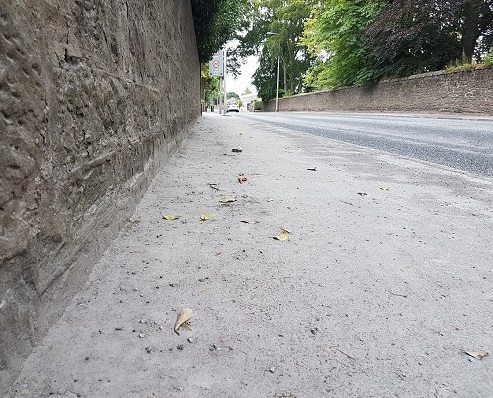
I highlighted at the latest meeting of Community Spirit Action Group residents’ complaints about a bad pothole in Tullideph Street along from the Tullideph Road junction.   I had reported this to the City Council.
The council’s Roads Maintenance Partnership has now advised me that :

An order has … been raised for the repair of a pothole on Tullideph Street approaching the Tullideph Road junction with a timescale for repair of approximately twenty eight days. There is currently a slight backlog with pothole repairs however additional resources have been allocated to address this.”

Emily Thornberry responds to reports Theresa May refused to sign a joint statement with European leaders expressing regret at President Trump’s withdrawal from Paris agreement

image_pdfimage_print

Emily
Thornberry, Labour’s Shadow Foreign Secretary
,
responding to reports that Theresa May has refused to sign a joint statement
with other European leaders expressing regret at President Trump’s withdrawal
from the Paris agreement, said:

“The leaders of France, Germany
and Italy are absolutely right to stand by the Paris Agreement and make clear
to Donald Trump that it is not up for renegotiation. The commitments made in
Paris are vital to stop the world reaching the point of no return on climate
change, and there can be no question of watering them down.

"The only question is why
Theresa May does not have her name on this joint statement. Given the chance to
present a united front with our European partners, she has instead opted for
cowardice and subservience to Donald Trump. It is a dereliction of her duty
both to our country and to our planet.

"It is bad enough that she
failed so badly to persuade Trump to stick to the Paris agreement, but it is
even worse that she lacks the backbone to stand up to him now. This proves that
Mrs May is the very last person we want negotiating for Britain on
Brexit.”