Today – Aileen Carr at the Wighton!

From Sheena Wellington :

Wighton Heritage Centre, Central Library – Cappuccino Concert with Aileen Carr!
Saturday 19th August, 11am (doors open 10.30am) – Admission £5 (tea/coffee available for small charge)

Aileen Carr was born in Coupar Angus, in Perthshire. Her father, self-taught on the melodeon, had a fine Scots voice, while her mother also sang and played the piano at musical evenings at home.   

Aileen’s family could not afford piano lessons for her but that didn’t hold back Aileen’s interest in music and song.   In true folk singing style she would happily sing to people as a little girl and as a teenager was encouraged to sing and perform with a local concert party.

The 1960s were exciting times for the folk revival in Scotland but it was hearing the likes of Belle Stewart at the 1967 Blairgowrie Festival that was a defining moment for Aileen – not to mention the day she was given, at teacher training college, a copy of Norman Buchan and Peter Hall’s 1973 ‘Scottish Folksinger’. On her family moving to Goole in Yorkshire, Aileen became a floor singer at the South Cave folk club and at the Bluebell Club in Hull, where she met many performers such as Alison McMorland and Archie Fisher. In the 1970’s she returned to Scotland and became a regular solo singer at St Andrews and other folk clubs, performing at Kinross Festival and throughout Britain and Ireland. In the 1980’s she joined Ceolbeg for a time and later became a member of the highly popular a capella group, Palaver.

Aileen continues to sing solo, and over and above her clear, disciplined performances and her excellent, powerful singing voice, her most important attribute is the way she persistently searches out fresh and interesting material from both sung and printed sources, constantly researching texts, tunes and history. Although an eclectic singer in the true folk tradition, it is the great classical story ballads – especially Scottish – and their rich history that she enjoys most of all.

Some years ago Aileen was invited to perform at the Edinburgh International Festival – the critics summed her up well:

‘Her singing is confident and strong and she makes the longer ballads all the more easily digestible by showing that she really cares’ (The Herald)

‘There was nothing to beat the full-blooded, attacking style of Aileen Carr, at her powerful, ‘wha-daur-meddle’ best’ (The Scotsman)
Five killed in north China house fire

Five people were killed in a fire that engulfed a house in north China’s Inner Mongolia on Saturday.

Firefighters in Ulanqab city received a call at 4:16 a.m. They put out the fire at a residential house about half an hour later, and found five bodies.

Cause of the fire is being investigated.

Understanding the Trump phenomenon

Listening to the “liberal left” trying to explain the Trump phenomenon is a frustrating experience. Of course I agree with them that all elected politicians should condemn any efforts to whip up racial hatred. What interests me is they say that the big Trump vote was only possible because of the large inequalities they see today. These must be inequalities thrown up by the last eight years of Democrat rule, as there was no Trump insurgence eight years ago. Presumably they would argue that today’s inequalities build on inequalities in earlier decades which were not large enough or obvious enough to produce a Trump. They see the Trump phenomenon as a protest vote against these inequalities.

There is a germ of truth in what they are saying. Many people who were fed up with low wages or no wages voted for Mr Trump.They did not however vote for him to protest against inequality. They voted for him to cut their taxes and fire up America’s economy so they can get a bit richer. They voted for him in the full knowledge that he is a very rich man, was going to be surrounded by many other rich men, and favoured cutting the taxes the rich pay as well as the taxes lower paid people pay. They were not jealous of Mr Trump’s riches. They want some of them to rub off on them.

The germ of truth comes in these voters attitudes towards Mrs Clinton. There were two types of privilege and wealth on offer in the two contrasting Presidential candidates. Mr Trump offered the version of entrepreneurial riches, acquired by himself or some would say with help from his father’s business acumen. This is completely acceptable to most Trump voters. They do not mind if an entrepreneur makes large sums and pays himself fabulous money. Nor do they baulk at soccer or baseball stars, singers or actors earning great money either. They willingly pay for their services, and have the choice not to.

The type of privilege they object to is privilege that comes through political office and big budget politics. The lurid rhetoric of Trump supporters, often going beyond the tough language of the campaign proper, concentrated on “the swamp” of Washington, seeing it as a source of corruption. Mrs Clinton herself faced endless disobliging chants and allegations, as she was the perfect representative of those with families that draw big salaries from the state and live in a world of big budgets from party financing. Voters thought big politics had let them down, was syphoning off too much of their money through taxes they had to pay, and was rewarding for those in it, not for those it should seek to serve.

Trump voters worried about easy migration because they think wages have been depressed too much. They worried about trade systems which allow so many foreign imports, because they want to help make those things at home. They worried about just how much they have to pay to Washington in taxes when they need to spend more on their own needs. They will not mind if Mr Trump allows rich people to become richer, as long as they become richer too.

Russia’s participation in the construction of the European X-ray free-electron laser installation

Since 2009, Russia has been involved in an international project to build and operate the European X-ray free-electron laser installation. The installation is being built in Hamburg, Germany, and is intended for research in a number of areas, including solid state physics, geophysics, chemistry, materials science, medicine, and structural microbiology. The signed directive instructs the Kurchatov Institute National Research Centre to pay the remaining share of the Russian Federation’s contribution towards the construction of the installation. The funds for these purposes have been allocated from the 2017 federal budget.

Reference

Drafted by the Ministry of Education and Science of Russia.

The construction of the world’s most powerful free-electron laser, the European X-ray free-electron laser installation (hereinafter XFEL, installation) is nearing completion in Hamburg, Germany. The installation will make it possible to pursue research at a level previously inaccessible for scientists in materials science, nanotechnology, chemistry, and biology, including studying viruses practically on an atomic level, determining the molecular composition of cells, and creating 3D images in the nanoworld, as well as recording ultrafast chemical processes in real time. 

In keeping with Government Directive No.1025-r of 23 July 2009, Russia participates in the international project to build and operate XFEL. Russia is a key partner in implementing the project and second after Germany in the size of its share (26.79%). The Russian Federation has made an important contribution to developing the free electron laser idea and supplied Russian-made high-technology equipment, as well as special-purpose contributions towards the construction of the installation.

The participant in the project from the Russian Party is the Federal State Budgetary Institution Kurchatov Institute National Research Centre (hereinafter, Kurchatov Institute).

The Convention on the Construction and Operation of the Installation provides for the participants in the project assuming definite financial obligations. Since 2009, Russia has allocated special-purpose contributions towards implementing the project.

The signed directive instructs the Kurchatov Institute to pay the remaining share of the Russian Federation’s contribution towards the construction of the installation. The funds for these purposes have been allocated from the 2017 federal budget.

The decision makes it possible to complete the project within the planned timeframe. The launching of the installation will offer new opportunities for studying chemical and physical processes. Implementing the project will enable Russian researchers as full-fledged participants in the international cooperation in the physical, chemical, materials science, and biomedical research to use what they develop, specifically new synchrotron radiation sources, and access the most advanced technologies.      

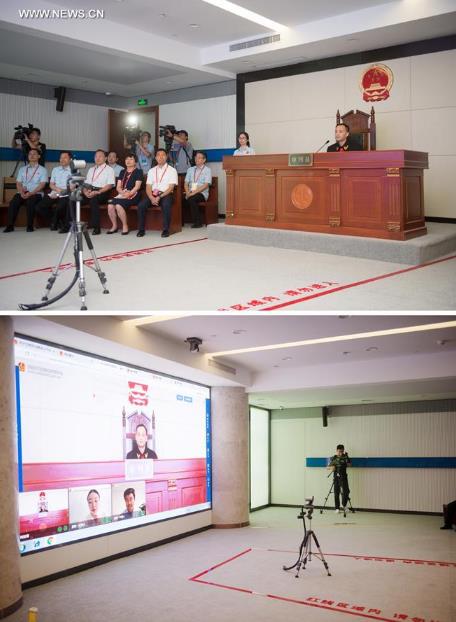
China launches first Internet court in e-commerce hub

Combo photo shows the working process in a court room of the Internet court in Hangzhou, capital of east China’s Zhejiang Province, Aug. 18, 2017. The court, first of its kind in China, specializing in handling Internet-related cases, opened Friday to cater to the increasing number of online trade disputes and copyright lawsuits. The cases handled by the court will be tried online. [Photo/Xinhua]

China’s first court specializing in handling Internet-related cases opened Friday in the e-commerce hub of Hangzhou, capital of Zhejiang Province, to cater to the increasing number of online disputes.

The Hangzhou Internet Court heard its first case regarding a copyright infringement between an online writer and internet giant Netease on its opening day.

Sitting in front of their computers in Hangzhou and Beijing, the agents representing the plaintiff and the defendant communicated with the judge online. The trial lasted about 20 minutes.

“The Internet court breaks geographic boundaries and greatly saves time in traditional hearings,” said Wang Jiangqiao, vice president of the court.

The court mainly handles civil cases such as contract disputes involving online shopping, service and small loans, copyright and infringement lawsuits, domain name dispute, Internet defaming and some administrative lawsuits.

It will also handle certain cases assigned by superior courts.

By registering on court’s website, plaintiffs can file lawsuits and pay legal costs. The cases handled by the court will be tried online. The process is quicker, and plaintiffs and defendants can have their disputes handled while at home and at much lower cost.

“The hearing of an Internet-related case often lasts at least two days and each side has to spend thousands of yuan to travel to the court,” said Zhang Sijia, a lawyer.

“We are involved in cases all over the country and the costs are too high to attend every lawsuit. Sometimes even if we win the case, we lose a huge amount of money in the process. It will significantly lower our costs if we can have them done online,” said Yang Wei, vice president of Netease.

The opening of the court is along with the fast growing internet users and the consequent online disputes in China.

According to the latest report from the China Internet Network Information Center, China had about 751 million Internet users and 724 million mobile Internet users as of the end of June.

As China pushes its Internet Plus and innovation strategies, the Internet is playing an increasingly important role in the country’s economic transformation. China is home to a number of Internet giants such as Alibaba, Baidu and Tencent.

The income of China’s top 100 Internet companies rose 46.8 percent year-on-year to 1.1 trillion yuan (about 164 billion U.S. dollars) in 2016, latest official data showed.

It was the first time the total has surpassed one trillion yuan, according to calculations by Ministry of Industry and Information Technology and the Internet Society of China.

But the country is also seeing a surge in cyber disputes as more people go online to shop, publish their works and manage finance.

In 2015, the Zhejiang provincial higher people’s court initiated a pilot online court program at three district courts in Hangzhou to handle online trade, copyright and financial services disputes.

So far, a total of 15 courts in Zhejiang have joined the program and dealt with nearly 23,000 cases.

“With more cases accepted, we found it hard to judge a case according to traditional lawsuit regulations,” said Li Shaoping, deputy head of Supreme People’s Court.

The Internet court was therefore outlined at the 36th meeting of the Central Leading Group for Deepening Overall Reform in June as the latest effort to deepen judical reform through lifting the efficiency of justice, improving the hearing procedures of Internet-related cases and promoting the sound development of the Internet industry.

The new court allows both sides to submit evidence in real time and is connected with big data to help judges make decisions.

“For example, the system can present the judge with similar cases as references in the course of the proceeding,” said Wang. “The judge can also check the transaction history at any time when dealing with cases involving online transaction disputes.”

“By setting up the Internet court, we hope to establish a professional platform to deal with Internet-related cases with new concepts and specially-designed regulations,” Li said.

Zhou Hanhua, law researcher with the Chinese Academy of Social Sciences, said the Internet court involved the use of information technology in judicial procedures and process transformation.

The reform should try to let everyone feel justice in each case, he added.