Results of the Q3 2017 ECB Survey of Professional Forecasters

PRESS RELEASE

21 July 2017

  • HICP inflation expectations have been revised downwards for 2017, 2018 and 2019. Longer-term HICP inflation expectations remain unchanged at 1.8%.
  • Expectations for HICP excluding food and energy have been revised upwards for 2017, but remained unchanged for forecast horizons further out.
  • Real GDP growth expectations have been revised upwards for 2017, 2018 and 2019.
  • Unemployment rate expectations have been revised downwards.

Respondents to the ECB Survey of Professional Forecasters (SPF) for the third quarter of 2017 reported average point forecasts for inflation of 1.5%, 1.4% and 1.6% in 2017, 2018 and 2019, respectively. That represents downward revisions of 0.1 percentage points at each of those three horizons. Average longer-term inflation expectations (which referred to 2022) remained unchanged at 1.8%.

Expectations for the annual inflation rate of HICP excluding food and energy were revised upwards for 2017, to 1.1%, but remained unchanged for all other forecast horizons (1.3% in 2018, 1.5% in 2019 and 1.7% in 2022).

SPF respondents revised their expectations for growth in euro area economic activity upwards for 2017 and 2018 by 0.2 percentage points to 1.9%, and 1.8%, respectively. Expectations for economic growth in 2019 were revised up by 0.1 percentage points to 1.6%. There were no changes to longer-term economic growth expectations (1.6%).

Unemployment rate expectations continued to show a declining trajectory. The average point forecasts were 9.2%, 8.8% and 8.4% for 2017, 2018 and 2019, respectively. Relative to the SPF for the second quarter of 2017, this represents downward revisions of 0.2, 0.3 and 0.3 percentage points for 2017, 2018 and 2019, respectively. The average point forecast for the longer-term unemployment rate (which referred to 2022) was revised downwards by 0.3 percentage points, to 8.1%.

Table: Results of the ECB Survey of Professional Forecasters for Q3 2017

(annual percentage changes, unless otherwise indicated)

Survey horizon

2017

2018

2019

Longer term (1)

HICP inflation


SPF Q3 2017

1.5

1.4

1.6

1.8

Previous SPF (Q2 2017)

1.6

1.5

1.7

1.8

HICP inflation excluding food and energy

SPF Q3 2017

1.1

1.3

1.5

1.7

Previous SPF (Q2 2017)

1.0

1.3

1.5

1.7

Real GDP growth


SPF Q3 2017

1.9

1.8

1.6

1.6

Previous SPF (Q2 2017)

1.7

1.6

1.5

1.6

Unemployment rate (2)


SPF Q3 2017

9.2

8.8

8.4

8.1

Previous SPF (Q2 2017)

9.4

9.1

8.7

8.4

1) Longer-term expectations refer to 2022 in the Q3 2017 SPF and to 2021 in the Q2 2017 SPF.

2) As a percentage of the labour force.

For media enquiries, please contact Stefan Ruhkamp, tel.: +49 69 1344 5057.

  • The ECB Survey of Professional Forecasters (SPF) is conducted on a quarterly basis and gathers expectations for the rates of inflation, real GDP growth and unemployment in the euro area for several horizons, together with a quantitative assessment of the uncertainty surrounding them. The participants in the survey are experts affiliated with financial or non-financial institutions based within the European Union. The survey results do not represent the views of the ECB’s decision-making bodies or of its staff. The next Eurosystem staff macroeconomic projections will be published on 7 September 2017.
  • Since 2015 the results of the SPF have been released on the ECB’s website. For surveys prior to the first quarter of 2015, see the ECB’s Monthly Bulletin (2002-14: Q1 – February, Q2 – May, Q3 – August, Q4 – November).
  • The SPF survey for the third quarter of 2017 was conducted between 3 and 7 July. The total number of responses was 56, broadly comparable with the average number of responses to surveys in the third quarter of a year (54).
  • The SPF report and data are available via the SPF webpage and via the ECB’s Statistical Data Warehouse.
Media contacts

Euro banknote counterfeiting remains low in first half of 2017

PRESS RELEASE

21 July 2017

  • 331,000 counterfeit euro banknotes were withdrawn from circulation in the first half of 2017
  • Around 85% of the counterfeits were €20 and €50 banknotes
  • All euro banknotes can be verified using the “feel, look and tilt” method
  • Euro banknotes continue to be a trusted and safe means of payment

Some 331,000 counterfeit euro banknotes were withdrawn from circulation in the first half of 2017, a decrease compared with the second half of 2016. The likelihood of receiving a counterfeit is thus very slight. The number of counterfeits remains very low compared with the number of genuine banknotes in circulation, which has risen steadily, at rates above GDP growth, since they were introduced. In 2016, for instance, the number and value of euro banknotes in circulation grew by around 7.0% and 3.9% respectively. There are now over 20 billion euro banknotes in circulation, with a total value of more than €1.1 trillion.

The half-yearly trend is shown below:

Period

2014/1

2014/2

2015/1

2015/2

2016/1

2016/2

2017/1

Number of counterfeits

331,000

507,000

454,000

445,000

331,000

353,000

331,000

Breakdown by denomination:

Denomination

€5

€10

€20

€50

€100

€200

€500

Percentage breakdown

1.0%

2.4%

36.9%

47.6%

9.0%

1.6%

1.5%

During the first half of 2017:

  • the €20 and €50 notes continued to be the most counterfeited banknotes. Together, they accounted for 85% of the counterfeits;
  • most of the counterfeits (96.7%) were found in euro area countries. Around 2.3% were found in EU Member States outside the euro area and 1.0% were found in other parts of the world.

Check your banknotes!

Ever since the first series of euro banknotes was issued, the Eurosystem – i.e. the ECB and the 19 national central banks of the euro area – has encouraged people to be vigilant when receiving banknotes. You can check your notes by using the simple “feel, look and tilt” method described in “The €uro” section of the ECB’s website and on the websites of the national central banks. If you receive a suspect banknote, compare it directly with one you know is genuine. If your suspicions are confirmed, please contact the police or – depending on national practice – your national central bank or your own bank. The Eurosystem supports the law enforcement agencies in their fight against currency counterfeiting.

The Eurosystem communicates in various ways to help people distinguish between genuine and counterfeit notes, as well as to help professional cash handlers ensure that banknote-handling and processing machines can reliably identify and withdraw counterfeits from circulation.

The Eurosystem has a duty to safeguard the integrity of the euro banknotes and continue improving banknote technology. The second series of banknotes – the Europa series – is even more secure and is helping to maintain public confidence in the currency.

The new €50 banknote, with its innovative security features, was launched on 4 April 2017. Banknote equipment manufacturers and other suppliers will continue to receive support from the Eurosystem in adapting their machines and authentication devices to the new banknote. If their equipment is still unable to accept this banknote, operators/owners should contact their suppliers or manufacturers without delay.

For media queries, please contact Eszter Miltényi-Torstensson, tel.: +49 69 1344 8034.

Media contacts

Terna: EIB lends EUR 130 million for “Italy-France” interconnector

Italy-France Interconnector

Italy-France Interconnector

Terna: EIB lends EUR 130 million for “Italy-France” interconnector

21/07/2017

EIB

[Rome, Italy]

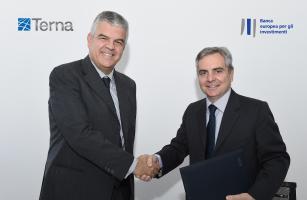
An agreement was signed today between Terna and the European Investment Bank (EIB) for a EUR 130 million loan in support of investments for the public component of the “Piedmont-Savoy” project, the new 320 kV direct current electricity interconnector that will link Italy and France. The loan has a term of 22 years and a fixed interest rate of 1.64%.

“We are very proud of the contribution that the European Investment Bank has chosen to provide to this strategically important project, which will make Europe’s entire power grid more efficient and safer and help to implement the single electricity market”, remarked Luigi Ferraris, Terna’s CEO. “The interconnector with France is an innovative project that is unique globally thanks to the engineering solutions adopted, combining sustainability and development, as provided for in Terna’s investment plan for the country.”   

“This operation confirms the EU bank’s engagement in the vital sector of energy networks and further consolidates its fruitful partnership with Terna: in recent years we supported with EUR 1 billion financings in total the Italian network operator’s key investment plans to upgrade and develop the electricity transmission network”, said EIB Vice-President Dario Scannapieco.

The high-voltage power interconnector between Piossasco (Italy) and Grande-Île (France) known as “Piedmont-Savoy” provides for an overall cross-border exchange capacity (combining public and private components) of 1 200 MW. The project will use technological solutions that are unprecedented globally and has been identified by the European Commission as a project of common interest (PCI) at Community level. With a length of 190 km, equally distributed between Italy and France, this will be the world’s longest direct current cable power line, fully integrated within the transmission infrastructure system and therefore ‘invisible’.

The project confirms Terna’s culture in terms of sustainability and respect for the land and is consistent with the strategy of growth designed to combine investment with the objectives of greater safety, minimal environmental impact and lower grid costs. The operation also comes under the EIB’s financing priorities in the fields of energy and environment.

When the work has been completed – the power line is expected to be operational by the end of 2019 – “Piedmont-Savoy” will be the fourth interconnector between Italy and France, serving to increase the exchange capacity between the two countries by some 40% and bolstering the integration and competitiveness of the electricity market, in line with EU strategy.

EIB to finance upgrade of Alliander electricity grid in the Netherlands

Dutch network company Alliander has signed a EUR 300 million loan agreement with the European Investment Bank

The loan will be used to finance parts of the renewal and expansion of the distribution network used by Liander, a subsidiary of Alliander, to distribute electricity to customers. This investment will contribute to make the network future-proof. The investment programme is expected to be completed in late 2018.

“Network operators play an important role in the transition to a sustainable energy supply in the future, this will require substantial investments. The EIB is very pleased to be able to contribute to this through this loan,” says EIB Vice-President Pim van Ballekom. “Alliander is a new client for the bank. Every day Alliander reaches more than three million customers in the Netherlands, meaning it plays an important role in society; that is an important factor for the Bank when considering whether to award a loan.”

Mark van Lieshout, Alliander’s CFO adds: “With this loan the EIB contributes to the diversification of our funding sources, and will be financing part of our investments over the coming years. These investments are necessary to enable the transition to a sustainable energy supply and ensure that the energy supply in the future will remain affordable, reliable and accessible.”

Improvements will be made to the grid in the areas where Liander operates: the Provinces of Gelderland and North Holland, large parts of the Provinces of Friesland and Flevoland and part of the Province of South Holland.

Press release: Appointment of Lord and Lady Justices of Appeal: 21 July 2017

The Queen has been pleased to approve the appointment of Mrs Justice Asplin as Lady Justice of Appeal and the following as Lord Justices of Appeal: Mr Justice Coulson, Mr Justice Holroyde, Mr Justice Peter Jackson, Mr Justice Leggatt, Mr Justice Newey and Mr Justice Singh.

These appointments will fill forthcoming vacancies in the Court of Appeal arising from autumn 2017.

These appointments are to be made in light of forthcoming retirements in the Court of Appeal and vacancies that arise as a consequence of a number of changes including the appointment of Sir Ian Burnett as Lord Chief Justice and Sir Adrian Fulford as Investigatory Powers Commissioner.

The appointment of Lord and Lady Justices of the Court of Appeal are made by Her Majesty The Queen on the advice of the Prime Minister and the Lord Chancellor following the recommendation of an independent selection panel.

Selection panel

The selection panel was chaired by the Lord Chief Justice, Lord Thomas of Cwmgiedd. The other panel members were Sir Terence Etherton, the Master of the Rolls; Lord Kakkar, the Chairman of the Judicial Appointments Commission; and two lay Commissioners of the Judicial Appointments Commission: Professor Noel Lloyd and Professor Emily Jackson.

In accordance with section 79 of the Constitutional Reform Act 2005 as amended by the Crime and Courts Act 2013, the panel determined the selection process to be followed. In accordance with s10(3) of the Senior Courts Act 1981, the selection exercise was open to applicants that satisfied the judicial eligibility condition on a 7-year basis or were Judges of the High Court.

Appointments

Mrs Justice Asplin

Called to the Bar (Gray’s Inn) in 1984. She was appointed both a Master of the Bench and Queen’s Counsel in 2002. She was made a Deputy High Court Judge in 2007 and a Justice of the High Court (Chancery Division) in October 2012. She is responsible for issues and co-ordination in relation to litigants in person on behalf of the Judiciary and has written a Guide to the Chancery Applications Court for Litigants in Person.

Mr Justice Coulson

Called to the bar (Gray’s Inn) in 1982 after graduating from the University of Keele. He became a well-respected junior at the Technology and Construction Bar from 1983 onwards. He was appointed Queen’s Counsel in 2001 and he became a Recorder the same year. In 2004, he was appointed a Senior Circuit Judge in the Technology and Construction Court. In 2008 he was appointed as a High Court Judge in the Queen’s Bench Division. He was a presiding Judge of the North Eastern Circuit between 2011 and 2014. He was appointed as the Judge in Charge of the Technology and Construction Court in 2016.

Mr Justice Holroyde

Called to the bar (Middle Temple) in 1977 and took silk in 1996. He was appointed as a Recorder in 1997 and as a High Court Judge in the Queen’s Bench Division in January 2009. He was a Presiding Judge on the Northern Circuit from 2012 until 2015.

Mr Justice Peter Jackson

Called to the bar (Inner Temple) in 1978 and took silk in 2000. He was appointed as a Recorder in 1998, a Deputy High Court Judge in 2003 and a High Court Judge in the Family Division in October 2010.

Mr Justice Leggatt

Called to the Bar (Middle Temple) in 1982. He practised as a barrister specialising in commercial law. He was appointed Queen’s Counsel in 1997. He became a Recorder of the Crown Court in 2002 and a Deputy High Court Judge in 2008. He was made a Justice of the High Court (Queen’s Bench Division) in October 2012.

Mr Justice Newey

Called to the Bar (Middle Temple) in 1982. He practised at the Chancery Bar between 1983 and his appointment as a High Court Judge at the beginning of 2010. Before taking silk in 2001, he was one of the Junior Counsel to the Crown (Chancery/A Panel) (from 1990) and Junior Counsel to the Charity Commissioners (from 1991). In 2003 he became an (Acting) Deemster of the Isle of Man, and in 2006 he was appointed as a Deputy High Court Judge. He also served as a DTI inspector, inquiring into the affairs of MG Rover and associated companies. He has been the Chancery Supervising Judge for the Midland, Wales and Western Circuits since 2014.

Mr Justice Singh

Called to the Bar (Gray’s Inn) in 1989 and was appointed Queen’s Counsel in 2002. His practice was mainly in the areas of public law, human rights and employment law. He was one of the Junior Counsel to the Crown, serving on the A Panel from 2000 to 2002. He was also the Additional Junior Counsel to the Inland Revenue from 1997 to 2002 and Chair of the Administrative Law Bar Association from 2006 to 2008. He was appointed as a Deputy High Court Judge in 2003 and a Recorder of the Crown Court from 2004. He was appointed as a High Court Judge in 2011. He was a Presiding Judge on the South Eastern Circuit from January 2013 until December 2016.