Most births this year added a child beyond first one

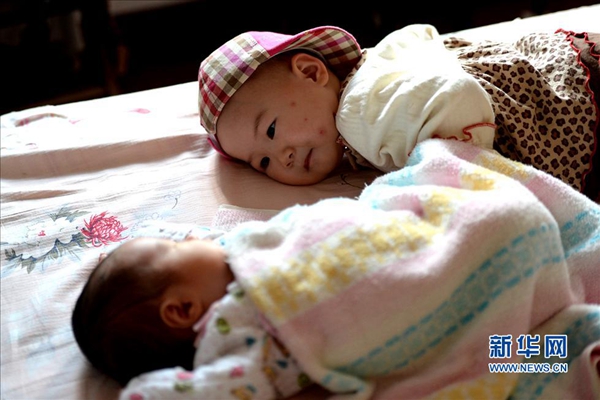
A baby girl lies on the bed with her younger brother in Liuzhou City, Guangxi Province. [Photo/Xinua]

More than half of the births in China during the first five months of the year involved a second child – or even additional ones – more than a year after the universal second-child policy was introduced in January 2016, according to China’s top health authority.

The number of births at Chinese hospitals between January and May was 7.4 million, an increase of 7.8 percent over the same period last year, Wang Peian, vice-minister of the National Health and Family Planning Commission, said at an annual meeting of the China Population Association held in Kunming, Yunnan Province, last week.

Of all births in the first five months, 57.7 percent were at least the second child of their parents, an increase of 8.5 percentage points over the same period last year, he said.

The total number of births at hospitals in China last year was about 18.5 million, the highest level since 2000, according to the commission. More than 99 percent of births in China take place in hospitals.

The universal second-child policy has produced good results, and the number of babies born has been increasing significantly despite a drop in the number of women of fertile age, Wang said.

Over the past year, health authorities have been improving measures to support the policy and establish a social environment that encourages childbirth, he said.

With an increasing number of pregnancies, China faces some health challenges in the next few years – for example, a significant number of the mothers are over 35 – according to health officials and doctors. The number of pregnant women over age 35 is expected to remain at about 3 million through 2020.

“Surveys show that many couples from the generation born in the 1970s who were hesitant about having a second child during the initial period when the universal second-child policy was adopted are now hurrying to give birth to a second child so they won’t miss that last chance,” Ma Xiaowei, another vice-minister of the commission, said last week.

In Guilin, in the Guangxi Zhuang autonomous region, more than 28 percent of women who gave birth last year were at higher risk in pregnancy and childbirth, according to a report in Guilin Evening News on Friday. One factor was age.

At Guilin Women and Children’s Hospital, doctors saved 140 pregnant women in critical condition in the first half of the year. The oldest pregnant woman treated so far this year was 56, the report said.

China introduced its family planning policy in the late 1970s to check its soaring population by limiting most urban couples to one child. Couples in rural areas could have a second child if the first one was a girl, and in some ethnic regions couples in rural areas could have more than two children.

A major policy change at the end of 2013 allowed couples nationwide to have a second child if either parent was an only child. That limitation was erased last year.

Beijing police hunt for attacker after fatal hit-and-run

The Beijing police are hunting for a man who allegedly stabbed five people and committed a hit-and-run that killed one and injured eight others on his way to escape on Sunday.

The suspect hurt five people with a scissor around 3 p.m. in Jugezhuang Township in the suburban district of Miyun and fled on a van. His van then hit nine people, leaving one dead and eight injured, according to the police.

The injured are being treated in hospital. The Miyun police are searching for the suspect who is still at large.

Public comment sought on Beijing-Xiongan rail

An environmental impact assessment for a new high-speed railway linking Beijing and Xiongan New Area was released on Saturday. It was the first public acknowledgment that a new line will be built.

China Railway Design Corp announced the assessment on its website and is seeking public comment.

According to the notice, the Beijing-Xiongan railway will start at Liying in Beijing’s Daxing district, pass through Langfang and terminate at Xiongan East Railway Station-a total length of 100.3 kilometers.

The new line will also pass through the capital’s new airport, which will be about 36 km from Liying and about 64 km from Xiongan New Area. The airport is expected to open in 2019.

The existence of a railway plan was reported in April by Tianjin News. According to the report, a planning map showed two railway stations in the new area-Xiongan Railway Station and Xiongan East Railway Station. The environmental assessment covers the latter.

According to an earlier report, the Tianjin-Xiongan railway route will connect the area with Tianjin’s new railway station, which is also in the planning stages.

An older rail line is already in operation. Passengers must transfer in Baoding or Tianjin to get to the Xiongan area on high-speed rail.

Since July 7, four daily high-speed railway services have been started. The journey takes one hour and 50 minutes.

The new Beijing-Xiongan line follows a different route.

Xiongan New Area is located in the center of a triangular area defined by Beijing, Tianjin and Shijiazhuang, capital of Hebei province.

Located about 100 km southwest of downtown Beijing, the new area will mostly cover Xiongxian, Rongcheng and Anxin counties in Hebei.

It will eventually encompass 2,000 square kilometers, with a population of up to 2.5 million people.

Under the area’s development plan, a major transportation network should be in place in Xiongan by 2020. The area will be well connected to Beijing, Tianjin and other cities in Hebei by 2022, when the Winter Olympic Games will be held.

Xiongan New Area is intended to house the bulk of Beijing’s noncapital functions, including some administrative and public institutions, company headquarters, financial institutions, higher education institutions, and science and technology units.

“UK Government’s EU Withdrawal Bill could put us back decades” – warns Cabinet Secretary

Speaking at the Royal Welsh Showground, the Cabinet Secretary said devolution had enabled Welsh Government to create policies for the specific needs of Welsh farmers, with their input.  

The Cabinet Secretary said:

“Devolution has allowed us to tailor our policies for Welsh farmers with an understanding of their distinct needs. I’m worried the Withdrawal Bill, coupled with their lack of engagement with us to understand the needs of Welsh farmers, will mean this understanding is lost and the industry in Wales will move back decades.

“This view was clearly reflected in last week’s report from the House of Lords’ EU Committee, which fully supported our position on the future governance of the UK.

”In Wales we have a higher proportion of sheep farmers than in England and 90% of Welsh red meat exports go to the EU.  I want to make sure the support they currently get is not jeopardised by Brexit.”

The Bill as it stands means Wales will have fewer powers and flexibility than it had when in the EU. It would take away the Welsh Government’s ability to interpret EU law and tailor it for Welsh needs. It will give the UK greater power over issues such as farm payments and animal health, which have been devolved to Wales for almost two decades. 

The Cabinet Secretary reassured farmers she will continue to stand up for their interests. She will today meet with the Secretary of State for Environment, Food and Rural Affairs, Michael Gove, and will raise her concerns.

The Cabinet Secretary added:

“Since this process started we’ve been working with our stakeholders to make sure the approach we’re taking in Wales benefits everyone – something that’s not happening in England.  We’re taking this process seriously.  Our policy paper, Brexit and Devolution, highlights leaving the EU must be about the future, not the past. We want to work with England, Scotland and Northern Ireland to develop a strong future which benefits everyone.

“Today I’m meeting with Michael Gove and I’ll be raising all these concerns with him.  I’ll be making clear this Bill has shown a complete disregard for devolution as did his decision to cancel the next two planned meetings of UK agriculture and environment ministers.  These meetings are crucial as the negotiations move forward and cancelling them shows a complete lack of commitment to working together.”

As part of a continued programme of actions to support the specific needs of the Welsh food and farming industry the Cabinet Secretary will this week announce Wales will join the Atlantic Area Food Export Programme, meaning SMEs will benefit from €1.8million to increase their competitiveness in international markets.  

The Cabinet Secretary said:

“We’ll continue to rally behind the Welsh food and drink industry – only last week new figures showed the industry had grown by almost 20% over the past year and we want to see it continue to grow year on year with our support.” 

Amid rising violence in Jerusalem, UN and diplomatic partners urge maximum restraint on all sides

23 July 2017 – Expressing deep concern about the escalating tensions and violent clashes taking place in and around the Old City of Jerusalem, the United Nations and its diplomatic partners in the Middle East peace process have called on all to demonstrate maximum restraint and work towards de-escalating the situation.

In a statement issued late yesterday, the envoys of the so-called Middle East Quartet &#8211 comprising the UN, Russia, the United States and the European Union &#8211 strongly condemned acts of terror, and expressed regret for all loss of innocent life caused by the violence, and hope for a speedy recovery to the wounded.

The statement comes in the wake of a series of deadly stabbings, other violent incidents and rising tensions in and around Jerusalem’s Old City since mid-June, particularly near the holy site known as the Temple Mount and as Haram al-Sharif.

Noting the particular sensitivities surrounding the holy sites in Jerusalem, and the need to ensure security, the Quartet envoys called on all to demonstrate maximum restraint, refrain from provocative actions and work towards de-escalating the situation.

Through their statement, the envoys welcomed the assurances by the Prime Minister of Israel that the status quo at the holy sites in Jerusalem will be upheld and respected. Further, the Quartet encouraged Israel and Jordan to work together to uphold the status quo, noting Jordan’s special role as recognized in its peace treaty with Israel.

The Quartet envoys reiterated that violence deepens mistrust and is fundamentally incompatible with achieving a peaceful resolution of the Israeli-Palestinian conflict, the statement concluded.