Crude oil production during June, 2017 was 2984.50 TMT which is 2.13% lower than target but 0.60% higher when compared with June 2016.
Jul242017
Jul242017
Crude oil production during June, 2017 was 2984.50 TMT which is 2.13% lower than target but 0.60% higher when compared with June 2016.
Jul242017
The Ceremony of assumption of office by Shri Ramnath Kovind, the President-elect will be held on Tuesday, the July 25, 2017, at 12.15 PM in the Central Hall of Parliament House, New Delhi.
Jul242017
The public sector has collected much land and many buildings over the years. Managing this well can provide better conditions for employees and better results for taxpayers.
I am not one who thinks we should sell off our core estate, or go in for expensive financing through sales and leasebacks. I was critical of Gordon Brown doing some of this. It is cheapest and best to own the freehold of the core estate, and to take direct responsiblity for the maintenance and replacement of the buildings on the core estate. The UK government still has crucial sites with heritage buildings in Central London and elsewhere. Most Councils have good central sites, some with heritage buildings. Lets use them and look after them in the public sector.
In central London the Foreign Office, Downing Street, the Treasury, Parliament, the Scottish and Welsh Offices, the Banqueting Hall, the Queen Elizabeth Conference centre are all important sites and heritage buildings of varying ages. Keeping a strong central estate around the palaces of Westminster and Whitehall makes sense. Beyond the historic core it is good to have some other sites close to the action. The buildings for departments like Education, Business, Culture Media and Sport, Transport and the Home Office do not have the same architectural and historical significance as the heritage buildings. Some of this space may become surplus to overall Whitehall requirements, and some of the properties where the state is freeholder may be suitable for substantial redevelopment. Sub letting to other users in some cases may be a good source of revenue whilst keeping land holdings that could be useful. The further from the core, the better the case for disposal of surplus accommodation.
Beyond central London there are huge MOD holdings. There is some move away from the most valuable areas. In my own constituency the army has moved out from its large Arborfield base so that can be sold for the taxpayers and transformed into private housing. There needs to be suitable forces housing supplied elsewhere. I continue to campaign for a home base approach for all three services where single or family accommodation is provided for service personnel at a constant place where their children can go to school and their loved ones can live or be nearby without constant change.
There is some movement down in total numbers of public service employees, as various services come to rely more on computing power. This over time frees space for disposal or re letting. As a general policy aim those officials who need regular and easy access to Ministers should come to live on the heritage estate near to Parliament. Major centres of public sector employment should be away from highly stressed and expensive parts of the country. As more comes to be done on line so there will be mroe scope to streamline local offices, and to create more one stop shops incorporating more than one government fucntion or department.
The government is going over to a system of centrally managed estates with rental charges to departments for use whether the state is paying rent to a third party or owns the building. This should inject more discipline into property use, and could also lead to a demand for higher standards of services and interior fitment from client departments. This would be good for morale.
Jul242017
Good afternoon. I would like to thank the Minister for Defence, the Honourable Mr Dominic Nitiwul for hosting this event.
His Excellency Kofi Annan was a trailblazer – the first UN career official to be appointed Secretary-General and the first from Sub-Saharan Africa. This training centre which bears his name is also blazing a trail. It is at the cutting edge of peace support training and education in Africa, and the only centre of its kind on the continent to have a dedicated institute for Women, Peace and Security. Over fifteen thousand students from around the world have trained here since 2004. That’s an impressive contribution to global peacekeeping. It’s typical of Ghana’s commitment to UN Peacekeeping, from Congo in the 1960s, to South Sudan today – Ghana has always been in the top tier of countries contributing peacekeepers. Back in 2015, when President Obama called on fellow leaders at the UN to commit more resources to peacekeeping operations, Ghana once again answered the call.
It is also typical of the contribution of other African nations. Currently almost half of the men and women in uniform at Peacekeeping missions around the world are African. I want to pay tribute to your commitment, and to remember those peacekeepers who have given their lives for peace.
Today I want to look to the future. I want to talk about the UK’s commitment to better peacekeeping and the 3Ps reform agenda. I want to talk about our work on ending sexual violence and stigma. And finally I want to talk about getting more women involved in peacekeeping, and gender issues more broadly.
The United Kingdom is a long-standing supporter of peacekeeping, although compared to Ghana I recognise that our contribution of troops is still modest. Today, we have around seven hundred British soldiers in blue berets. We have doubled our contribution since committing to do so two years ago, with two new deployments to UN missions in Somalia and South Sudan: our first in two decades.
The UK is also committed to better peacekeeping. The joint Communiqué signed at the London Peacekeeping Defence Ministerial last September is a blueprint for peacekeeping reform.
It calls for improvement in three areas – the 3Ps of peacekeeping – planning, pledges and performance.
Better planning is about ensuring better coordination across the UN system so that we can get the right missions with the right skills deployed to the right place at the right time. The UK has invested significantly in the Secretary General’s Strategic Planning and Analysis Unit, which has led to advances in the UNs ability to identify the needs of missions, and match them with the capabilities offered by member states.
Pledges are about helping the UN to identify and meet the specific needs of each mission. In November the UK will co-host Canada’s Peacekeeping Defence Ministerial in Vancouver. We will explore smart pledging and innovations in training; look at how we protect those at risk; and consider a rapid response to the early warning signs of conflict.
Finally, having the right plan and the right people in place only works if they perform effectively. That’s why performance is so important. We need to see strong leadership of peacekeeping mission and ensure that troops are doing the job they have been sent to do. The UN needs to be able to take action against troops who do not meet this standard.
When that performance falls below the level that is expected it puts the mission at risk. It can also bring the mission and the UN into disrepute. Such is the case with the appalling sexual abuse, committed by a small number of peacekeepers against the people they were sent to protect. Such crimes are abhorrent; they cannot be allowed to continue.
As the Prime Minister’s Special Representative on Preventing Sexual Violence, as well as Minister for the UN, I applaud the efforts of Ghana and of this Centre in particular, to tackle this difficult issue, through courses addressing the challenges of preventing sexual violence in conflict. We want to see more coordination between member states that need training and those that can offer it.
For our part, I am proud that the UK has delivered training for more than seven thousand African peacekeepers each year since 2014, on gender issues and the prevention and response to conflict-related sexual violence. We must do everything possible to improve the performance of peacekeepers and to ensure they properly protect the people in their care.
I know Secretary-General Guterres is reviewing the UN’s peace and conflict prevention structures. I hope his recommendations will lead to improvements in planning, pledges and performance.
I want to turn now to the role of women. Safeguarding women’s rights; ensuring that they take part in political processes; and that they participate fully in conflict resolution are all priorities for the United Kingdom. We have given the UN £2m to help achieve this aim.
I spoke earlier about my particular role with regard to preventing sexual violence. One of my priorities is tackling the stigma that many survivors of sexual violence face. The UK is developing a set of Principles for Global Action, to help policy makers understand how they can incorporate this critical issue into their own work. I look forward to working with Ghana on this initiative.
I also hope that we can follow your example of deploying women at all levels in peacekeeping missions. One in ten of Ghana’s peacekeepers are women, the highest percentage of the top 10 troop contributing nations. I am sure this is down to the excellent training this centre provides. This, and the Women, Peace and Security Institute here, demonstrate Ghana’s commitment to this issue.
By way of comparison, 7% of UK Peacekeepers are women. We are working hard to increase that number and I am very pleased that we will have a female commanding officer leading our troops in South Sudan.
Ladies and gentlemen, I hope I have shown you the UK’s commitment to working for better peacekeeping. It is a privilege to be discussing it with you – in a centre dedicated to doing just that. With the growing demands on peacekeeping, it is more important than ever that we work together to make the UN system and our missions as effective as they can be. I look forward to hearing about your experiences and your views on how we can tackle the many challenges ahead. Thank you.
Jul242017
|
|
|
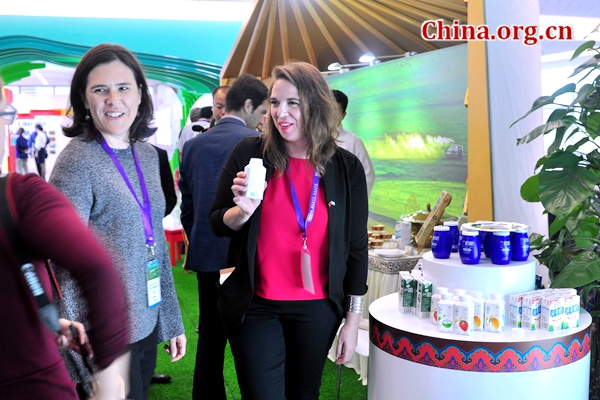
International attendees enjoy dairy products made in Inner Mongolia Autonomous Region during an exhibition promoting the region’s socioeconomic and cultural development on July 21. [Photo by Guo Yiming/China.org.cn] |
North China’s Inner Mongolia Autonomous Region held a promotional event to present its socioeconomic and cultural development globally in Beijing on July 21 in the run up to its upcoming 70th anniversary celebration.
The event, co-organized by the Ministry of Foreign Affairs (MFA) and the People’s Government of Inner Mongolia Autonomous Region, showcased major milestones since the establishment of the region under the leadership of the Communist Party of China (CPC) in 1947 through an exhibition including photos, industrial and agricultural products, cultural heritages and ethnic costumes.
In his opening remarks, the Foreign Minister Wang Yi recognized the huge achievement made by the people of various ethnic groups in Inner Mongolia, the country’s first autonomous region of minority nationalities.
Wang particularly mentioned the two “business cards” of Inner Mongolia, i.e. its open trade both historically and in modern times as well as its ecological and green development in the desertification-prone landscape.
He called for people around the world to come and explore the magnificent region.
John McKinnon, New Zealand’s ambassador to China, said that New Zealand has many links with Inner Mongolia as he outlined existing connections and similarities in areas including the dairy industry and animal husbandry.
He also foresees a big step forward in the region’s tourism potential and hopes that the two sides can expand interaction and exchanges under the Belt and Road Initiative.
More than 500 people including diplomatic envoys and representatives in China from almost 130 countries, international organizations, Chinese and foreign experts and scholars, delegates from industrial and commercial sectors, as well as journalists attended the event.
Bordering Mongolia and Russia, Inner Mongolia Autonomous Region covers an area of 1.18 million square kilometers of which the majority is grasslands. Its main strength lies in dairy production, animal husbandry, agriculture, tourism, new energy and mineral resources.