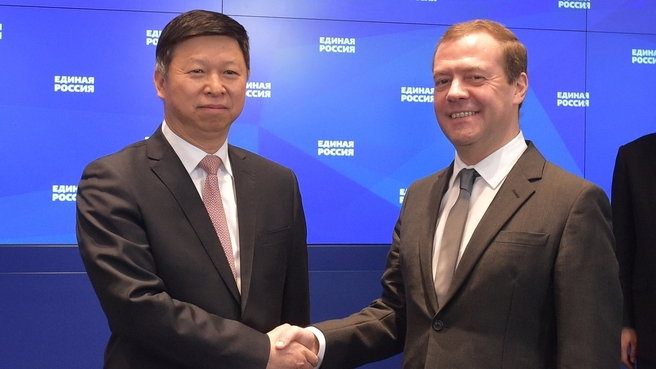
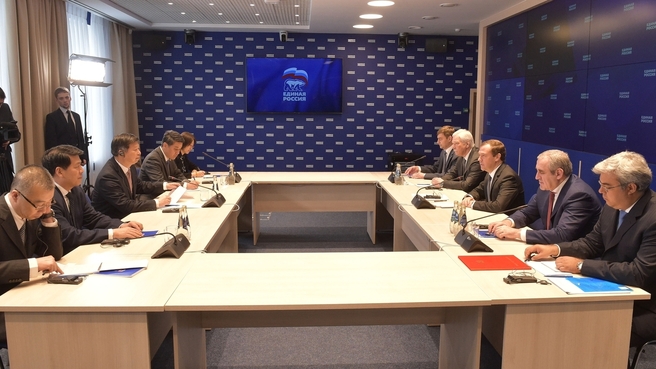
Dmitry Medvedev meets with Head of the International Department of the Communist Party of China Central Committee Song Tao

image_pdfimage_print

Excerpt from the transcript:

Meeting with Head of the International Department of the Communist Party of China Central Committee Song Tao

Dmitry Medvedev: Your Excellency, Head of the International Department of the Communist Party of China Central Committee Song Tao, Chinese friends, I would like to welcome you to the headquarters of United Russia party on Kutuzovsky Prospekt, where its Central Executive Committee is located.

I know that you have already had meaningful consultations within the framework of party-to-party dialogue in Kazan, where an interparty forum was held. I have discussed it with my colleagues, and they told me that it was an interesting and very useful event.

The relations between our countries have reached a very high level, not only when it comes to interstate relations, but also with relations between the ruling parties, the Communist Party of China and United Russia. It is for this reason that consultations of this kind are even more valuable.

This year, a plethora of events is scheduled on the state and party levels. We are looking forward to meeting our colleagues. I ask you to convey my best wishes to the President of the People’s Republic of China Xi Jinping and Prime Minister Li Keqiang. There will be a meeting with President Xi Jinping in July as part of his visit to Russia. The 22nd regular meeting of heads of government will take place in October 2017 in China. So you see, there will be quite a few contacts.

Of course, I would like to wish you every success in preparing for and holding the 19th Congress of the Communist Party of China, which will have great importance for the development of your country.

Once again, welcome. I’m very glad to meet you.

Song Tao (via interpreter): I am glad for this meeting with our colleagues. First of all, allow me to convey the best wishes of General Secretary Xi Jinping and Premier of the State Council Li Keqiang. I would like to take this opportunity to once again congratulate you on your reelection as Chairman of United Russia party at the recent congress.

This time, I am in Russia at the instructions of General Secretary Xi Jinping. He often says that bilateral relations between China and Russia are those that matter the most in today’s world, and are the best relations between the great powers. No matter how the international situation changes, China will always be committed to its relations with Russia as those of a comprehensive partnership and strategic cooperation. President Vladimir Putin and President Xi Jinping have reached major agreements regarding the development of our relations and promoting our centuries-old friendship.

As you have said, there are a number of important events coming up. In May, President Vladimir Putin will travel to China to attend the One Belt, One Road summit, and in September, he will attend a regular meeting of BRICS heads of state. A number of meetings between the two heads of state are expected to take place. You will also travel to China on an official visit.

Close bilateral contacts are indicative of the high level of relations between China and Russia. I think that as global powers, China and Russia are able to influence the international situation in meaningful ways, and they need to step up their strategic cooperation and enhance mutual trust in the interests of stability and peace on the planet.

< …>

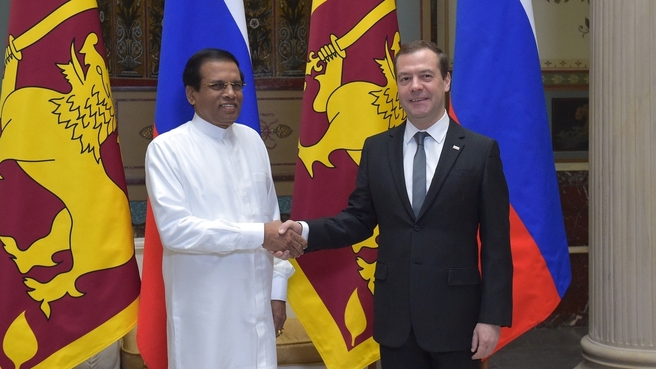
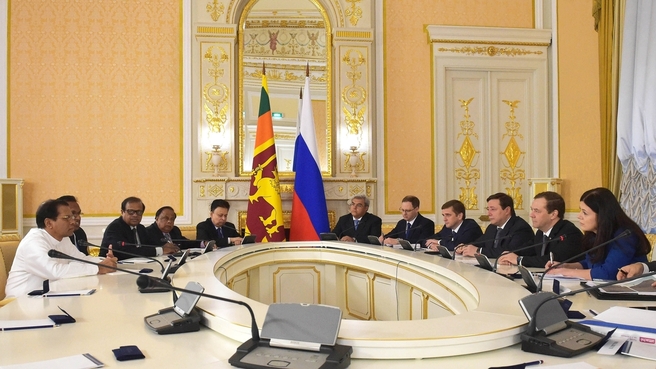
Dmitry Medvedev’s meeting with President of Democratic Socialist Republic of Sri Lanka Maithripala Sirisena

image_pdfimage_print

The parties discussed topical issues concerning Russian-Sri Lankan cooperation in the field of trade, economy, humanitarian and cultural issues.

Excerpts from the transcript:

Dmitry Medvedev’s meeting with President of Sri Lanka Maithripala Sirisena

Dmitry Medvedev: This is your first official visit to Russia marking 60 years of our diplomatic relations.

You have already had productive talks with President Putin. Now it is our turn to fulfill all the agreements reached at the meeting.

The relations between Russia and Sri Lanka have intensified. We established regular contacts between our foreign ministries, parliaments and defence ministries.

At the same time, there are a significant number of aspects that could strengthen our cooperation in trade, economy, humanitarian and cultural issues.

< …>

Establishing Sengilei Mountains National Park

image_pdfimage_print

The national park covering 43,697 hectares will be created in the Ulyanovsk Region, with the goal of preserving the unique woodland and steppe of the Middle Volga in the Sengilei Chalk Mountains.

Reference

Submitted by the Ministry of Natural Resources and Environment.

The Development Concept for the Specially Protected Areas of Federal Importance through 2020 (approved by Government Directive No.2322-r of 22 December 2011) provides for the establishment of Sengilei Mountains National Park in the Ulyanovsk Region.

The signed resolution provides for the establishment of Sengilei Mountains National Park (hereinafter the “national park”) covering a total of 43,697 hectares of the woodland reserve land (around 92 percent of the territory) and land under other ownership and usages (without prohibitions on economic activity).

The purpose of the national park is to preserve the unique woodland and steppe in the Middle Volga Region in the chalk mountains of Sengilei within the economic environment of the Ulyanovsk Region.

The territory of the national park is home to over 80 types of mushroom and over 800 plant species, over 50 mammals, over 140 bird species, 17 amphibians and reptiles, over 1,500 insect species and over 30 types of fish. Some species are under special protection and listed in the Red Data Book of Russia and the Ulyanovsk Region.

The cultural and historical heritage of the territory is particularly valuable. It dates back to the state of Volga Bulgaria that existed between the 10th and 13th centuries, with numerous settlements, villages, burial mounds and cemeteries. The unique scenery and relic plants combined with cultural landmarks are a draw for tourists, promoting eco-tourism both in the national park and the region.

The comprehensive environmental survey justifying its status as a specially protected area of federal importance was opened for public comment and passed a state environmental expert review.

The resolution creates legal framework to ensure special protection of the nature area and facilities within Sengilei Mountains National Park.

Doorstop after visit to cyclone affected areas in North Queensland

image_pdfimage_print

PRIME MINISTER:

Nature flings its worst at Australians and it has certainly happened here in The Whitsunday region but it is bringing out the very best.

I want to ask first Brigadier Chris Field, who is the Commander of 3rd Brigade and the State Recovery Coordinator to talk about the work that he is leading with State Emergency Services, Police and 1,300 members of the Australian Defence Force. We’re also here with the Opposition Leader Bill Shorten, the local Member George Christensen, the Mayor of The Whitsundays Andrew Willcox and the Liberal leader Tim Nicholls.

So, Brigadier?

BRIGADIER CHRISTOPHER FIELD, AM, CSC:

Thank you, Prime Minister. I’d firstly like to recognize the outstanding communities of North Queensland for the remarkable resilience in the face of this natural disaster. Also the state and local emergency services who are working nonstop and they’re still on their feet doing great work for Queensland.

The Australian Defence Force is well postured with both maritime land and air assets supporting the local efforts and will continue to do so.

As the area becomes more accessible over the next few days, you will see more and more Australian Defence Force assets joining our state and local government partners.

PRIME MINISTER: 

And Brigadier, the HMAS Melville is coming to provide water, fresh water and supplies to Daydream Island this morning?

BRIGADIER CHRISTOPHER FIELD:

Yes, Prime Minister, we’re fortunate the HMAS Melville has been on task conducting port surveys but she is also going to support the Daydream Island people with emergency support and also to do evacuations if required.

PRIME MINISTER:

And Andrew, you need to get some electricians in here to get the power back on?

MAYOR ANDREW WILLCOX:

Exactly right.

PRIME MINISTER:

Yeah, the Brigadier is going to fly them in from Townsville.

MAYOR ANDREW WILLCOX:

Appreciate the assistance, but also I appreciate the Prime Minister and the Opposition Leader Mr Shorten coming up into our area. There’s no politics in this, you’re just helping us out and we appreciate very, very much what you’re doing for us.

PRIME MINISTER:

Well the whole nation is united supporting you. Our Defence Forces, as I said, working with the police, the emergency services – we’ve met them, congratulated them, thanked them for their work. The resilience of the community is backed up by the whole nation.

And Bill, we’re on a unity ticket here today aren’t we?

LEADER OF THE OPPOSITION:

Yeah we are.

PRIME MINISTER:

Good on you, mate.

LEADER OF THE OPPOSITION:

I just want to add my words to the Prime Minister’s – we congratulate the strength of the local community.

Australians should realise that the storm may have passed but the work has just begun.

And we were privileged to see residents, small business people – they know they’ve got a power of work to do but the rest of Australia should not underestimate the degree of difficulty they face. There’s been a lot of rain. There’s a lot of infrastructure down. The people are still cut off from different areas in this local region. Australians should get behind them. But what I’d also say to insurance companies is the storm may have passed but there’s still obligations by insurance companies to people that have policies. And in coming weeks and days and months, all sides of politics will be vigilant to make sure that people’s legitimate and bona fide claims aren’t tied up in fine print and red print and legalese.

Again I just congratulate the community.

PRIME MINISTER:

Thank you.

JOURNALIST:

Prime Minister what can you tell the people of this region about what sort of federal assistance package will be in place?

PRIME MINISTER:

Right well all of the National Disaster Recovery Assistance is available. There’s assistance available right now, for immediate needs. We’ll be providing support for the reconstruction of local infrastructure. I’ve made an announcement today which will mean the council can get to work straight away, bringing on labour, using their own assets and they’ll get the benefit of the federally supported funding. The formula will be 75 per cent with a natural disaster of this scale – 75 per cent federal, 25 per cent state. But we’re making sure that those funds are going to flow and the council in particular can access it straight away.

So that’s very important to you isn’t it Andrew?

MAYOR ANDREW WILLCOX:

Exactly and thanks Prime Minister for fast-tracking that as well. We do appreciate it.

JOURNALIST:

Prime Minister what are the challenges like the lack of power and water? How concerned personally are you about rising anxiety and tension?

PRIME MINISTER:

Look, we understand the anxiety that people have, particularly when they’re out of fresh water. That’s why the ADF is getting fresh water out to the islands, and we have – how many helicopters do we have –  12 available right now. So they will be getting supplies out to remote communities, or communities that have been cut off.

George, a number of your communities here are going to be cut off for some days by road, aren’t they?

GEORGE CHRISTENSEN, MEMBER FOR DAWSON:

Well, they are. You can’t access Bowen, here, by road from the south or the north – same with Proserpine, same with Airlie Beach. Little communities up and down the rural northern coast from Mackay – like Midge Point, Seaforth, also cut off – so it is very, very difficult. And these people, yes, they probably are going to be frustrated as days pass by and they haven’t got services like power and water and even telephones being connected, but I think that everyone does recognise that it is challenging times with the weather and you know, the Ergon workers, the Telstra workers, the SES volunteers and our emergency service personnel are doing as good a job as they can in very, very trying circumstances, along with our ADF personnel that are assisting too.

PRIME MINISTER:

And we have the helicopters. We can move the emergency workers, the people from Ergon and Andrew were talking about the electricians to get the power back on. The roads are blocked – blocked for how long do you think?

BRIGADIER CHRISTOPHER FIELD:

Again, depending on the weather, we thought we were winning until we had that big storm last night and then we were back to actually square one. The weather report is that it is going to clear later on today. We are hoping that’s the case. Once we have got access, we can fix it.

PRIME MINISTER:

Chris, we’ll get those workers in quickly by helicopter, and so that they can get started. So we are getting that under way today.

JOURNALIST:

Prime Minister, what message will you take back to people in, say, New South Wales, Victoria, South Australia that obviously have no real understanding of what’s gone on here? How will you describe this to them?

PRIME MINISTER:

Well, this is, as I said, an example of nature flinging her worst at Australians. The people of The Whitsunday region, the people of North Queensland, Far North Queensland are very familiar with cyclones. They are very resilient, but the whole nation gets behind them and supports them.

Our ADF is here. Our 1300 men and women of the ADF, servicemen and women, are working here now. This is the largest pre-deployment of the Australian Defence Force in advance of a natural disaster in our history.

The Bureau of Meteorology did a great job in identifying this low, recognising that it could develop into a cyclone, and that’s why the planning was able to be put in place. And you’ve seen great leadership at the Local Government level, the state level, and at the federal level, working together.

So this is a very concentrated, team effort by all of our agencies, but above all, as the mayor and George understand best of all, as locals, the spirit of this community, the resilience of it.

Just talking to Michelle, you know, who was driving us around the town this morning – she has got a pumpkin farm that has been beaten up, she has got zucchinis that she says she was going to pick yesterday, so they are mush now.

So farmers right across this region will be hard-hit.

This area exports $450 million of farm produce a year. It is a food bowl and it is going to be hard-hit and it will take some time to recover. And that’s why we are here to show our support and our commitment.

As Bill said, this is a very bipartisan effort. We are all behind the people of The Whitsunday region, the people of North Queensland as they recover from this storm.

JOURNALIST:

Bill – it is a very short tour, but have you seen enough to actually get a good gauge?

LEADER OF THE OPPOSITION:

What I’ve seen is that the people here are going to have to work hard to get back on their feet, but what I’ve also seen is they will get back on their feet, and I agree with what Malcolm said.

And in the addition, what I would say to Australians, if you want to help in the medium to longer term – The Whitsunday region is a great place to holiday. They will tidy this up, they will be back on their feet and I think the best way the rest of Australians can help is perhaps when you are thinking about your next holiday – come to The Whitsunday region.

PRIME MINISTER:

Bill, that’s a great message, and we are going to provide some additional support. I have been talking to the Minister for Trade and Tourism Steven Ciobo about that, because Bill is right, it is a really important point, the storm has gone, the clean-up will happen, and then it’s back in business. And sometimes people forget that, and either don’t make holiday plans or cancel them. So we want the tourists back.

The other thing I would say, and again we will all say this with one voice – if it’s flooded, forget it. Don’t walk in, swim in, drive in floodwaters. If it’s flooded, forget it. Be safe. There is still plenty of risk out there.

This is the time to be safe, follow the advice of the authorities. They are looking after this situation, and when the floodwaters are down, and as the clean-up proceeds everything will get back to normal and the tourists will be back and we are urging them to come, aren’t we Bill?

LEADER OF THE OPPOSITION:

A beautiful place to come for a holiday.

PRIME MINISTER:

Absolutely. That’s it.

JOURNALIST:

Prime Minister, will you be able to get to Airlie Beach or have you seen over The Whitsunday islands and the damage there?

PRIME MINISTER:

We won’t be getting to Airlie Beach today because we have got to get back to Parliament, but we are going to see some of the damage in the Proserpine area. But obviously this is a short visit. But I know Tim, you will be back up here –

TIM NICHOLLS, QUEENSLAND OPPOSITION LEADER:

Yes.

PRIME MINISTER:

Tim Nicholls will be back up here with his state colleagues, as well, inspecting the situation and of course providing our support and encouragement to the outstanding work of the emergency workers, the ADF and above all, such a brave and resilient community.

Thank you all very much.

[ENDS]

Radio interview with Jay & Dave, Triple M Mackay and The Whitsundays

image_pdfimage_print

PRESENTER:

Malcolm Turnbull has called us – mate, good morning to you? How are you?

PRIME MINISTER:

Well, I’m good but how are you? How’s it looking in the aftermath?

PRESENTER:

Oh look, as far as looking it looks like a bomb has hit some areas in Mackay and The Whitsundays.

PRESENTER:

Not good, not good at all.

PRIME MINISTER:

Yeah, right. Okay, well the ADF will be going in with the emergency service workers from Queensland.

I have just spoken to the Premier about it and we’ll have a better idea of what the damage is and what needs to be done. But the community is borne up with great resilience and we’ve been thinking about you and our prayers have been with you over that tough night.

PRESENTER:

How does it feel, and I, we see you on TV quite often when the arrival of Tropical Cyclone Debbie, which is now obviously ex-Tropical Cyclone Debbie we have to clarify.

PRIME MINISTER:

Yep.

PRESENTER:

When coming close to the coast, we see people like Annastacia Palaszczuk on the television and as a leader of our state for herself and for you, the leader of our country, how does it make you feel knowing that this is going to affect one of your states? And you know, there is going to be people here who are going to potentially lose their life and property – that must be a pretty confronting thing for you as a Prime Minister?

PRIME MINISTER:

Well it is and our hearts go out to the people of North Queensland.

But above all what we have to do is put in place the preparations to ensure that people get the right advice, that people are protected, that people are evacuated and that we have the servicemen and women, the ADF, the emergency service workers ready to go in as soon as the storm has passed to protect the community and begin the task of reconstruction.

And as you know we have Brigadier Chris Field has been appointed the recovery coordinator. He is the Commander of 3rd Brigade in Townsville.

So we are working very closely together and I think the Premier has, well I know the Premier has acknowledged this but the level of preparation and cooperation and engagement by the ADF is the highest it has ever been. So we are as from one natural disaster to another, from one cyclone to another, we are able to better anticipate it and better prepare for it. And that’s what we have done on this occasion.

PRESENTER:

Now, just on the economical side of things, The Whitsundays especially, it is a tourist town. You know, we have agriculture, at the same time the mines, but also tourism – have you looked at some sort of relief package there at the same time?

PRIME MINISTER:

Yes, I have been discussing that with the Minister for Tourism and Trade, Steven Ciobo – who you know is a fellow Queenslander.

The most important thing we are going to need to do is obviously make sure that the damage is repaired but above all to get the message out – and George Christensen was making this point yesterday here in Canberra – to get the message out that the sun will be shining again, the resorts will be open again and people shouldn’t be cancelling their holidays. In fact, this is a good time, this will be a good time to come up and visit Queensland and The Whitsundays.

There is often a slump after an event like this that goes well beyond the period needed for recovery. So it is important we do everything we can to help Queensland tourism and indeed all agriculture as well. But tourism particularly because we’ve got to get that marketing message out. So yes we’ll be very much focused on that.

As I have said, I have spoken to the Premier this morning and I’ll be looking forward to speaking to her again in the course of the day and over the next few days.

PRESENTER:

It is going to be a pretty hard couple of days for a lot of residents around Mackay and The Whitsundays and we are not out of the woods yet.

PRIME MINISTER:

No.

PRESENTER:

We’ve still got some really damaging winds and rain this morning.

PRIME MINISTER:

And can I just repeat the message that I know you will have been saying is please, stay safe. Take the advice of the emergency authorities.

Don’t go into flooded waters – don’t drive through them, walk through them, let alone try to swim through them. The flood is yet to peak, as you know, in Mackay. We’ve just been looking at some of the flood gauges at the Crisis Coordination Centre here in Canberra. But above all stay safe with flood waters and of course don’t go near any fallen power lines.

It is very important to stay safe. As you know, often many of the injuries associated with events like this occur after the storm has passed.

PRESENTER:

Malcolm Turnbull, thanks for joining this morning. Mate, appreciate the call.

PRIME MINISTER:

Thank you.

[ENDS]