New Xinjiang regulation aims to prevent extremism

image_pdfimage_print

Northwest China’s Xinjiang Uygur Autonomous Region has introduced China’s first local regulation, which will come into effect on Saturday, to contain and eradicate extremism.

The regulation clarifies major acts of extremism, proposes detailed measures to prevent, contain and purge them, and identifies responsibilities of government departments and the public.

According to the regulation, 15 actions are categorized as extremism, including interfering with others’ religious freedom, forcing others to participate in religious activities, driving believers of different religions away from their homes, expanding the concept of “halal” to areas other than food, wearing or forcing others to wear burqa-like robes, marriage or divorce through religious means rather than legal processes, and depriving children of the right to national education.

The introduction of the regulation draws a clear line between legal religion and illegal religion, which provides legal support for protecting the former and purging the latter, said Chen Tong, president of the law school under Xinjiang Normal University.

Wildlife diversity increases at planned park

image_pdfimage_print

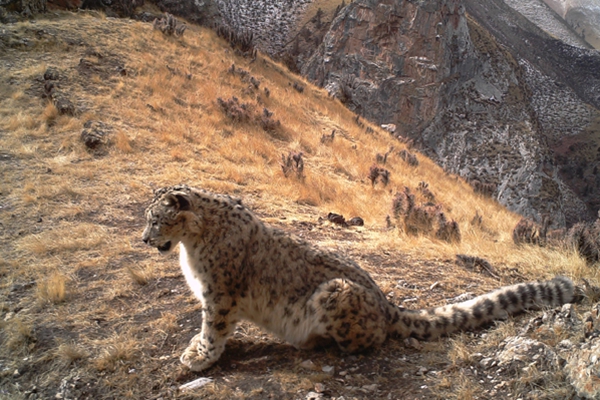
An image of a snow leopard is captured by an infrared camera in the Sanjiangyuan area in January. [Photo/Xinhua]

Wildlife protectionists and herders said the diversity of wild animals has increased in the Sanjiangyuan area, China’s first planned national park.

A three-year observation project, which began in 2014, recorded frequent sightings of snow leopards, brown bears, lynxes, Tibetan foxes, wolves, steppe cats and otters in the region, said Xiao Lingyun with Peking University’s Center for Nature and Society.

These animals were observed in a 2,000-square-kilometer area, Xiao said.

“From images captured by infrared cameras, we can see these animals often move around, not alone, but in groups, and their movements show they have a rather casual lifestyle,” she said.

It is generally known that wild animal habitats have grown increasingly fragmented due to human activity, but the fact that wild carnivores were frequently observed at the source of the Lancang River is a key sign that the area has a diverse animal population, Xiao said.

“Some wild species establish their habitats near residences of local herders, and they are not fearful of humans,” said Zhao Xiang, a wildlife protectionist with the Shanshui Nature Protection Center.

Sanjiangyuan literally means “the source of three rivers”, referring to the Yangtze, Yellow and Lancang (Mekong) rivers.

The national park is expected to open in 2020.

Panda dies after being released into the wild

image_pdfimage_print

Hesheng, a captive-bred panda, died in September 2016, two months after being released into the wild in southwest China’s Sichuan Province, Chengdu Research Base for Giant Panda Breeding announced Friday.

The male panda, born in 2013, had undergone training at Liziping Nature Reserve from March 2016 and was released into the wild in July.

On Sept. 11, Hesheng was spotted safe and well some 3.5 km away from where he was released. Just weeks later, however, on Sept. 27, his GPS collar sent an alarm, prompting an overnight search for Hesheng.

When researchers found his limp body they noticed injuries on his right shoulder, right ear and right hind limb. An autopsy confirmed Hesheng died of septicemia due to a bacterial infection after being attacked by unknown animals.

Giant pandas are among the world’s most vulnerable and rare animals, with a known population of only 1,600, mostly in China.

PLA’s THAAD opposition ‘more than words’

image_pdfimage_print

Senior Colonel Wu Qian, spokesperson of China’s Ministry of National Defense (MOD), responds to media questions at a routine press conference on March 30, 2017. [Photo by Chen Boyuan/China.org.cn] 

The Chinese military once again expressed its firm opposition to the deployment of the THAAD (Terminal High Altitude Area Defense) system in South Korea, stressing its opposition “will never be just in words.”

Senior Colonel Wu Qian, Ministry of National Defense (MOD) spokesperson, speaking at a routine press conference on March 30, said China was serious about opposing THAAD.

“The deployment of THAAD will never make South Korea any safer. The Chinese military’s opposition against THAAD will never be just in words,” he insisted.

The MOD’s strong stance came after two THAAD launchers, along with support equipment, were delivered to a U.S. base in South Korea, according to South Korea’s Yonhap News Agency. Analysts said that THAAD might be fully operational in April.

Former South Korean President Park Geun-hye, recently impeached on corruption charges, agreed to the THAAD deployment on the grounds of the nuclear threat from North Korea.

Sr. Col. Wu refuted this. He said that China opposes any country jeopardizing another state’s safety, as well as regional stability, under the pretext of the ballistic missile threat from North Korea.

Apart from China, Russia also opposes THAAD, believing it disturbs the regional strategic equilibrium. On March 28, Chinese and Russia military delegates held their second meeting on joint anti-ballistic missile issues in Geneva on the sidelines of the Conference on Disarmament.

Their first meeting was held last November during the 7th Xiangshan Forum in Beijing. Soon afterwards, they conducted a joint computerized anti-ballistic missile (ABM) test.

As to whether the next such test would involve a live firing, the MOD spokesperson responded only vaguely.

“The THAAD system deployed by the United States and South Korea far exceeds the defense needs of South Korea,” he said, citing a memo issued after the Geneva meeting. “We oppose any country deploying the military facilities whose capacities are beyond their own defense requirements.”

Recent American reports speculated that North Korea might conduct its sixth nuclear test shortly. Hence, both the United States and South Korea stepped up their vigilance, and were keen on knowing whether the PLA would strengthen its border defenses with North Korea in case of such a nuclear test.

The MOD spokesperson declined to respond to a “hypothetical question,” but emphasized that the Chinese military maintained normal combat readiness and training.

Colombia: UN receives 7,000 weapons from FARC-EP as hunt for hidden caches continues

image_pdfimage_print

30 March 2017 – The United Nations Mission in Colombia is set to register some 7,000 weapons this weekend, but the search for other caches of weapons hidden by the Revolutionary Armed Forces of Colombia-People’s Army (FARC-EP) continues, the Mission’s chief has said.

Jean Arnault, the head of the Mission, said yesterday: “As for registration, we are at 85 percent of the weapons in the camps. This weekend we will reach a figure of approximately 7,000 registered weapons. On these weapons there are concerns: many are new and are short and long weapons, high calibre. It is a record that covers the range of FARC-EP weapons.”

The weapons hand over has been in place since the beginning of the month and the UN hopes to possess 60 per cent of all FARC-EP arms by April 1. However, in a press conference on the topic yesterday, Mr. Arnault said accessing hidden and hard to reach caches could delay the process.

A further 1,000 weapons are set to be received from FARC-EP members participating in peace promotion or, pedagogia de paz, bringing the number of arms collected by the UN to 8,000.

It was also reported at the press conference that commitments made at the Cartagena meeting of the Follow up, Promotion and Implementation Commission (CSIVI) to make progress on preparation of registration zones and camps, security and legal guarantees and provision of health services would further accelerate the laydown of arms process.

In November last year, the Colombian Government and FARC-EP, the largest rebel group in the South American nation, signed a peace deal, ending a 50 year conflict.