Sturgeon to continue independence push

25 Jul 2017

07 May 2011 MSP pictured in the garden lobby during the MSP registration session. Pic - Andrew Cowan/Scottish Parliament

The Scottish Conservatives have criticised the SNP’s determination to “wrench Scotland” out of the United Kingdom.

The criticism comes after it has emerged SNP leader Nicola Sturgeon has decided to meet the Scottish Independence Convention (SIC) in the coming weeks to “move forward the case for independence in the current political landscape.”

The meeting, confirmed to the National by SIC, has been suggested by sources as a way to allow the SNP to engage with the “wide independence movement.”

After Sturgeon suggested the SNP’s regression in June’s General Election would see the party wait until the terms of Brexit were clear before considering a Section 30 order – the legislation needed to hold a legally valid referendum – the Scottish Conservatives are urging the SNP to drop its push for a divisive second independence referendum.

Scottish Conservative shadow finance secretary Murdo Fraser said:

“So much for the First Minister’s claims that her Government would get back to the day job. Nicola Sturgeon is showing where her true priority lies, and it’s not Scotland’s economy, health service or education.

“The First Minister spending her time meeting independence campaigners will simply confirm the Scottish public’s view that independence always has and always will be the only thing the SNP cares about.

“People are growing hugely frustrated at the SNP’s neglect over a vast range of issues to instead focus on its blinkered obsession to wrench Scotland out of the United Kingdom.”


A copy of the National article:   http://www.thenational.scot/news/15431319.Nicola_Sturgeon_to_meet_with_Scottish_Independence_Convention_to_discuss_ho

Daily News 25 / 07 / 2017

EU Consumer Conditions Scoreboard: consumers show growing demand for cross-border online shopping

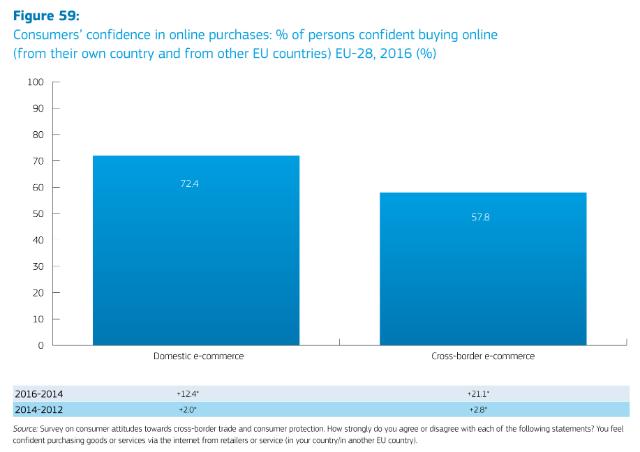
The 2017 edition of the Consumer Conditions Scoreboard shows that more and more EU consumers are shopping online and that their trust in e-commerce has increased, in particular in buying online from other EU countries. For retailers, however, the Scoreboard shows that many are still reluctant to expand their online activities and continue to have concerns about selling online to consumers in other EU countries. Such concerns are mainly linked to a higher risk of fraud and non-payment in cross-border sales, different tax regulations, differences in national contract law and in consumer protection rules. Commissioner Jourová said: “My priority has been to improve trust of the people and smaller retailers in the Digital Single Market. Consumers are now more confident when they shop online. And we’ve equipped them with a quick procedure to get their money back if something goes wrong, even when buying from another country. The challenge now is to encourage more businesses to respond to this growing demand.” While consumer conditions have improved overall since the last Scoreboard, the levels of trust, knowledge and protection still vary greatly between EU Member States. The Scoreboard also shows that consumer trust in e-commerce has dramatically increased. In ten years the share of Europeans buying online has almost doubled (from 29.7% in 2007 to 55% in 2017). Since the last Scoreboard consumers’ levels of trust have increased by 12 percentage points for purchases from retailers located in the same country and by 21 percentage points for purchases from other EU Member States. A press release, the full report and a factsheet are available online. (For more information: Christian Wigand– Tel.: +32 229 62253; Mélanie Voin – Tel.: +32 229 58659)

La politique de Cohésion investit pour une mobilité plus sûre et plus rapide en Roumanie

407 millions d’euros des fonds de la politique de Cohésion sont investis dans trois projets d’infrastructure routière qui amélioreront la connectivité et, à terme, la croissance et l’emploi à l’Ouest du pays. “Ces projets soutenus par l’UE ont le triple objectif d’améliorer la sécurité routière, de contribuer au développement économique des régions concernées et de renforcer la cohésion territoriale en Roumanie,” a commenté la Commissaire à la politique régionale Corina Creţu. Plus de 336 millions d’euros sont investis dans la construction de la section entre les villes de Dumbrava et Deva sur l’autoroute Lugoj-Deva, située sur le Réseau Transeuropéen de Transport (RTE-T) et des infrastructures qui y sont liées (ponts, carrefours, tunnels…). Le temps de trajet entre les deux villes sera réduit d’un tiers pour les automobilistes. Environ 62 millions d’euros vont ensuite contribuer à remettre à neuf une partie de la route nationale 6 entre les villes d’Alexandria et Craiova au Sud-Ouest du pays. Cela améliorera la sécurité routière et réduira de trois quarts d’heure le temps de trajet. Enfin, près de 9 millions d’euros vont financer la construction de la section entre les villes de Timișoara et Lugoj et d’une rocade aux abords de Timișoara. Plus d’informations sur les fonds européens en Roumanie sont disponibles sur la plateforme Open Data. Pour plus d’informations: Christian Wigand– Tel.: +32 229 62253; Sophie Dupin de Saint-Cyr – Tel.: +32 229 56169)

Mergers: Commission opens in-depth investigation into Knorr-Bremse’s proposed takeover of competing brakes manufacturer Haldex

The European Commission has opened an in-depth investigation to assess the proposed takeover of Haldex by Knorr-Bremse under the EU Merger Regulation. The Commission has concerns that the deal may reduce competition for brake systems and related components for commercial vehicles in Europe. The Commission’s initial investigation has shown that the proposed merger would likely remove a significant competitor from an already very concentrated sector. The concerns refer to a number of markets where Knorr-Bremse and Haldex currently compete, such as electronic braking systems (EBS) and air disc brakes for both trucks and trailers, anti-lock braking systems (ABS) for trailers, valves and air treatment systems. Commissioner Margrethe Vestager, in charge of competition policy, said: “Brakes are a crucial component for the safety of the millions of trucks, trailers and buses that transport goods and passengers across Europe every day. We want to ensure that Knorr-Bremse’s takeover of Haldex does not restrict competition for these critical components, which could lead to less innovation, for example in the development of automated driving, or to price increases for vehicle manufacturers, fleet operators and ultimately consumers.” The full press release is available online in EN, FR, DE and SV. (For more information: Ricardo Cardoso – Tel.: +32 229 80100; Maria Sarantopoulou – Tel.: +32 229 13740)

Mergers: Commission clears acquisition of Centrica Langage and Centrica SHB by EPH

The European Commission has approved, under the EU Merger Regulation, the acquisition of Centrica Langage Ltd. and Centrica SHB Ltd. of the UK by Energetický a průmyslový holding, a.s. (EPH) of the Czech Republic. Centrica Langage and Centrica SHB are two gas-fired power plants located near Plymouth and Stallingborough in the UK, respectively. EPH is a utility company engaged in brown coal extraction, electricity and heat production, distribution and supply as well as gas transmission, distribution, and storage. The Commission concluded that the proposed acquisition would raise no competition concerns because of the companies’ limited combined market share and the presence of several established competitors. The transaction was examined under the simplified merger review procedure. More information is available on the Commission’s competition website, in the public case register under the case number M.8516. (For more information: Ricardo Cardoso – Tel.: +32 229 80100; Maria Sarantopoulou – Tel.: +32 229 13740)


ANNOUNCEMENTS

EU – Turkey High Level Political Dialogue taking place today in Brussels

Federica Mogherini, High Representative for Foreign Affairs and Security Policy / Vice President of the European Commission and Johannes Hahn Commissioner for European Neighbourhood Policy and Enlargement Negotiations are hosting the EU – Turkey High Level Political Dialogue in Brussels. Turkey is represented by the Minister of Foreign Affairs Mevlüt Çavuşoğlu and the Minister for EU Affairs and Chief Negotiator Ömer Çelik. The parties will discuss EU-Turkey relations and common challenges ahead, in particular with regards to regional and international issues. The High Level Political Dialogue will be followed by a press conference at approximately 17:00 which will take place in the VIP Corner of the Commission’s Berlaymont building and will be transmitted live on EbS. (For more information: Maja Kocijancic – Tel.: +32 229 86570; Alceo Smerilli – Tel.: +32 229 64887)

Upcoming events of the European Commission (ex-Top News)

EU consumers show growing demand for cross-border online shopping, new survey reveals

For retailers, however, the Scoreboard shows that many are still reluctant to expand their online activities and continue to have concerns about selling online to consumers in other EU countries. Such concerns are mainly linked to a higher risk of fraud and non-payment in cross-border sales, different tax regulations, differences in national contract law and in consumer protection rules.

While consumer conditions have improved overall since the last Scoreboard, the levels of trust, knowledge and protection still vary greatly between EU Member States.

Commissioner Jourová said: “My priority has been to improve trust of the people and smaller retailers in the Digital Single Market. Consumers are now more confident when they shop online. And we’ve equipped them with a quick procedure to get their money back if something goes wrong, even when buying from another country. The challenge now is to encourage more businesses to respond to this growing demand.”

More trust in e-commerce but barriers remain, including for retailers

The Scoreboard shows that consumer trust in e-commerce has dramatically increased. In ten years the share of Europeans buying online has almost doubled (from 29.7% in 2007 to 55% in 2017). Since the last Scoreboard consumers’ levels of trust have increased by 12 percentage points for purchases from retailers located in the same country and by 21 percentage points for purchases from other EU Member States.

Although there has been much progress, the Scoreboard shows that consumers are still facing obstacles when trying to buy from online retailers based in another EU country. For example, 13% of respondents reported a payment being refused and 10% were refused delivery of products to their country.

As for retailers, only 4 out of 10 of those currently selling online said that they are considering selling both domestically and across borders in the coming year. Many still have concerns about selling online in other countries, namely because of a higher risk of fraud, differences in national tax regulations or national contract law rules, or differences in consumer rules.

This is why the Commission has made a proposal for modern digital contract rules to harmonise contract rules for online sales of goods, and to promote access to digital content and online sales across the EU.

Awareness of consumer rights improving, but still low and uneven levels across the EU

Compared to the previous edition of the Scoreboard, consumers are more aware of their rights. On average, 13% of consumers are aware of their key rights (an increase of 3.6 percentage points since 2014).

However, consumer conditions are generally better in northern and western EU countries than eastern and southern ones. 94.5% of Finns complain when they encounter a problem, for example, whereas only 55.6% of Bulgarians do so. Exposure to unfair commercial practices, such as the use of aggressive marketing techniques, also varies greatly: 40.9% of Croatians are affected, in comparison to 3.4% of Austrians.

To tackle these issues, the Commission is working on a proposal to update consumer rules. The aim is to make sure that every European consumer is aware of their rights and that these rights are correctly enforced throughout the EU.

Retailers’ insufficient knowledge of consumer rights

The 2017 Scoreboard shows that retailers’ knowledge of consumer rules hasn’t improved since the previous edition. Only 53.5 % of their answers to questions on basic consumer rights were correct. Again the level of knowledge varies between countries, with only 36.2% of Croatian retailers knowing these rights compared to 62.3% of retailers in Germany.

Room for improvement with the speed of handling complaints

While consumers are finding fewer reasons to complain, the ones who have done so are more satisfied with how their complaints are handled.

However, almost one third of consumers decided not to complain, as they considered the sums involved were too small (34.6%) or that the procedure would have taken too long (32.5%).

This is why the Commission has improved the Small Claims procedure (since 14/07/2017), which now allows consumers to benefit from a fast-track online procedure for claims up to €5,000. The Commission is also encouraging out-of-court settlements with the Online Dispute Resolution (ODR) platform, which offers easy online access to alternative dispute entities for online transactions.

Background

The Consumer Scoreboards provide an overview of how the Single Market works for EU consumers. Published since 2008, they aim to ensure better monitoring of consumer rights and provide evidence to inform policy.

There are two types of Scoreboard, which are published in alternate years and based on large scale surveys:

  • The Consumer Conditions Scoreboard, which monitors national conditions for consumers in three areas: 1. knowledge and trust, 2. compliance and enforcement, 3. complaints and dispute resolution. It also examines progress in the integration of the EU retail market and in e-commerce.
  • The Consumer Markets Scoreboard, which tracks the performance of over 40 consumer markets on the basis of key indicators such as trusting that sellers comply with consumer protection rules, the comparability of offers, the choice available in the market, the extent to which consumer expectations are met, and the detriment caused by problems that consumers encounter. Other indicators, such as switching and prices, are also monitored and analysed (2016 edition).            
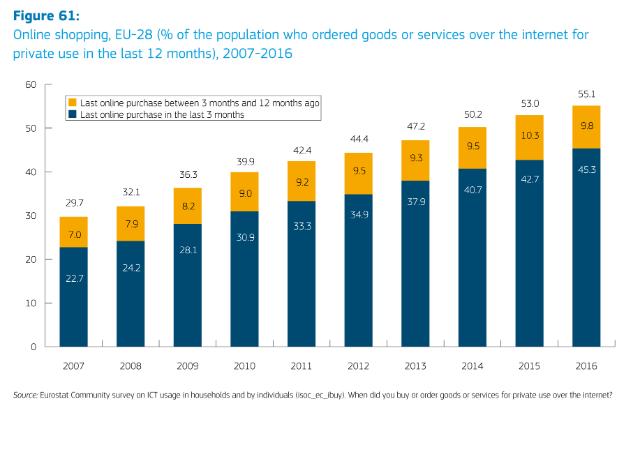
Graph 61

graph 59

For more information

Report

Factsheet

Infographic

Consumer Scoreboards

Digital Single Market