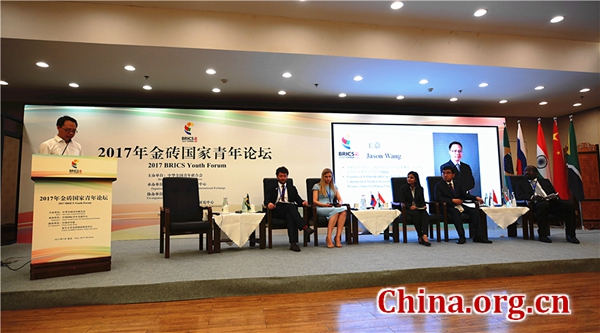
BRICS youth debate innovation and entrepreneurship

Guest speakers from five BRICS countries join a discussion at the 2017 BRICS Youth Forum in Beijing on July 25. [Photo by Zhang Jiaqi/China.org.cn]

The innovativeness and entrepreneurship of the youth stand out as the two main focal points at a panel discussion of young delegates at the 2017 BRICS Youth Forum in Beijing on July 25.

The BRICS countries have similarities in their development course, and exchanging experiences in fostering innovation and entrepreneurship among the BRICS youth is conducive to coordinated cooperation among the BRICS countries.

Marco Vinholi, an official from the Legislative Assembly of the State of San Paulo of Brazil, introduced the concept of active entrepreneurship and the obstacles faced by start-ups in Brazil.

“The mark of our generation is innovation and entrepreneurship,” he said. “The basic obstacles to youth entrepreneurship are the lack of qualifications, international cooperation and funding for young entrepreneurs, as well as the bureaucracy. The BRICS countries should improve people-to-people exchanges, increase cooperation on innovation and provide more funds.”

Svetlana Skorikova, project manager of the Center for International Cooperation of the Russian Union of Youth (RUY), called for setting up a BRICS youth business incubator.

Innovation and entrepreneurship are among the interesting areas of cooperation for young people, said Skorikova, further specifying that the main purpose of the incubator is to generate and encourage more business cooperation among BRICS countries.

Gitika Lakhotia, risk consultant of Klynveld Peat Marwick Goerdeler, a professional service company and one of the Big Four auditors, outlined the measures the Indian government introduced to promote youth entrepreneurship since 2014.

The Start-up India and Stand-up India initiatives facilitated business registration by providing a one-stop service. Besides, India also established a new bank to help the re-financing of SMEs and provided professional training to SME entrepreneurs and women.

Xu Zewei, CEO of 91jinrong.com, an e-finance platform in China, shared his experience of operating a start-up company in China.

“You will not succeed unless you try,” He encouraged the youth to start new companies under the favorable policies towards youth entrepreneurs.

He also called for further decreasing the cost of starting new companies, and encouraged mutual help among investors and entrepreneurs.

South African representative Abel Motsoge, chairman of JHB head office, pointed out the major difficulties for start-ups in South Africa.

He said many new companies failed to operate for more than two years due to the high bidding cost and bureaucracy. He called for more government support and increasing BRICS cooperation in communications, finance, infrastructure, logistics and renewable energy.

First Mars simulation base to be built in Northwest China

China’s first Mars simulation base will be built in Northwest China’s Qinghai Province, China News Service reported on Tuesday.

Located in Dachaidan Hongya region of Haixi Mongolian and Tibetan autonomous prefecture, a hinter land of Qinghai-Tibet Plateau, the base will be established in Qaidam Basin. The area’s landform, natural landscape and climate condition resemble closely to those of Mars, said Wang Jingzhai, the prefecture’s deputy Party chief.

Spread over 95,000 square kilometers of desert, the area has China’s largest Yadan landform, or dry areas with wind erosion landscape. It also has other elements, such as mountain, prairie, Gobi desert, river and lake.

Adjacent to many tourist attractions along the Hexi Corridor, a part of the Silk Road in Gansu Province, the Mars simulation base will be turned into a cultural and tourist experience base that combine elements of “science, science fiction, nature, ecology and culture”, said Liu Xiaoqun, director of lunar and deep space exploration general department, Chinese Academy of Sciences.

The base will comprise two functional areas – “Mars community” and “Mars campsite” – which will be connected by road but invisible to each other, Liu said.

As the only one of its kind in China, the base has filled the gap in science practice education base that combines the fields of space, astronomy, geology, meteorology and new energy, Liu said.

How productive are MPs?

Several correspondents of this blog, and others in the public debate, have rushed to raise the issue of how productive are MPs in response to any of us who highlight the general issue of public sector productivity. It is a fair question. MPs who want a more productive- and better paid – public sector do need to consider their own contribution. The total cost of MPs is tiny in relation to public sector output, but those who would lead must expect more scrutiny and should be expected to lead by example.

It was this issue which led David Cameron to make the cost of politics an issue in government. It led to the decision to back a reduction in the number of MPs. The current plan is to remove 50 out of 650, offering a 7.7% increase in labour productivity. The question for this Parliament is will the other parties now agree to this, as Conservatives still want to put through this reform.

Those of us who want England to be better represented can also do this in a way which does not add to the bills for political government. The twin hatted MP who is both a UK and an English MPs would be a lower cost more productive model than the one adopted in Scotland.

It is true that in recent years the number of peers has continued to expand. Peers are only paid if they turn up, so it is not quite as bad as it looks, but few can deny the Upper House is now overmanned. There are various proposals for dealing with this. A few are now in effect. Peers can now retire and are encouraged to do so. We need to consider more steps to limit numbers. It is mainly up to the Lords to decide what they think is best. Options include a use it or lose it rule, a fixed single term of appointment, or a high overall retirement age. It is easiest to bring in these changes by giving newly appointed peers different contracts with retirement built in at an appropriate future date in the light of each individual’s circumstances. More retirements could be encouraged by letting people keep their courtesy titles without rights to sit in the Lords and vote.

The other main way political government can raise its productivity is by controlling numbers and costs in MPs offices. I choose to do all my own research, article and blog writing and speech making myself without researchers and writers working for me. Other MPs have other ways of limiting their demands on additional staff and costs. All MPs interested in raising public sector productivity should of course review what they can do within their own very small part of the public sector by way of example.