In Iraq, UN chief Guterres urges more support for those who have 'suffered enormously'

image_pdfimage_print

31 March 2017 – Highlighting the lack of resources for United Nations programmes assisting those displaced by the fighting in Iraq’s Mosul Secretary-General António Guterres urged the international community to do more to help the people who have &#8220suffered enormously and go on suffering.&#8221

&#8220This is a moment in which the Iraqi people [and] the people of Mosul need the solidarity of the international community,&#8221 Mr. Guterres told the press at the Hassan Sham camp, located about 30 kilometres east of Mosul.

&#8220Solidarity with those liberating Mosul [and] with the civilians who are suffering […] to guarantee protection of those civilians and, at the same time, solidarity with the victims and creating the conditions for reconciliation,&#8221 he added.

In his remarks, he also drew attention to the severe lack of funding for UN programmes assisting the displaced. Currently, te funding stands at eight per cent.

&#8220[This] shows how limited our resources are compared to the tragedy these people are facing,&#8221 noted the UN chief.

According to estimates, there are about 11 million people in need of humanitarian assistance in the country. Of this figure, about three million are internally displaced. In Mosul, more than 285,000 individuals have been displaced due to the military operations to retake the city from Islamic State of Iraq and the Levant (ISIL/Da’esh) terrorists, including some 122,000 over the past month. Cumulatively, more than 350,000 individuals have been displaced since the operations began on 17 October 2016.

Mr. Guterres further spoke of efforts by the regional government of Kurdistan as well as by non-governmental organizations and stressed that international solidarity is vital to improve the conditions of those affected as well as to create conditions for reconciliation within the communities and at the national level once Mosul is fully liberated.

Also highlighting that terrorism is a global threat and terrorist groups are interlinked, greater support from the international community was in everyone’s interest.

&#8220Because the terrorist threats we see in Mosul are the same as the terrorist threat we see everywhere in the world,&#8221 he said.

Jury notice form of return online

image_pdfimage_print

Members of the public will be receiving jury notices in the post. If you get one, you must fill in the Form of Return. You can do this online.

Jury service

Each year people are randomly selected from the Electoral Register to potentially be called for jury service. 

If you get a jury notice, this means that you may be called for jury service at any time during a 12-month period from the beginning of July 2019 until the end of June 2020.

You must fill in a Form of Return within 14 days of receiving your jury notice. The most straightforward way to do this online at the following link:

If you fail to make a return within 14 days, or make a false statement, you will be liable on conviction of a Magistrates’ Court to a fine of up to £1,000.

You should fully read the documents attached to the notice.

Jury summons

If you are selected at random for jury service, you will receive a jury summons.

This will have further information, including where and when you are required to attend to meet your legal obligations as a juror.

The jury summons will give you at least 10 days’ notice to enable you to make arrangements to attend. However, longer notice will try to be given where possible.

You can find more information in the jury service section. 

More useful links

News story: Headley Court partners with Loughborough University for research study

image_pdfimage_print

The Biomechanical Associations and Efficacy of Injectable Therapies in Tendinopathy (BEFIT) study is funded with a grant from the Higher Education Funding Council for England and brings together university academics and MOD collaborators to investigate risk factors and treatment of tendon pain in our regular armed forces.

The main focus of the project is a randomised controlled trial investigating the effect of high volume injection therapy in Achilles and patellar tendinopathy. There have been some encouraging results from other centres but currently there is no controlled study to provide evidence for the use of these injections in military personnel.
Commenting on the importance of this programme the Director of Defence Rehabilitation, Col John Etherington, said:

Reducing musculoskeletal injuries (MSKI) remains our main effort in improving the health and operational readiness of our personnel. We know that approximately 60% of medical downgradings and 60% of medical discharges are associated with MSKI. Getting the very best treatment at the right place and at the right time is key to us helping our personnel fulfil their potential. I am delighted that we have been able to pool resources in this type of project to drive forward best practice.

The research has made good use of the Help for Heroes motion tracking laboratory at Headley Court together with Loughborough University biomechanics. Factors which may predict tendon pain and its response to treatment are also being analysed.

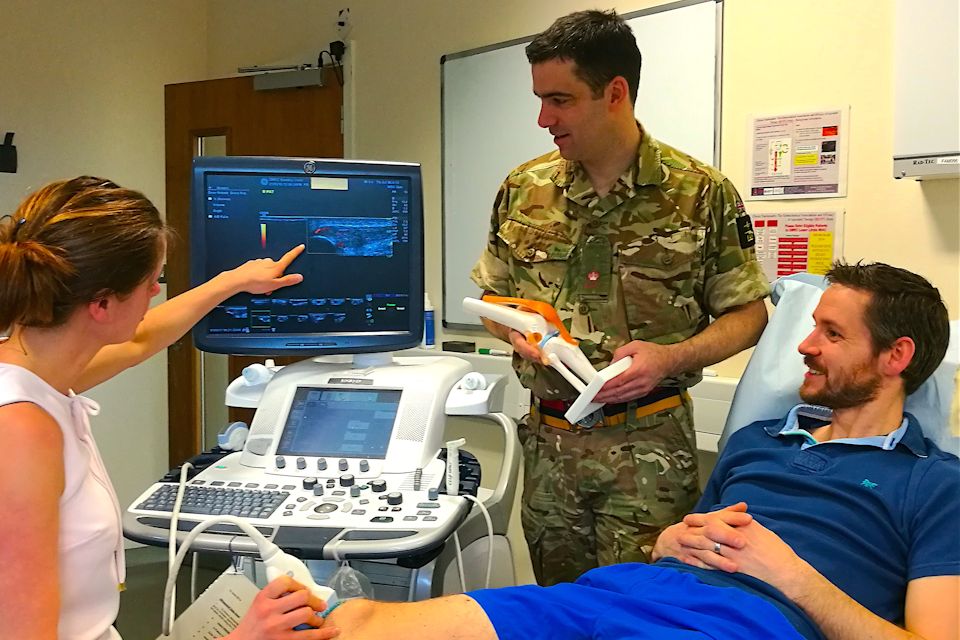
BEFIT study clinic. Crown Copyright. All rights reserved

Gp Capt Alex Bennett the Head of Research at Headley Court and Defence Professor for Rehabilitation described the need for this research within defence:

This well designed clinical trial has been approved not only by the MOD Research Ethics Committee but also the Medicines and Healthcare products Regulatory Agency and gives us the best opportunity to test fully whether these injections can benefit our patients.

Professor Mark Lewis, Dean of the School of Sport Exercise and Health Sciences at Loughborough University said:

The relationship between Loughborough University and the Academic Department of Military Rehabilitation at Headley Court via the National Centre for Sport and Exercise Medicine is of critical importance to the university. This project not only cements that relationship but, more importantly, has the potential to deliver huge benefits to tendinopathy sufferers in the UK military and more widely to the general public. We are grateful to the HEFCE for supporting this project through a Catalyst fund.

A dedicated BEFIT study clinic has been established at DMRC Headley Court. Anyone with questions about the research programme should email Sqn Ldr Robert Barker-Davies at DMRC-SEM3@mod.uk or phone 95238 ext 7497 or 01372371310.

News story: Headley Court partners with Loughborough University for research study

image_pdfimage_print

The Biomechanical Associations and Efficacy of Injectable Therapies in Tendinopathy (BEFIT) study is funded with a grant from the Higher Education Funding Council for England and brings together university academics and MOD collaborators to investigate risk factors and treatment of tendon pain in our regular armed forces.

The main focus of the project is a randomised controlled trial investigating the effect of high volume injection therapy in Achilles and patellar tendinopathy. There have been some encouraging results from other centres but currently there is no controlled study to provide evidence for the use of these injections in military personnel.
Commenting on the importance of this programme the Director of Defence Rehabilitation, Col John Etherington, said:

Reducing musculoskeletal injuries (MSKI) remains our main effort in improving the health and operational readiness of our personnel. We know that approximately 60% of medical downgradings and 60% of medical discharges are associated with MSKI. Getting the very best treatment at the right place and at the right time is key to us helping our personnel fulfil their potential. I am delighted that we have been able to pool resources in this type of project to drive forward best practice.

The research has made good use of the Help for Heroes motion tracking laboratory at Headley Court together with Loughborough University biomechanics. Factors which may predict tendon pain and its response to treatment are also being analysed.

BEFIT study clinic. Crown Copyright. All rights reserved

Gp Capt Alex Bennett the Head of Research at Headley Court and Defence Professor for Rehabilitation described the need for this research within defence:

This well designed clinical trial has been approved not only by the MOD Research Ethics Committee but also the Medicines and Healthcare products Regulatory Agency and gives us the best opportunity to test fully whether these injections can benefit our patients.

Professor Mark Lewis, Dean of the School of Sport Exercise and Health Sciences at Loughborough University said:

The relationship between Loughborough University and the Academic Department of Military Rehabilitation at Headley Court via the National Centre for Sport and Exercise Medicine is of critical importance to the university. This project not only cements that relationship but, more importantly, has the potential to deliver huge benefits to tendinopathy sufferers in the UK military and more widely to the general public. We are grateful to the HEFCE for supporting this project through a Catalyst fund.

A dedicated BEFIT study clinic has been established at DMRC Headley Court. Anyone with questions about the research programme should email Sqn Ldr Robert Barker-Davies at DMRC-SEM3@mod.uk or phone 95238 ext 7497 or 01372371310.

News story: A new way to pay

image_pdfimage_print

Instead of paying in advance, a new ‘Pay on Invoice’ process will streamline the way we manage a range of applications.

We are committed to reducing the regulatory burden and improving the process for licence applications.

From 1 April those making applications will no longer need to attach proof of payment making the end-to-end process simpler, easier and quicker.

The benefits of the new process include removing the need to work out complex fees and reducing the chance of applications being rejected for incorrect payment details.

Additionally the simplified payment process should result in fewer delays and make it easier for companies to reconcile financial records and accounts.

Overall the process is aimed at saving companies time and money.

Richard Humphreys, MHRA’s Deputy Director of Finance said:

We have listened to our customers and launched this new project in order to make the process of payment much easier and quicker.

We hope the new process will reduce the regulatory burden and reduce unnecessary delays.

As with everything we do, we welcome your feedback.

If you have any questions please get in touch by emailing sales.invoices@mhra.gsi.gov.uk

There have been no changes to our payment terms and invoices must be settled on receipt of invoice. Penalty fees can be incurred for non-payment, details of the penalties are set out in the Fees Regulations. Non-payment may also result in suspension of any licence or authorisation, followed by legal proceedings for unpaid amounts, as a debt due to the Crown.

More information can be found here