Press release: Attorney General helps record number of victims and families get justice

New statistics released today show the Attorney General’s Office has helped more victims and their families get justice than ever before, after 141 criminals had their sentences increased under the Unduly Lenient Sentence (ULS) scheme in 2016.

The ULS scheme allows victims of crime, prosecutors and members of the public to ask for certain sentences to be reviewed. The Attorney or Solicitor General then asks the Court of Appeal to review the sentence to have it increased if they believe the Court made an error in sentencing.

32 criminals, including an arsonist, someone carrying a firearm and 2 men found guilty of child neglect, all had their community sentence quashed and replaced with an immediate custodial sentence. Of these, 17 sex offenders who originally escaped prison are now serving time behind bars.

1 rapist and 1 attempted murderer had their determinate sentence replaced with a life sentence and now can only be released with permission from the Parole Board.

The Attorney General Jeremy Wright QC MP said:

“The Unduly Lenient Sentence scheme allows victims of crime, their families and the public to challenge sentences that they believe are too low, and last year we saw a record number of sentences increased.

“A sentencing exercise is not an exact science and in the vast majority of cases, judges get it right. The scheme is available to ensure that the Solicitor General and I can independently review those cases where there may have been an error in the sentencing decision.”

From 8 August, the scheme will cover an additional 19 terror-related offences including supporting extremist organisations, encouraging acts of terror or failing to disclose information about a terrorist attack. This extension is a first step to extending the scheme even further.

In 2016, 837 referrals were received by the Attorney General’s Office, a 17% increase from the previous year. The Attorney and Solicitor General referred 190 cases to the Court of Appeal that they thought needed looking at again, compared to 135 in 2015.

Of the 141 offenders who had their sentences increased, these related to crimes in the following categories:

Sex Offences 41
Grievous Bodily Harm with intent 19
Robbery 16
Firearms 11
Drugs 8
Burglary 7
Kidnapping 6
Manslaughter 6
False Imprisonment 6
Perverting the Course of Justice 4
Blackmail 3
Child Neglect / Cruelty 3
Arson 2
Death By Dangerous Driving 2
Conspiracy to cause explosions 2
Causing or allowing the death of a vulnerable adult 2
Attempted Murder 1
Murder 1
Threats to kill 1

141 cases resulting in sentence increases is a small proportion of the 80,000 Crown Court cases heard each year, but the ULS scheme is there to allow adjustment of those sentences where an increase is warranted.

The scheme was brought about after the public outcry that happened after the 1986 Ealing Vicarage rape case where 21 year old Jill Saward was brutally raped by a gang of robbers at her father’s vicarage.
Press release: Universal broadband to reach all parts of the UK

Homes and businesses from all parts of the UK are set to benefit from universal high speed broadband, the UK Government announced today.

BT has put forward an offer to voluntarily provide this service across the country, which would largely be delivered by Openreach. The offer has been received after the government committed to introduce a Universal Service Obligation (USO) through regulation to give every home and business in the UK the right to request a high speed connection of at least 10 Megabits per second (Mbps). That’s the speed that will meet the typical needs of a family for them to be able to stream films, carry out video conferencing and browse the web at the same time.

The BT proposal would mean many premises will receive substantially more than 10Mbps – homes and businesses are also expected receive connections more quickly than could be delivered under a regulatory approach. The Government will now consider this offer alongside a consultation on the regulatory USO – which is being launched today.

Secretary of State for Wales Alun Cairns said:

The UK Government is committed to ensuring the UK is leading the way in broadband provision. Successful broadband partnerships are creating a lasting legacy in Wales, which will play a key role in the future prosperity of our communities. The Government will now consider the proposals carefully to ensure the final decision provides the best outcomes for the people of Wales.

Culture Secretary Karen Bradley said:

The government is taking action to ensure that people everywhere in the UK can get a decent broadband connection as soon as possible. We warmly welcome BT’s offer and now will look at whether this or a regulatory approach works better for homes and businesses.

Whichever of the two approaches we go with in the end, the driving force behind our decision making will be making sure we get the best deal for consumers.

The communications regulator, Ofcom, has advised that 10Mbps, with quality requirements to limit delays and support uploading content as well as downloading it, meeting the needs of a typical household. It will also provide improved connectivity for many small businesses. A regulatory USO would provide a safety net, meaning that fast and reliable broadband was available to everyone, regardless of where they lived. Our consultation opening today will outline detailed proposals for how this new right to request a connection would work in practice.

This will help Government take a decision on the best way to get better broadband in hard to reach areas. No decision has been taken, and the Government will carefully weigh the merits of the two approaches. Unlike under a regulatory USO, the proposal from BT is to proactively build the necessary network infrastructure to connect the majority of households and businesses rather than wait for this to be done on request.

It is also proposed that BT would fund this investment and recover its costs through the charges for products providing access to its local access networks. The approach to recovering these costs will be considered in Ofcom’s current wholesale local access review.

BT Chief Executive Gavin Patterson said:

We are pleased to make a voluntary offer to deliver the Government’s goal for universal broadband access at minimum speeds of 10Mbps.

This would involve an estimated investment of £450m – £600m depending on the final technology solution.

This investment will reinforce the UK’s status as the leading digital economy in the G20. We already expect 95% of homes and businesses to have access to superfast broadband speeds of 24Mbps or faster by the end of 2017. Our latest initiative aims to ensure that all UK premises can get faster broadband, even in the hardest to reach parts of the UK.

The Government will now work with BT over the coming months to develop the proposal – which, if it is accepted, will be legally-binding. The Government will make a decision following its consultation on the regulatory USO.

Notes to editors:

  1. BT proposes to use a range of technologies to deliver this, including fibre to the cabinet and fibre to the home.
  2. It proposes to use fixed broadband technologies to take the UK’s 10Mbps fixed coverage to 99 per cent. It expects to complete the build of this fixed network by either December 2021 or December 2022 depending on the mix of technologies used, some of which are subject to trial and industry consultation.
  3. However, BT plans to launch the fixed wireless service before then so that the UK will have 10Mbps coverage to around 99% by the end of 2020. Fixed wireless will be made available at an affordable price for hard to reach premises.
  4. All of these technologies will come with quality standards including a minimum 1Mbps upload speeds, and requirements to minimise delays from contention and latency.
  5. The number of premises that will only have satellite as an option is expected to be 0.3% by the end of 2022.
  6. Today, over 93 per cent of UK homes and businesses can already get superfast broadband (24 Mbps+), and as a direct result of the Government’s Superfast Broadband Programme, this will increase to 95 per cent by the end of this year.

Press release: Universal broadband to reach every part of the UK

BT has put forward an offer to voluntarily provide this service across the country, which would largely be delivered by Openreach. The offer has been received after the government committed to introduce a Universal Service Obligation (USO) through regulation to give every home and business in the UK the right to request a high speed connection of at least 10 Megabits per second (Mbps). That’s the speed that will meet the typical needs of a family for them to be able to stream films, carry out video conferencing and browse the web at the same time.

The BT proposal would mean many premises will receive substantially more than 10Mbps – homes and businesses are also expected receive connections more quickly than could be delivered under a regulatory approach. The Government will now consider this offer alongside a consultation on the regulatory USO – which is being launched today.

Culture Secretary Karen Bradley said:

The government is taking action to ensure that people everywhere in the UK can get a decent broadband connection as soon as possible. We warmly welcome BT’s offer and now will look at whether this or a regulatory approach works better for homes and businesses.

Whichever of the two approaches we go with in the end, the driving force behind our decision making will be making sure we get the best deal for consumers.

The communications regulator, Ofcom, has advised that 10Mbps, with quality requirements to limit delays and support uploading content as well as downloading it, meeting the needs of a typical household. It will also provide improved connectivity for many small businesses. A regulatory USO would provide a safety net, meaning that fast and reliable broadband was available to everyone, regardless of where they lived. The consultation being launched today outlines detailed proposals for how this new right to request a connection would work in practice.

This will help Government take a decision on the best way to get better broadband in hard to reach areas. No decision has been taken, and the Government will carefully weigh the merits of the two approaches. Unlike under a regulatory USO, the proposal from BT is to proactively build the necessary network infrastructure to connect the majority of households and businesses rather than wait for this to be done on request.

It is also proposed that BT would fund this investment and recover its costs through the charges for products providing access to its local access networks. The approach to recovering these costs will be considered in Ofcom’s current wholesale local access review.

BT Chief Executive Gavin Patterson said:

We are pleased to make a voluntary offer to deliver the Government’s goal for universal broadband access at minimum speeds of 10Mbps.

This would involve an estimated investment of £450m – £600m depending on the final technology solution.

This investment will reinforce the UK’s status as the leading digital economy in the G20. We already expect 95% of homes and businesses to have access to superfast broadband speeds of 24Mbps or faster by the end of 2017. Our latest initiative aims to ensure that all UK premises can get faster broadband, even in the hardest to reach parts of the UK.

The Government will now work with BT over the coming months to develop the proposal – which, if it is accepted, will be legally-binding. The Government will make a decision following its consultation on the regulatory USO.

Notes to editors:

  1. BT proposes to use a range of technologies to deliver this, including fibre to the cabinet, fibre to the home and fixed wireless. Fixed wireless will be made available at an affordable price for hard to reach premises.
  2. They would use these technologies to take the UK’s 10Mbps coverage to around 99 per cent by 2020. All of these technologies will come with quality standards including a minimum 1Mbps upload speeds, and requirements to minimise delays from contention and latency.
  3. Fixed coverage would be made available to as many premises as possible. BT expects to complete the build of this fixed network by either December 2021 or December 2022 depending on the mix of technologies used, some of which are subject to trial and industry consultation.
  4. The number of premises that will only have satellite as an option is expected to be 0.3% by the end of 2022.
  5. Today, over 93 per cent of UK homes and businesses can already get superfast broadband (24 Mbps+), and as a direct result of the Government’s Superfast Broadband Programme, this will increase to 95 per cent by the end of this year.

News story: Foreign Secretary condemns missile test by North Korea

The Foreign Secretary, Boris Johnson, said:

The UK strongly condemns North Korea’s second test of an intercontinental ballistic missile and calls on the regime to immediately stop all activity that breaches UN Security Council resolutions.

The UK will stand alongside our allies and partners as we confront the growing threat North Korea poses to regional and international security. Once again North Korea shows no regard for its international obligations.

We urge the DPRK regime to put the well-being of its own people ahead of the illegal pursuit of nuclear and ballistic missile programmes.

European Commission launches infringement against Poland over measures affecting the judiciary

The Polish authorities have one month to reply to the Letter of Formal Notice.

The Commission’s key legal concern identified in the law on the organisation of ordinary courts relates to the discrimination on the basis of gender due to the introduction of a different retirement age for female judges (60 years) and male judges (65 years). This is contrary to Article 157 Treaty on the Functioning of the European Union (TFEU) and Directive 2006/54 on gender equality in employment. In the Letter of Formal Notice, the Commission also raises concerns that by giving the Minister of Justice the discretionary power to prolong the mandate of judges who have reached retirement age, as well as to dismiss and appoint Court Presidents, the independence of Polish courts will be undermined (see Article 19(1) of the Treaty on European Union (TEU) in combination with Article 47 of the EU Charter of Fundamental Rights). The new rules allow the Minister of Justice to exert influence on individual ordinary judges though, in particular, the vague criteria for the prolongation of their mandates thereby undermining the principle of irremovability of judges. While decreasing the retirement age, the law allows judges to have their mandate extended by the Minister of Justice for up to ten years for female judges and five years for male judges. Also, there is no time-frame for the Minister of Justice to make a decision on the extension of the mandate, allowing him to retain influence over the judges concerned for the remaining time of their judicial mandate.

In addition, First Vice-President Frans Timmermans sent a letter yesterday to the Polish Minister of Foreign Affairs reiterating the invitation to him and the Polish Minister of Justice for a meeting in Brussels at their earliest convenience in order to relaunch the dialogue. As he said in the context of the Rule of Law dialogue: “The Commission’s hand is still extended to the Polish authorities, in the hope of a constructive dialogue.”

Next steps

The Commission’s Letter of Formal Notice requests the Polish Government to reply within one month. After examining Poland’s reply, or if no observations have been submitted within the prescribed time-limit, the Commission may issue a Reasoned Opinion, the second stage of the infringement procedure.

Background

The College of Commissioners decided on Wednesday 26 July to launch this infringement procedure as soon as the Law on the Ordinary Courts Composition was published. The publication took place on 28 July.

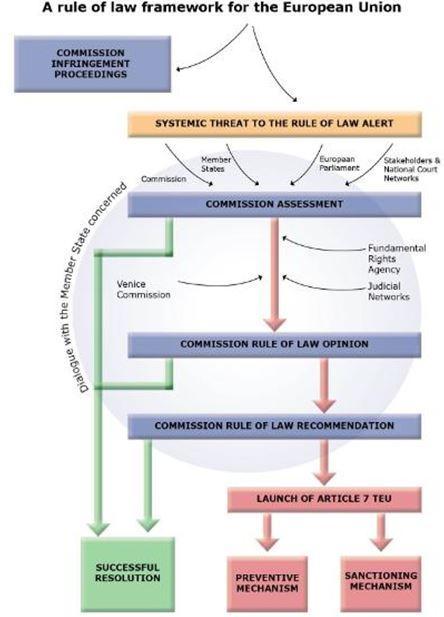
The infringement comes in addition to the ongoing Rule of Law Dialogue launched by the Commission in January 2016 and the complementary Rule of Law Recommendation issued on 26 July. The rule of law is one of the common values upon which the European Union is founded. It is enshrined in Article 2 of the Treaty on European Union. The European Commission, together with the European Parliament and the Council, is responsible under the Treaties for guaranteeing the respect of the rule of law as a fundamental value of our Union and making sure that EU law, values and principles are respected. Events in Poland led the European Commission to open a dialogue with the Polish Government in January 2016 under the Rule of Law Framework. The Framework – introduced by the Commission on 11 March 2014 – has three stages (see graphic in Annex 1). The entire process is based on a continuous dialogue between the Commission and the Member State concerned. The Commission keeps the European Parliament and Council regularly and closely informed.

Annex I – Rule of Law Framework

&

Annex II – Article 7 Treaty on European Union

1.   On a reasoned proposal by one third of the Member States, by the European Parliament or by the European Commission, the Council, acting by a majority of four fifths of its members after obtaining the consent of the European Parliament, may determine that there is a clear risk of a serious breach by a Member State of the values referred to in Article 2. Before making such a determination, the Council shall hear the Member State in question and may address recommendations to it, acting in accordance with the same procedure.

The Council shall regularly verify that the grounds on which such a determination was made continue to apply.

2.   The European Council, acting by unanimity on a proposal by one third of the Member States or by the Commission and after obtaining the consent of the European Parliament, may determine the existence of a serious and persistent breach by a Member State of the values referred to in Article 2, after inviting the Member State in question to submit its observations.

3.   Where a determination under paragraph 2 has been made, the Council, acting by a qualified majority, may decide to suspend certain of the rights deriving from the application of the Treaties to the Member State in question, including the voting rights of the representative of the government of that Member State in the Council. In doing so, the Council shall take into account the possible consequences of such a suspension on the rights and obligations of natural and legal persons.

The obligations of the Member State in question under the Treaties shall in any case continue to be binding on that State.

4.   The Council, acting by a qualified majority, may decide subsequently to vary or revoke measures taken under paragraph 3 in response to changes in the situation which led to their being imposed.

5.   The voting arrangements applying to the European Parliament, the European Council and the Council for the purposes of this Article are laid down in Article 354 of the Treaty on the Functioning of the European Union.