

Dstl challenges data scientists to solve real world challenges in first public competition
Apr32017
Dstl challenges data scientists to solve real world challenges in first public competition
Apr32017
The Defence Science and Technology Laboratory (Dstl) has today announced the launch of the Data Science Challenge. The challenge is designed to bring the brightest minds in data science together to solve real-world problems. The first challenges – detecting and classifying vehicles from aerial imagery and the classification of documents by themes– are now open to entrants, with each challenge boasting a total prize fund of £40,000.
The Data Science Challenge is part of a wider programme set out in the Defence Innovation Initiative that aims to build an open innovation ‘ecosystem’, harnessing the talents of individuals, academia and industry to develop new approaches to complex problems. The Data Science Challenge is piloting new ways of working including the use of crowdsourcing to engage the data science community to develop cutting edge solutions to Defence and Security problems.
The Data Science Challenge includes two distinct problems that will test the participants’ ability to mine large unstructured datasets to extract useful information:
Being able to automatically detect and categorise vehicles in aerial imagery will dramatically improve how quickly we can assess and identify them. This challenge asks participants to detect and classify vehicles such as buses, cars and motorbikes, from a set of aerial images.
Analysing data in documents such as media reports can provide a better understanding of a potential crisis situation, growing instability in a particular region or specific theme such as terrorism. Using news material, this challenge asks participants to predict topic tags for classifying unseen reports so that they can be used to improve awareness and understanding.
Minister for Defence Procurement Harriett Baldwin MP said:
Our Innovation Initiative is about harnessing diverse and talented individuals from business, academia, and beyond to keep the UK ahead of our adversaries.
In this latest challenge, supported by our £800 million Innovation Fund, we are calling on experts to develop the latest technology to crunch big data and identify the solutions that will keep us safe.
James Srinivasan, a Principal Data Scientist at Dstl added:
Around the world, governments are using the power of data to meet many of the huge challenges that they are facing. By analysing complex, evolving information, data science can provide invaluable insight that informs how we can best respond to event.
There is real talent out there and we want to encourage the curious to experiment and learn. We are determined to push the boundaries of what can be done, and to keep striving to always be better. This is why we are launching the Data Science Challenge today.
We are keen to encourage all data scientists, not just those in the defence and security sectors, who want to rise to the challenges that we have thrown-down today, to get involved.
The Data Science Challenge is sponsored by Dstl, the Government Office for Science, Secret Intelligence Service and MI5.
Participants can register from today at www.datasciencechallenge.org and have between 3 April and 11.59pm on 17 May 2017 to develop and submit their solutions. Winners from each of the challenges will be announced at the end of May 2017.
The top three entrants will receive cash prizes. The first prize is £20,000, the second placed entrant will receive £12,000 whilst the third will get £8,000.
Apr32017
The Defence Science and Technology Laboratory (Dstl) has today announced the launch of the Data Science Challenge. The challenge is designed to bring the brightest minds in data science together to solve real-world problems. The first challenges – detecting and classifying vehicles from aerial imagery and the classification of documents by themes– are now open to entrants, with each challenge boasting a total prize fund of £40,000.
The Data Science Challenge is part of a wider programme set out in the Defence Innovation Initiative that aims to build an open innovation ‘ecosystem’, harnessing the talents of individuals, academia and industry to develop new approaches to complex problems. The Data Science Challenge is piloting new ways of working including the use of crowdsourcing to engage the data science community to develop cutting edge solutions to Defence and Security problems.
The Data Science Challenge includes two distinct problems that will test the participants’ ability to mine large unstructured datasets to extract useful information:
Being able to automatically detect and categorise vehicles in aerial imagery will dramatically improve how quickly we can assess and identify them. This challenge asks participants to detect and classify vehicles such as buses, cars and motorbikes, from a set of aerial images.
Analysing data in documents such as media reports can provide a better understanding of a potential crisis situation, growing instability in a particular region or specific theme such as terrorism. Using news material, this challenge asks participants to predict topic tags for classifying unseen reports so that they can be used to improve awareness and understanding.
Minister for Defence Procurement Harriett Baldwin MP said:
Our Innovation Initiative is about harnessing diverse and talented individuals from business, academia, and beyond to keep the UK ahead of our adversaries.
In this latest challenge, supported by our £800 million Innovation Fund, we are calling on experts to develop the latest technology to crunch big data and identify the solutions that will keep us safe.
James Srinivasan, a Principal Data Scientist at Dstl added:
Around the world, governments are using the power of data to meet many of the huge challenges that they are facing. By analysing complex, evolving information, data science can provide invaluable insight that informs how we can best respond to event.
There is real talent out there and we want to encourage the curious to experiment and learn. We are determined to push the boundaries of what can be done, and to keep striving to always be better. This is why we are launching the Data Science Challenge today.
We are keen to encourage all data scientists, not just those in the defence and security sectors, who want to rise to the challenges that we have thrown-down today, to get involved.
The Data Science Challenge is sponsored by Dstl, the Government Office for Science, Secret Intelligence Service and MI5.
Participants can register from today at www.datasciencechallenge.org and have between 3 April and 11.59pm on 17 May 2017 to develop and submit their solutions. Winners from each of the challenges will be announced at the end of May 2017.
The top three entrants will receive cash prizes. The first prize is £20,000, the second placed entrant will receive £12,000 whilst the third will get £8,000.
Apr32017
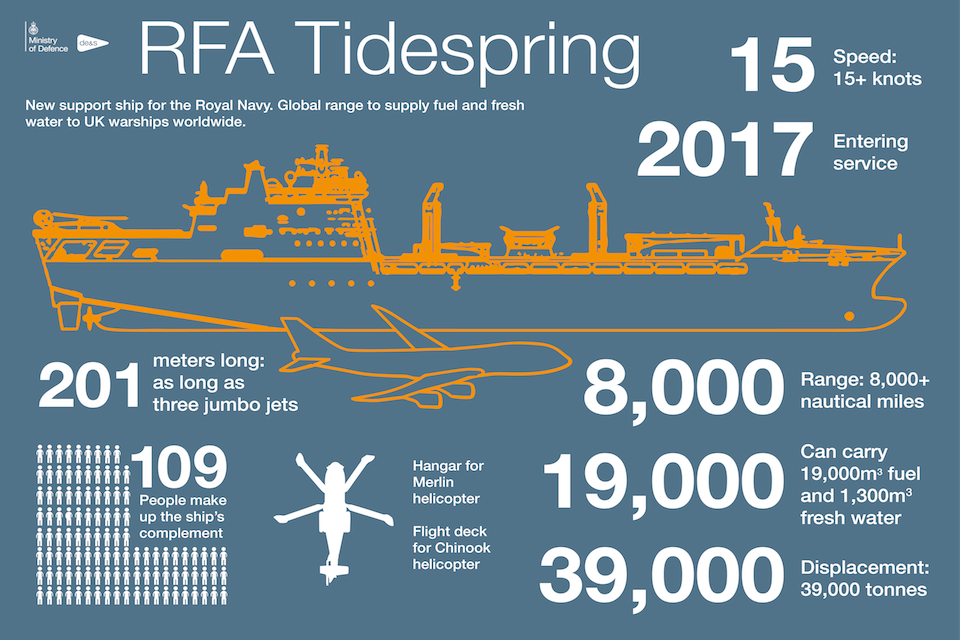
The 39,000-tonne tanker, which can carry up to 19,000 cubic metres of fuel and 1,300 cubic metres of fresh water, will join the Royal Fleet Auxiliary, a civilian-manned fleet which provides support for warships, helping the Royal Navy to maintain its operations 24/7, 365 days a year, around the world.
Tidespring is the first of a fleet of four Tide Class tankers which will all be taken through customisation in Falmouth. She will now undergo an intense programme of work at the A&P shipyard, and is expected to enter service before the end of the year. The new Tide Class tankers will provide key support to the Queen Elizabeth Class carriers when they come into service, alongside the wider fleet.
The arrival is a significant milestone in the ‘Year of the Navy’ which will also see the debut in Portsmouth of the first of the Queen Elizabeth-Class aircraft carriers, the start of construction for the fleet of new Type 26 Frigates and the opening of the first permanent Royal Navy base east of Suez in more than half a century.
The first of the newest support ships for the Royal Navy, RFA Tidespring.
RFA Tidespring’s UK arrival is a key milestone in 2017, the Year of the Royal Navy, which will also see the MOD develop world-class ships and submarines in support of Britain’s role as a leading naval power.
Backed by a rising Defence budget, the delivery of the Tide Class tankers is a crucial element of the Government’s £178 billion plan to ensure our armed forces have the equipment they need.
The customisation work is helping to support around 300 jobs at A&P Falmouth. The UK work content in the wider Tide Class programme is worth around £150 million, sustaining further jobs at 27 UK-based companies. The project is being delivered well within budget by the MOD.
Systems to be installed in Falmouth include the communications equipment, self-defence weapons and armour needed to allow the ship to operate in the most challenging environments.
RFA Tidespring. Crown Copyright.
RFA Tidespring will be a familiar and reassuring presence for Royal Navy ships as they undertake missions in defence of the UK’s interest.
The continued successful delivery of the Tide Class programme, meeting all requirements and under budget stands as a testament to the excellent working relationships which DE&S has built with suppliers in the UK and around the world.
The Tide Class has a flight deck able to accommodate the large Chinook helicopter and offer significant improvements over previous RFA tankers such as double hulls and greater environmental protection measures.
Apr32017
The 39,000-tonne tanker, which can carry up to 19,000 cubic metres of fuel and 1,300 cubic metres of fresh water, will join the Royal Fleet Auxiliary, a civilian-manned fleet which provides support for warships, helping the Royal Navy to maintain its operations 24/7, 365 days a year, around the world.
Tidespring is the first of a fleet of four Tide Class tankers which will all be taken through customisation in Falmouth. She will now undergo an intense programme of work at the A&P shipyard, and is expected to enter service before the end of the year. The new Tide Class tankers will provide key support to the Queen Elizabeth Class carriers when they come into service, alongside the wider fleet.
The arrival is a significant milestone in the ‘Year of the Navy’ which will also see the debut in Portsmouth of the first of the Queen Elizabeth-Class aircraft carriers, the start of construction for the fleet of new Type 26 Frigates and the opening of the first permanent Royal Navy base east of Suez in more than half a century.
RFA Tidespring’s UK arrival is a key milestone in 2017, the Year of the Royal Navy, which will also see the MOD develop world-class ships and submarines in support of Britain’s role as a leading naval power.
Backed by a rising Defence budget, the delivery of the Tide Class tankers is a crucial element of the Government’s £178 billion plan to ensure our armed forces have the equipment they need.
The customisation work is helping to support around 300 jobs at A&P Falmouth. The UK work content in the wider Tide Class programme is worth around £150 million, sustaining further jobs at 27 UK-based companies. The project is being delivered well within budget by the MOD.
Systems to be installed in Falmouth include the communications equipment, self-defence weapons and armour needed to allow the ship to operate in the most challenging environments.
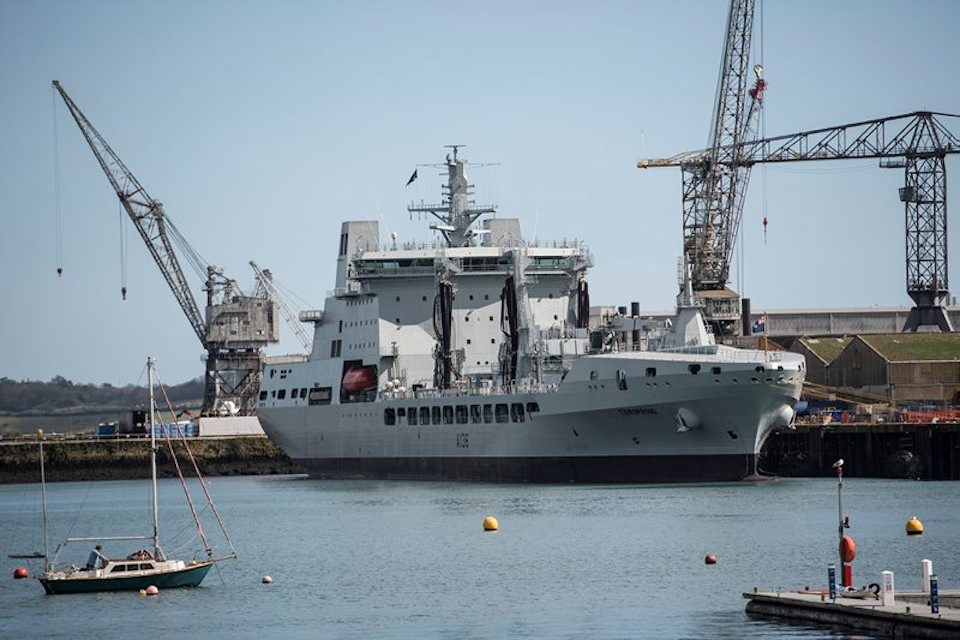
RFA Tidespring will be a familiar and reassuring presence for Royal Navy ships as they undertake missions in defence of the UK’s interest.
The continued successful delivery of the Tide Class programme, meeting all requirements and under budget stands as a testament to the excellent working relationships which DE&S has built with suppliers in the UK and around the world.
The Tide Class has a flight deck able to accommodate the large Chinook helicopter and offer significant improvements over previous RFA tankers such as double hulls and greater environmental protection measures.