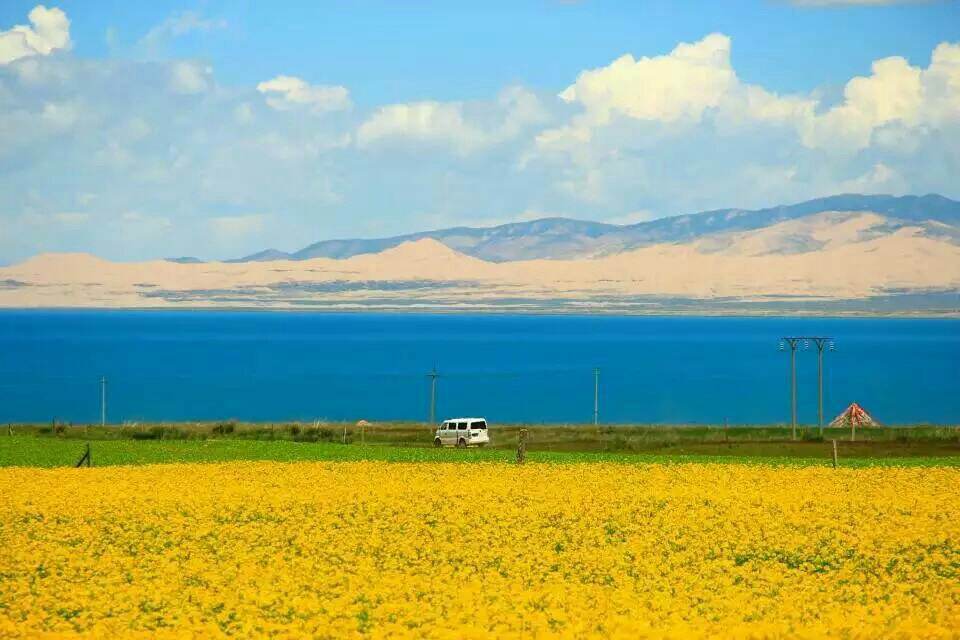
China probes pink plateau lake in Qinghai

image_pdfimage_print

 Qinghai Lake

Chinese officials and environmental experts are investigating a plateau lake that has turned pink.

The one-square-kilometer lake is part of Qinghai Lake complex in Qinghai Province. It is separated from the main lake by a sand strip.

Xinhua reporters confirmed that the surface of the small lake has turned pink, the mud and weeds under the water were also tainted, and there was an unpleasant smell.

Officials with the Qinghai Lake Preservation and Administration Office said a large amount of mud and weeds were tainted by a “pink-colored substance.”

Water samples have been sent to a lab in central Hubei Province for analysis, the officials said.

The officials were only alerted after a member of the public uploaded images of the pink lake to the Internet, sparking heated debate.

“The lake is surrounded by pastures and small settlements. There is no industry nearby, so we can rule out the hypothesis that the lake was polluted that way,” said a statement posted on the office’s website.

The lab tests are still ongoing.

Qinghai Lake, perched on the northeast part of Qinghai-Tibetan Plateau, covers 4,429 square kilometers, and is the country’s largest salt lake and an important habitat for plateau birds.

The lake expanded in recent years thanks to the government-led preservation efforts, especially reforestation to keep desert and sands at bay.

31.2 degrees! Hottest mid-April day in Shanghai over 120 years

image_pdfimage_print

Shanghai recorded its hottest April day in 120 years Saturday, with temperatures reaching 31.2 degrees Celsius.

Shanghai’s existing weather records show that the last time a mid-April day was 33 degrees Celsius was in 1896, according to Kong Chunyan, chief service officer at Shanghai central meteorological station.

The city has experienced a warm front and the southwesterly inland wind was not very strong. This, coupled with low humidity and low cloud coverage, resulted in temperatures rising very quickly, according to the local weather station.

Shanghai, which enjoys a subtropical climate, usually sees high temperatures during the June-September period. The city’s highest temperature on record was 40.8 degrees in 2013.

Sunday will be foggy and cloudy with a chance of showers. The highest temperature will drop to 26 degrees.

“Conditions are not sufficient for another day of temperatures of 30 or above,” said Kong.

UN calls for total tobacco ban in China’s public places

image_pdfimage_print

Dr. Bernhard Schwartländer, WHO Representative in China, speaks at the launch ceremony for the report on April 14, 2017 in Beijing. [Photo by Chen Boyuan / China.org.cn] 

The United Nations has urged that all public places in China impose a smoking ban to help reduce tobacco-related diseases that are hurting both China’s health and economy.

While congratulating Shanghai on becoming the latest Chinese city – following Beijing and Shenzhen – to enforce a total smoking ban in public places, the UN remains hopeful that more cities following their examples.

“The Bill China Cannot Afford: Health Economic and Social Costs of China’s Tobacco Epidemic”, a report jointly launched on April 14 by the World Health Organization (WHO) and the United Nations Development Programme (UNDP) stresses that stricter tobacco control could avert millions of deaths.

China is the world’s largest tobacco producer, consumer and manufacturer. In 2014, Chinese smokers consumed 44 percent of the world’s cigarettes, more than the next 29 cigarette- consuming countries combined, including Indonesia, Japan, Russia and the United States.

The report found that around 28 percent of adults (aged above 15) are currently smokers. An average smoker in China smokes around 22 cigarettes – more than one pack – each day; this is almost a 50 percent increase since 1980. The report warned that 1.38 million lives are lost in China each year from tobacco-related diseases.

“If nothing is done to reduce these numbers and introduce more progressive policies, the consequences could be devastating not just for the health of people across the country, but also for China’s economy as a whole,” warned Dr. Bernhard Schwartländer, WHO Representative in China, at a ceremony launching the report.

The pervasive tobacco issue in China, as the report argues, is the low sales price of tobacco. Although the latest tobacco tax increase in 2015 led to a slight rise in the retail price of cigarettes, the price rise was far lower than the average increase in salaries, making cigarettes even more affordable.

“Raising tobacco taxes is one of the most cost-effective measures to reduce consumption, while also generating substantial revenue for health and other essential programs,” said Bert Hofman, World Bank Country Director of China, Mongolia and Korea.

The report argued that raising retail price of cigarettes by 50 percent could lead to 47 million fewer male smokers, 20 million fewer premature deaths over 50 years, and saving eight million people from falling into poverty because of tobacco-related medical costs.

The report also addressed the question of the cost of tobacco control, for it is often an argument raised frequently by the tobacco industry that the use of tobacco contributes to the China’s economy.

“We have seen this over and over again around the world. For the WHO, health and human life are of the highest value and no human life can be measured against the amount of tax revenue you earn from this kind of product,” said Dr. Schwartländer.

Despite its tax contribution, the tobacco industry ultimately creates negative effect for the China’s economy, said Prof. Hu Angang, dean of Institute for Contemporary China Studies at Tsinghua University.

Hu explained that the tobacco industry causes more financial losses, such as smokers’ medical bills, a less efficient workforce (due to health-related absences) and smoking-related accidents, than benefits through its tax contributions.

“We actually did not know this fact until we were undertaking UN-led tobacco control research,” he said, adding: “We used to think that the tobacco industry helped boost the economy more or less.”

UN Sustainable Development Goals (SDGs) commit governments to take action to reduce tobacco use by one-third over the next 15 years in the belief that smoking is a main risk factor for the prevalence of non-communicable diseases.

The UNDP does acknowledge China’s progress in economic development and the subsequent poverty alleviation, according to Nicholas Rosellini, UN Resident Coordinator in China.

“The harmonious and human-centered development, which is the central goal of the Chinese government, requires leaving tobacco addiction behind,” said Rosellini.

Reliance on tobacco is inconsistent with poverty eradication and attaining sustainable development. The report concluded that tobacco control policies can be pro-poor and benefit people with the lowest income the most.

UN condemns attack on evacuees in Syria; underscores need to ensure safety of those trying to evacuate

image_pdfimage_print

15 April 2017 – Condemning today’s attack in Rasheedin, western Aleppo, Syria, on some 5,000 evacuees traveling from the besieged towns of Foah and Kefraya to Government-controlled areas, the United Nations has underlined the need to bring those responsible for the violent act to justice.

According to reports, at least 43 persons, including children, have been killed and many more injured.

“We call on the parties to ensure the safety and security of those waiting to be evacuated,” Stephane Dujarric, the Spokesman for the UN Secretary-General, said in a statement.

Mr. Dujarric added that the evacuations were being conducted in accordance with the agreement reached pursuant to the “Four Towns” Agreement, covering Foah, Kefraya, Madaya and Zabadani.

These four locations were referred to specifically in the Agreement to facilitate humanitarian access to the people in need.

In the statement, Mr. Dujarric also expressed condolences to the families of the victims of the incident and wished a speedy recovery to those injured.

Press release: UK to protect 200 million people from tropical diseases

image_pdfimage_print

The UK will protect over 200 million people from the pain and disfigurement caused by treatable tropical diseases, International Development Secretary Priti Patel announced today.

Neglected Tropical Diseases, such as trachoma, Guinea worm and river blindness, are avoidable infections but can deform, disable, blind and even kill if left untreated. They affect over a billion people in the poorest and most marginalised communities in the world, stopping children going to school and parents going to work – costing developing economies billions of dollars every year in lost productivity and reducing overall global prosperity.

Britain is already leading the way in fighting these diseases, and will more than double its support over the next 5 years. This will mean a billion treatments for people at risk in the developing world as part of an international push to eliminate and eradicate these ailments for good.

The UK’s total support package will:

  • wipe out Guinea worm, which is transmitted through dirty water
  • eliminate visceral leishmaniasis in Asia, a parasitic disease caused by infected sand-flies which destroy the internal organs
  • prevent up to 400,000 cases of blindness caused by trachoma, the leading cause of infectious blindness in the world
  • prevent tens of thousands of cases of disability caused by lymphatic filariasis, a mosquito-transmitted disease which can cause severe swelling of the lower limbs

The UK will also build on the great work done by our world-class universities, pharma companies and NGOs tackling Neglected Tropical Diseases by investing in pioneering research to drive the development of drugs that will control or eliminate them.

International Development Secretary Priti Patel said:

These diseases belong to the last century. They cause unimaginable suffering and pain to some of the world’s poorest people, forcing them into a deeper cycle of poverty with no way out. Yet they are treatable.

The UK’s support will protect over 200 million people from a future blighted by tropical disease and represents a huge leap towards ending this scourge.

Through our commitment, through our leading NGOs and pharma companies, through our world-class universities and researchers, Global Britain will continue to play a leading role in this fight. These diseases have been named ‘neglected’ for a reason, but I’m not prepared for them to be neglected any longer.

The doubling in UK funding announced today cements Britain’s commitment ahead of the WHO conference in Geneva next week where the Bill & Melinda Gates Foundation, governments, NGOs, multilateral organisations and the private sector will come together in an effort to relegate Neglected Tropical Diseases to the history books.

Notes to editors

The UK will invest a total of £360 million on implementation programmes to tackle NTDs between 2017-2018 and 2021-22.

The £360 million breaks down as follows:

  • £205 million of new support from 2017/18 to 2021/22

  • £55 million for the next two years which ‎forms part of an existing UK commitment made at the London Declaration in 2012

  • £100 million allocated from the Ross Fund portfolio

The Ross Fund Portfolio is a £1 billion programme, which brings together UK Government investments to tackle the world’s deadliest infectious diseases by developing, testing and delivering a range of new products (including vaccines, drugs and diagnostics).

The UK spend on NTD implementation between 2012 and 2016 averaged almost £30 million per year. This new investment will more than double the average annual spend on NTD implementation.

Research

In addition to the spend on implementation outlined above, the UK will invest the following in research and development for new technologies to fight NTDS with allocations also from the Ross Fund portfolio: £48m to the Drugs for Neglected Diseases Initiative, £30m to the Foundation for Innovative New Diagnostics and £10m to the Coalition for Operational Research on Neglected Tropical Diseases. These research programmes will support the development of drugs and diagnostics for Neglected Tropical Diseases and provide evidence to improve the delivery of NTD programmes.