Xi congratulates scientists on expedition to the Qinghai-Tibet Plateau

Chinese President Xi Jinping on Saturday sent a congratulatory letter to a research team on an expedition to the Qinghai-Tibet Plateau.

Xi expressed his congratulations and greetings to scientists, young students and support staff who joined the country’s second comprehensive scientific expedition to the plateau.

Xi said that they should focus on problems related to carrying capacity of the resources and the environment, disaster risk as well as green development on the plateau, according to the letter.

The Qinghai-Tibet Plateau is an important ecological safety barrier and strategic resource reserve base, Xi said in the letter.

He noted that the expedition will promote the plateau’s sustainable development and the world’s ecological environmental protection.

Vice Premier Liu Yandong read the letter at a ceremony in Lhasa, capital of southwest China’s Tibet Autonomous Region.

The expedition, led by the Chinese Academy of Sciences, will analyze the impact of environmental change on social development and provide suggestion for the building of a national park in the area.

China’s first comprehensive scientific expedition to the plateau began in the 1970s.

A large number of materials accumulated have provided solid scientific basis for economic and social development as well as environmental protection in the region.

Administration for tiger and leopard national park inaugurated

The administration for the much-anticipated tiger and leopard national park was officially inaugurated Saturday in Changchun, capital of northeast China’s Jilin Province.

Launch of of the Northeast Tiger and Leopard National Park Administration is a big step forward in protection of the endangered animals, said Zhang Jianlong, head of the State Forestry Administration.

The state-owned natural resources and assets management bureau of the national park was also launched Saturday.

“The establishment of the two organizations means increased protection efforts of Siberian tigers, Amur leopards and other types of natural resources,” Zhang said. “We will enhance supervision and patrol to make sure that the environment is well protected.”

The Northeast Tiger and Leopard National Park will cover more than 1.46 million hectares. About 71 percent of the area is in Jilin and the rest in the adjacent Heilongjiang Province.

Construction of the park is scheduled to be complete in 2020.

A contest was also started Saturday to design a logo for the park. According to Chen Xiaocai, an official with the park administration, the logo should combine images of the Siberian tiger and Amur leopard with Chinese elements.

The contest will last till September 30. The winner will receive an award of 50,000 yuan (7,500 U.S. dollars). Those who are interested can log on the park website (www.hbgyglj.com) to learn more.

Zhao Li, head of the administration, said that the national park aims to create a stable habitat for wild Siberian tigers and Amur leopards.

“It will become a good example of cross-region cooperation of wildlife protection,” Zhao said.

Siberian tigers are one of the world’s most endangered species. Wild Siberian tigers predominantly live in northeast China and Russia’s far east. The population is below 500. The Amur leopard was put under top national protection in 1983 with only about 50 living in the wild along the Sino-Russian border.

Nation’s first internet court up and running

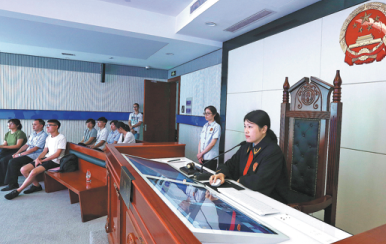
A judge hears a case on infringement of information-dissemination rights at the Hangzhou Court of the Internet on Friday.[Photo/ China Daily] 

China has set up its first court specializing in handling of internet-related disputes in Hangzhou, Zhejiang province, where many technology enterprises are located, amid rapid growth of online purchases and financial activities in the country.

The Hangzhou Court of the Internet is responsible for hearing six types of civil and administrative internet-related cases in the city, such as those involving online intellectual property rights and e-commerce disputes. It will also handle other web-related cases designated by higher courts, according to the top court.

“The establishment of the court is to meet the growing legal demand from litigants. It will also help the public to solve online disputes more effectively,” Zhou Qiang, president of the Supreme People’s Court, said after visiting the court on Friday.

He said the new court will play an important role in maintaining a safe internet and must provide good legal service to litigants.

A key feature of the court is that it allows litigants to handle a lawsuit entirely online. From case filing to the court hearing, litigants do not have to go to the court in person, according to Zhu Shenyuan, vice-president of the Zhejiang Provincial High People’s Court.

“Our aim is to make court hearings keep pace with the fast development of cyberspace and to explore new ways of hearing lawsuits so that it can be expanded across the country,” Zhu said.

People can register at the court’s website-netcourt.gov.cn, which includes an English-language version-and then provide evidence and materials. Defendants will be notified via text messages if the court files the case.

Judges will inform both parties of the trial time, and then those involved can log in to the website’s trial page, which uses a remote video system, according to Zhu.

The new internet court is a district-level court, and if litigants disagree with the verdict, they can appeal to the city’s intermediate people’s court, he said.

Cheng Jianle, deputy director of the provincial high court’s research office, said the court’s location was carefully chosen.

Hangzhou is home to such technology enterprises as Alibaba, the company behind the Alipay mobile payment system, and the Taobao online marketplace. Because of this, the city has witnessed a soaring number of online disputes in recent years, he said.

According to the provincial high court, Hangzhou courts handled about 10,000 cases related to e-commerce last year, up from about 600 in 2013.

A trial operation of the internet court, guided by the top court, began in May. On June 26, the establishment of the court was formally approved at a meeting of the Leading Group for Overall Reform presided over by President Xi Jinping.

As of Tuesday, it had accepted 2,605 cases since May, of which 1,444 have been concluded. In the court’s litigation service center, a digital screen showed that more than 1,200 of the accepted cases were related to defective online products, followed by conflicts caused by online piracy and e-commerce contracts.

The average time of hearings conducted online was 25 minutes, according to the internet court.

“The online hearings make our work more transparent and facilitate litigants,” said Du Qian, president of the internet court, adding that the court will enhance technology support to prevent network failures.

Zhou Hanhua, a law professor at the Chinese Academy of Social Sciences, said the court represents progress, since it’s the first to put all legal proceedings online. “But the court still faces challenges, such as how to facilitate those litigants who are not familiar with the internet.”

Yang Ming, deputy director of the internet law center at Peking University, said that authenticating evidence provided online needs further study.

News story: Tough new measures to protect savers from pension scams

The government has today (20 August 2017) confirmed new measures to protect private pension savers from the threat of unscrupulous pension scammers.

The measures will include:

  • a ban on cold calling in relation to pensions, including emails and text messages
  • a tightening of HMRC rules to stop scammers opening fraudulent pension schemes
  • tougher actions to help prevent the transfer of money from occupational pension schemes into fraudulent ones

The cold calling ban will be enforced by the Information Commissioner’s Office (ICO).

The government is also tackling scammers by ensuring that only active companies, which produce regular, up-to-date accounts, can register pension schemes. Limiting transfers of pension pots from one occupational scheme to another will mean trustees must check their receiving scheme is regulated by the Financial Conduct Authority, or has an active employment link with the individual, or is an authorised master trust.

The announcement comes as new figures released today show almost £5 million was obtained by pension scammers in the first five months of 2017. It is estimated that £43 million has also been unlawfully obtained by scammers since April 2014, with those targeted having lost an average of nearly £15,000, as scammers try to encourage savers to part with their money with false promises of low-risk, high-return investment opportunities.

Minister for Pensions and Financial Inclusion Guy Opperman said:

Today’s figures highlight the extent to which people’s savings are being targeted and stolen through elaborate hoaxes – leaving them with little opportunity to build up their savings again. That is why we are introducing tough new measures for those who scam.

If people have saved for a private pension, we want to protect them. This is the biggest lifesaving that individuals normally make over many years of hard work. By tackling these scammers, people should know that cold calling, apart from exceptional circumstances, is banned.

Economic Secretary to the Treasury Stephen Barclay said:

It’s utterly unacceptable that people who have worked all their lives to build up a pension pot should be subject to scams which may leave them out of pocket.

Pensions are often the most valuable asset a person has upon reaching retirement – and that’s why we are determined to crack down on scammers and protect our hardworking savers.

‘UN stands in solidarity with Finland in its fight against terrorism,’ says Guterres

19 August 2017 – United Nations Secretary-General António Guterres today condemned the terrorist attack in south-western Finland which killed at least two people.

&#8220The United Nations stands in solidarity with the Government of Finland in its fight against terrorism and violent extremism,&#8221 the Secretary-General said in a statement from his spokesperson.

He extended his heartfelt condolences to the Government and people of Finland, and wished a speedy recovery to the injured.

According to media reports, an assailant killed at least two people and wounded a half-dozen others on 18 August in an attack in Turku, Finland.