9 rescued from collapsed tunnel in SW China

Nine construction workers were rescued Saturday after having been trapped for two days in a collapsed railway tunnel in southwest China’s Yunnan Province, rescuers said.

Rescuers managed to dig a passageway to reach the workers at about 10:45 a.m. Saturday. The first worker was rescued at about 12:43 p.m. and eight minutes later, all had been rescued, rescue officials said.

All the workers are in stable condition.

The tunnel in the Xishuangbanna Dai Autonomous Prefecture they were working on collapsed at about 10:20 a.m. Thursday.

After digging a small opening through the rubble, rescuers managed to contact the workers with the help of a thin pipe and confirmed that all the workers were alive Friday. They even installed a mobile phone signal amplifier to help them keep in contact.

Later the workers were offered food three times.

More than 230 workers were involved in the rescue operation by excavating small tunnels or larger passageways in four directions.

The tunnel is part of a railway that connects Yuxi and Mohan in Yunnan.

Beijing’s landmark wholesale market closes for good

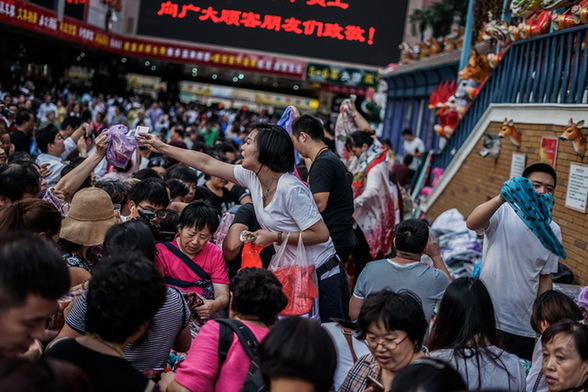
Tianyi Market, Beijing’s largest small commodities wholesale market, officially ended its 25-year life on Friday with thousands of shoppers enjoying their last chance of a cheap shopping spree.

Thousands of shoppers enjoy a last shopping spree at Beijing’s biggest wholesale market of Tianyi that closed for good on Sept. 15, 2017 after a 25-year operation. [Photo by Zheng Liang / China.org.cn] 

With one minute to go before closure, both shoppers and vendors stopped bargaining and took out their cameras or mobile phones to record the end of an era, with nostalgic farewell songs such as “Unforgettable Tonight” and “Auld Lang Syne” being played over the public address system.

“I have carried on business here for more than 10 years,” one vendor told China.org.cn, “I can’t just let it go in my heart.”

Tianyi Market opened on Nov. 18, 1992, and at its peak had more than 4,650 booths rented to 1,900 vendors selling over 130,000 kinds of commodities from all over the country. It was convenient for Beijing residents to buy all kinds of things for daily use and items for celebrating various festivals at cheap prices.

However, the Beijing government started a campaign to remove low-end businesses and wholesale markets, transferring them to neighboring cities, in order to reduce the population and relocate non-capital functions. It plans to remove all wholesale markets within the city’s Fourth Ring Road by 2020.

Tianyi Market has signed a contract cancellation agreement with the vendors and compensated them with four times the amount they initially paid in a guarantee deposit of 100,000 yuan (US$15,200).

However, for long-term vendors who likely paid one million yuan (US$152,000) in booth rent (guarantee deposit not included) for 10 years, for example, the compensation of 400,000 yuan (US$61,000) won’t necessarily help them much.

Liu Haitao, chairman of Tian Heng Group, which owns the real estate property containing Tianyi Market, said some vendors at first were not happy and didn’t understand the situation. However, his team negotiated with them and persuaded them to comply.

While some vendors have founded online platforms or returned to their hometowns to continue business, many others lost their living.

During the last days of Tianyi Market, tens of thousands of shoppers poured into the building for a last shopping spree, with security and customer flow controls tightened. Many goods were sold at very discounted prices.

After the market closed, the Tianyi building will be transformed into a venue to house technology companies and financial enterprises, Liu said. Tianyi Market may be reborn in Tianjin or neighboring Hebei Province, and many vendors have already pledged to follow it there and work with it again, a market representative said.

Previously, at the end of 2015, the branch of Tianyi Market at Di’anmen was closed after operating for 14 years.

Beijing has removed and improved 302 markets and 51 logistics centers in the period of 2015-2016. In 2017, the city plans to remove or renovate 120 markets and 38 logistics centers, according to an announcement by the Beijing Municipal Commission of Commerce. As of June, it had either removed or renovated 53 markets and three logistics centers.

Productivity

Productivity is an ugly sounding word from economics. Some are worried by it as they fear it means job losses, restructurings, making people work harder. Curiously enough it is a word which apparently unites the warring political parties. They all claim to want higher productivity. Some even understand that increased productivity is the key to higher real pay and better living standards. If business can produce more with less,  prices can be lower or specifications and quality higher, and we can afford to buy more or better.

Agreeing to support the general cause is as good as it gets. As we discovered again on Tuesday in the Finance Bill debate, productivity is also a word which divides, as different parties have different views of what you need to do to raise productivity, and where you might apply the policy.

I detected once again a distinct unease by Labour to discuss public sector productivity, for example. This is odd, given that Ministers- and indirectly MPs – have much more influence over how the public sector is financed and managed than we do over the private sector. I pointed out that during the long Labour years 1997-2010 there were no overall productivity gains in the main public services, at a time when private sector productivity was advancing moderately every year.It would be good to know from them why that was, and what they learned from the experience of presiding over a large sector with no clear gains.

The public sector has struggled with the digital revolution more than the private. The application of computer technology and robotics to business is transforming many areas of our lives. The UK public sector still does not have proper computerised records and controls in the NHS, tax has not yet gone fully digital and robotics are not much deployed.

The public sector has had access to substantial sums of capital to transform the way it does things, but has also had a disappointing record at implementing change through large computer programmes.

Beijing’s 1st maglev line to start service late 2017

Beijing’s first medium-low speed maglev line is scheduled to start operation at the end of the year, the line operator said Saturday.

Beijing Subway said it was preparing test runs.

Trains will stop at seven of the eight stations in the initial period as the Pingguoyuan interchange station is still under renovation and is expected to start service in late 2019, it said.

A total of 10 trains will be put into use in the first stage of operation.

With a maximum speed of 80 km per hour, the train is designed to carry a maximum 1,032 passengers at a time.

The line, with a total length of 10.2 km, will help improve transport for the suburban Mentougou district and optimize the industrial structure in Shijingshan district, it said.

Maglev trains are safer and cheaper compared to current metro and light rail cars. Electromagnets and specially designed tracks prevent the trains from overturning or derailing. They can also operate in severe weather with much less noise and zero emissions.

Remarks by Vice-President Dombrovskis at the first informal ECOFIN press conference in Tallinn

Good evening. Thanks to the Estonian Presidency for the warm welcome in Tallinn and for organising this timely discussion on the Economic and Monetary Union. We also discussed FinTech in a broader context of digital innovation.

On the Economic and Monetary Union, we discussed the rules and institutions of our Union.

It’s clear that a strong Economic and Monetary Union needs both well-functioning institutions and credible rules.

Both rules and institutions were strengthened during our response to the crisis. But there is room for making the EMU governance more efficient, complete and transparent.

However, reforms should not be done for the sake of reforms. Form must follow the substance. Institutions should evolve to meet the objectives we set.

The Commission believes that future EMU development should happen within the EU or community legal framework.

This applies to a possible future transformation of the European Stability Mechanism into a European Monetary Fund, which then should be firmly anchored in the community framework. And it also concerns possible creation of a European Minister for Economy and Finance. This new Minister should also work to promote structural reform efforts building on the work which we do already since 2015 with the Structural Reform Support Service. The Minister of Economy and Finance is one of the initiatives which we intend to launch with a 2025 perspective.      

We discussed the link between the EMU and the EU budget, and in particular the link with structural reforms and Euro area fiscal stabilisation function. So this part of our idea to have a euro area budget line within the EU budget.

All these topics that I mentioned will feature in the Commission’s EMU package, which we intend to put forward on 6 December. Today’s discussions provide us with valuable input for our preparatory work.

Today we also discussed one of the key Capital Market Union files – FinTech and FinTech revolution, which we are facing.

We already see FinTech services such as mobile payments, peer-to-peer lending, and online investments benefiting millions of Europeans. Looking ahead to the future, technologies like artificial intelligence, distributed ledgers and cloud computing hold even greater potential.

Ministers agreed that Europe should support the development of FinTech sector, emphasising the importance of technology neutrality.

This will only work if our companies will be able to take advantage of our single market, meaning to scale up, so that they can compete with their rivals in China and the US, where FinTech is booming.

For example, we are looking into EU-wide enabling legislation for crowdfunding and peer-to-peer lending. This would increase the scale and facilitate cross-border activity in this rapidly growing sector.

As to regulation, many spoke in favour of adopting existing rules to the challenges that FinTech brings, such as cyber threats and data privacy. But it is also important that FinTech is not ‘regulated to death’, even before this sector has evolved.

The Commission is currently working on a FinTech Action Plan, which we intend to present early next year.

Thank you.