Voting on the EU

One of the first votes I cast was a vote in the EEC referendum in 1975, when we were asked whether the UK should stay in or leave the EEC. My employer asked me to research the consequences of a Yes and a No vote. I constructed an economic forecast based on the two scenarios, read the Treaty of Rome, and started my lifetime study of the EEC/EU and all its doings.

As a result of this research I concluded that the UK should leave the EEC for two main reasons. The first was the content of the Treaty. It made it clear this was no mere common market. It stated the aim was “ever closer union” and sketched an ambitious project which duly unfolded in later years of creating a state called Europe. I realised that the main political parties were all arguing that this was just a free trade relationship, a common market, when it was something very different. They sought to reassure us that no powers of self government were being taken away, when that was the express aim of the wider project.

The second reason I decided against was the economic impact. My forecasts showed that we would run twin large deficits inside the EEC. We would run permanent large trade deficits – as indeed we did. They decided to liberalise the trade in goods where the continent was strong, and to resist proper liberalisation of trade in business and financial services where we were stronger. This asymmetry led to big import penetration of our markets, and loss of Uk industrial capacity. VW and BMW flourished whilst BL floundered. It was also likely to increase our state deficits, as the EEC required substantial and rising financial contributions from us. I did not forecast any introduction of a budget rebate as I did not foresee such a successful negotiation by a later UK government. Even after the Thatcher rebate the large contributions added to our budget deficits.

After the loss of the referendum I accepted the verdict of the people, and spent the next 25 years trying to ensure the EEC/EU was primarily a common market. By the 1990s this was demonstrably impossible, and I turned into an opponent of the centralising Treaties that followed, and started then campaigning for a way out via another referendum. Attending 21 Council of Ministers meetings, mainly as so called Single market Minister, confirmed my view that this was not primarily a common market. I disliked the absence of democratic challenge and accountability to what we were doing, and the use made of the so called common market to further a massive legislative programme that by passed national democracy.
Beijing to eliminate coal burning in outer villages

Beijing plans to replace coal with clean energy sources in 700 villages on its surrounding flatlands within the year. This would eliminate coal burning from seven of the city’s districts including Chaoyang, Haidian, Fengtai, Shijingshan, Daxing, Tongzhou and Fangshan, according to the Beijing Municipal Commission of Rural Affairs.

As of November 2016, Beijing had replaced coal with clean energy sources for 227,000 rural households in 663 villages, surpassing the target number by 43 percent. Of these households, 198,000 in 574 villages were fitted with electrical energy and 29,000 in 89 villages were provided with natural gas replacements.

In addition, Beijing will also promote clean energy use in 1,400 village committees and public areas as well as in agricultural facilities covering 790,000 square meters.

Air-source heat pumps, ground-source heat pumps and storage electric heaters are currently the three most common electricity-powered heating sources in Beijing. To ensure quality standard, the National Quality Surveillance and Testing Center of Air Conditioning Equipment is responsible for sample testing and giving feedbacks to districts, if there were any problem. Three hundred sets of equipment have been tested so far.

This year Beijing has launched the coal-to-power switch in nine rural towns and three sub-districts, benefiting 46,269 households. After open tendering and field visits, the capital city has selected 23 manufacturers of air-source heat pumps and 11 energy storage companies to contribute to the transition.

Beijing the top conference host in China in 2016

Beijing accommodated the most international conferences in China in 2016, an increase of nearly 20 percent from 2015, according to the 2017 China Incentive, Business Travel & Meetings Exhibition (CIBTM) in Beijing. The number ranks fourth in Asia and 15th globally.

In 2016, the yearly revenue from conferences in Beijing reached 10.96 billion yuan (US$1.65 billion), accounting for half of the total income of the city’s convention and exhibition industry.

Altogether 210,000 conferences were held, receiving over 16 million attendees. This included 5,000 international conferences, receiving 655,000attendees.

Xu Zhijun, deputy secretary of Beijing Municipal Government, said at the exhibition’s opening ceremony that the city has supported the development of the convention and exhibition industry, providing improvements to the facilities and the business environment, as well as nurturing clustered development of the industry.

Cao Pengcheng, deputy director of the Beijing Municipal Commission of Tourism Development, said the city has made revisions to its incentive programs in order to attract more international meetings and tours to Beijing.

Beijing targets 15 billion yuan in robotics industry by 2020

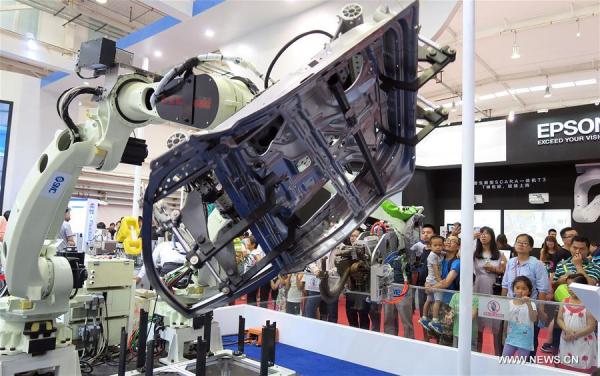
Visitors watch the demostration of a welding robot at the World Robot Conference 2017 in Beijing, capital of China, Aug. 25, 2017. Over 300 artificial intelligent (AI) specialists and representatives of over 150 robot enterprises attended the conference. (Xinhua/Li Mingfang) 

Beijing’s robotics industry aims to achieve a revenue of between 12 billion yuan and 15 billion yuan by 2020, according to the ongoing World Robot Conference 2017 which opened in Beijing on Wednesday.

At the conference, the Beijing Robotics Industry Innovation and Development Roadmap outlines a two-stage scheme to develop the robotics industry.

Beijing plans to achieve robotics industry revenue of between 12 billion yuan (US$1.8 billion) and 15 billion yuan, develop 10 leading enterprises in the sector and 10 research and development innovation headquarters by 2020.

By 2025, the city looks to achieve a revenue of 60 billion yuan in the industry. Beijing aims to form a top-notch robotics technology collaborative innovation system, develop a world-class artificial intelligence and construct a leading robotics innovation and application base.

Zhang Boxu, director of the Beijing Municipal Committee of Economic and Information Technology, said Beijing will strive to become a leader in robotics innovation with its advantage of scientific research, ecology and policy.

He added that Beijing is speeding up the development of its robotics industry, prioritizing the integrated application of industrial robots and supporting the development of service robots and special robots.

Press Releases: Attacks in Rakhine State and Release of the Rakhine Advisory Commission Report


Press Statement

Heather Nauert

Department Spokesperson

Washington, DC

August 25, 2017


The United States strongly condemns deadly attacks on security forces in Burma’s northern Rakhine State. We extend our condolences to the victims and their families. As government and security forces act to prevent further violence and bring those responsible for the attacks to justice, we expect them to do so in a way that is consistent with the rule of law, protects and respects human rights and fundamental freedoms, demonstrates transparency, and avoids inflaming a tense situation. We urge all in Burma, including in Rakhine State, to work toward peace and stability through their words and actions.

These attacks and the continuing challenges in Rakhine State underscore the importance of implementing the recommendations in the final report of the Kofi Annan-led Rakhine Advisory Commission released on August 24. We welcome the release of the report, as well as the Burmese government’s commitment to review and carry out the recommendations as quickly as possible. The United States has offered its support to the government as it works to address the long-term challenges addressed in the Commission’s report, including poverty, underdevelopment, shortcomings in government services and access to justice, and the need for improved security and better treatment of local populations, including ensuring a credible, transparent citizenship process for all people in Rakhine and lifting restrictions on freedom of movement.