ICCIE to open with more international participation

A total of 69 delegations from 59 countries and regions as well as international organizations have confirmed their participation in the 12th International Cultural and Creative Industry Expo (ICCIE), organizers said on Aug. 30.

The annual expo, taking place in Beijing from Sept. 11 to 13, will focus on innovative development of culture, science and technology through over a hundred events including exhibitions, promos, forums and parallel sessions.

The exhibitions will showcase the integrated development in the Beijing-Tianjin-Hebei region, the international language service industry, creative crafts and artwork in famed museums, Taiwan’s cultural and creative industry as well as traditional ethnic culture, said Lin Bin, a senior official from the ICCIE’s organizing committee.

To facilitate cultural exchange among the Belt and Road countries, the ICCIE organizers also invited representatives from 45 embassies in China as well as international organizations to promote their countries’ culture, education and tourism in face-to-face interactions with visitors at the expo.

This year’s expo will also highlight innovation and entrepreneurship from the younger generation as business-minded college students in Beijing will showcase their work and promote their creativity at the innovation fair.

The ICCIE in the previous 11 years had attracted 17,413 companies and organizations, bringing over 786 billion yuan in the forms of trade and cooperative agreements.
New species discovered along China-Myanmar border

Chinese scientists have discovered a new endangered species of flowering plant from the Annonaceae family, and the finding has been published in an international botanical journal.

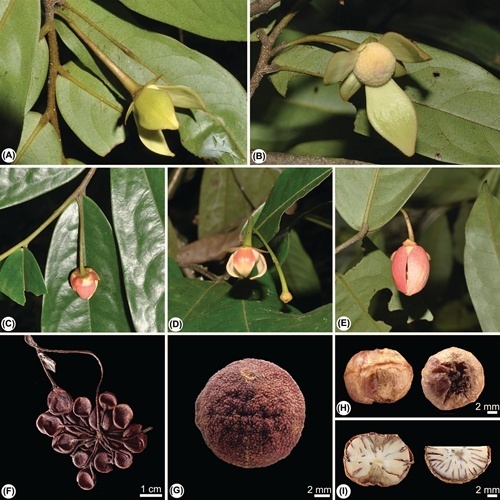
Polyalthia yingjiangensis flower and its fruits. 

Polyalthia yingjiangensis, known in Chinese as Yingjiang An Luo, was named after Yingjiang County in southwest China’s Yunnan Province where it was discovered. It belongs to the same botanical family as the custard apple and ylang-ylang, a tree whose fragrant greenish-yellow flowers are used to distill perfume.

“The discovery enriches the diversity of the area,” said Tan Yunhong, a botanist from Xishuangbanna Tropical Botanical Garden, Chinese Academy of Sciences (CAS).

Tan and other scientists from Southeast Asian Biodiversity Research Center and South China Botanical Garden discovered the plant during a field survey in Hongbenghe close to the China-Myanmar border. They believe the new species could also be found in Myanmar.

The Chinese scientists only found 10 plants during the survey conducted in April, 2016. A paper on the finding co-authored by Tan was published in the latest issue of Nordic Journal of Botany.

The plant was originally seen in 1980, but not confirmed as a new species at that time and this was the first time it has been seen again in 36 years, according to Tan.

Polyalthia yingjiangensis has been designated an endangered species, according to classification by the World Conservation Union. Currently there are only four samples available and the trees are known to grow in three localities, all in Yunnan.

Knowledge about the species is limited, however, scientists hope more field surveys can be done in areas that have not been studied, to help better understand the newly discovered plant.

Tan suggested conservation areas be set up to help preserve the rare species and public awareness be raised to save the plant from extinction.

Yingjiang, located in the transitional zone between India-Myanmar and East Himalayan flora, is rich in biodiversity. A large number of new species have been discovered in the region in recent years.

Typhoon Mawar lands in south China

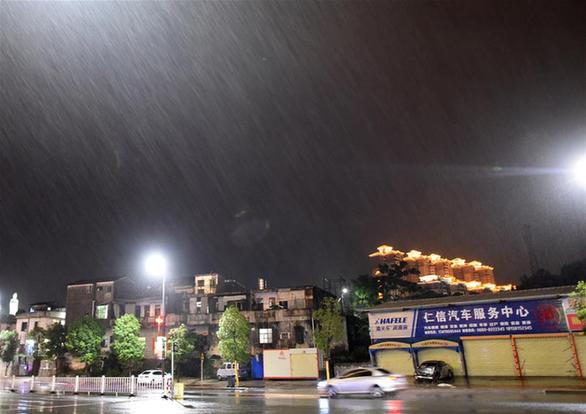
Mawar, the 16th typhoon this year, landed around 9:30 p.m. Sunday in Lufeng under Shanwei city in south China’s Guangdong Province, bringing gales of 20 meters per second at its eye, according to local meteorological authorities.

Torrential rain hits Lufeng City after the 16th typhoon Mawar lands in south China’s Guangdong Province, Sept. 3, 2017. Mawar, the 16th typhoon this year, landed around 9:30 p.m. Sunday in Lufeng, south China’s Guangdong Province, bringing gales of 20 meters per second at its eye. Mawar is the third typhoon that landed in Guangdong in the recent half month after Hato and Pakhar. [Photo/Xinhua]

Heavy rain battered the landing areas. Local government said about 2,200 fishing boats had returned to the harbor while more than 15,000 people were relocated to safe places.

The provincial meteorological bureau forecast that the typhoon would weaken rapidly after the landing and move towards northwest at a speed of about 10 km per hour, bringing downpours and gales to other cities in the province from Sunday night to Monday.

Flights and trains were suspended. Authorities have been on alert for secondary disasters.

Mawar is the third typhoon that landed in Guangdong in the recent half month after Hato and Pakhar.

North Korean Aggression – Nuclear Test

The North Korean regime claims to have conducted a successful test of a nuclear device, with a seismic event of 6.1 magnitude detected at a North Korean nuclear test site.

The regime has claimed to have detonated a hydrogen bomb, although that has not been confirmed.

This would be North Korea’s sixth nuclear test.

Australia utterly condemns North Korea’s flagrant defiance of United Nations Security Council resolutions, which ban nuclear weapons development and testing by Kim Jong-un’s regime.

We call for the UN Security Council to urgently consider further strong measures that would place pressure on North Korea to change course, and for all nations, especially the Permanent Five UNSC members, to apply the maximum possible pressure to this dangerous pariah regime.

North Korea is the only country that is testing nuclear weapons, and responsibility for the increasing tensions in the region sits with Pyongyang.

North Korea’s reckless conduct poses a grave danger to global peace and security.

Australia is doing its part to exert pressure on North Korea through our full implementation of UNSC sanctions and our autonomous sanctions regime.

We have repeatedly said we are committed to the path of diplomatic and economic pressure to resolve this crisis. We will continue to work with our ally and partners to change North Korea’s behaviour and deter it from threatening the region and the world with illegal weapons.

We welcome China’s intent to implement sanctions, and urge it to use its substantial economic and political leverage to rein in North Korea’s actions.

Now is the time for strengthened resolve by all members of the international community.

Investing in the future strength of the Australian resources sector

The Turnbull Government will commit $100 million to secure additional private investment in vital greenfield mineral exploration to drive the next wave of mineral discoveries crucial to the resources sector and the Australian economy.

The Government will provide tax incentives for junior exploration companies to encourage investment and risk taking which are needed to underpin the future strength of our resources sector and the Australian economy.

Prime Minister Malcolm Turnbull said the Junior Mineral Exploration Tax Credit (JMETC) would allow the tax losses in greenfield exploration companies to be distributed as a credit to Australian resident shareholders.

“Everything my government is doing is focussed on promoting investment and driving economic activity,” Prime Minister Turnbull said.

“These tax incentives will encourage ‘junior explorers’ to take risks and to have a go at discovering the next large-scale mineral deposit.

“We want to back enterprise. We want to turnaround the greenfields minerals exploration expenditure that have declined by almost 70 per cent over the past five years.”

Under the new $100 million Junior Mineral Exploration Tax Credit scheme,  Australian resident investors of junior explorer companies will receive a tax credit where the exploration company chooses to give up a portion of their losses relating to their greenfields exploration expenditure in an income year.

The ability to immediately distribute tax credits to investors will make investing in a ‘junior explorer’ more immediately attractive and encourage investment in small exploration companies undertaking greenfields mineral exploration in Australia.

Deputy Prime Minister, Minister for Agriculture and Water Resources and Minister for Resources and Northern Australia Barnaby Joyce said greenfield mineral exploration acts as a catalyst for new investment opportunities and job creation while supporting local businesses in regional communities across Australia.

“Despite good prospects Australia has not had a world-class mineral discovery in more than twenty years,” Mr Joyce said.

“This credit will make it more financially attractive for our mineral explorers to find resources in untapped regions.”

Specifically, only newly issued shares relating to capital raising for investment in new greenfields exploration activity will be eligible for these tax credits.

This will help maximise the incentive for additional investment in minerals exploration.

Tax credits of up to $100 million over four years will be made available from this financial year on a first-in first served basis consistent with arrangements to be administered by the Australian Taxation Office.

The JMETC improves on previous pilot programs assisting junior mineral explorers and has been developed based on industry feedback.