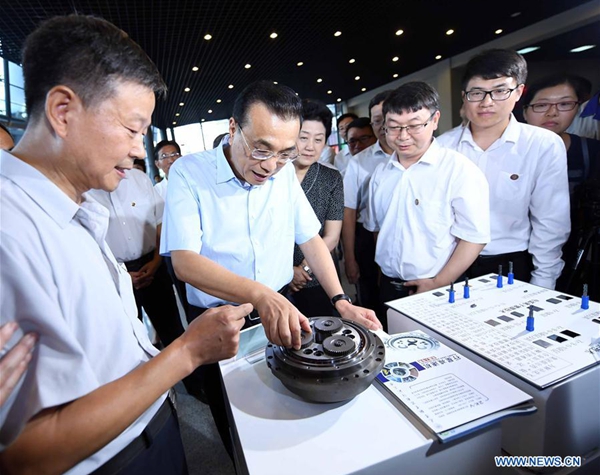
Li stresses vocational education to boost ‘Made in China’ brand

Chinese Premier Li Keqiang has stressed the importance of vocational education in boosting products made in China.


Chinese Premier Li Keqiang (2nd L, front) views technological achievements during an inspection to Tianjin University of Technology and Education in Tianjin, north China, Sept. 8, 2017. Li made an inspection here on Friday and stressed the importance of vocational education in boosting products made in China. During his inspection, the premier extended festive greetings to the teachers ahead of National Teachers’ Day, which falls on Sept. 10. (Xinhua/Zhang Duo)

Li made the remarks while inspecting Tianjin University of Technology and Education on Friday.

“While implementing the strategy of innovation-driven development, we need to encourage innovation on the one hand and translate good ideas into high-quality products on the other hand,” he said during the inspection ahead of Teachers’ Day, which falls on Sept. 10.

China needs to cultivate more professionals with higher quality, promote the spirit of the craftsman and encourage enterprises of various sizes to provide fine products amid efforts to boost the “Made in China” brand, Li said.

During his inspection, the premier extended festive greetings to the teachers.

He called for more efforts to foster a good environment of respecting teachers and valuing education and improve the quality of education to serve the country’s economic and social development.

Press release: UK matches public donations to Hurricane Irma British Red Cross Appeal

The UK government today (Saturday) pledges to double any public donations to the British Red Cross appeal for victims of Hurricane Irma.

For every £1 given towards the relief effort in the Caribbean, another £1 will be added through the Department for International Development’s Aid Match scheme, up to £3 million.

Donations will support people through the region, including in the badly hit British Overseas Territories of Anguilla, British Virgin Islands and Turks and Caicos.

Secretary of State for International Development Priti Patel says:

Today we are announcing we will double any public donations which are made to the British Red Cross appeal through DFID’s Aid Match scheme.

The overwhelming generosity of the UK public in times of crisis is one of the things that makes Britain truly great.

This will help get water, food, shelter and power to those left devastated by Hurricane Irma.

This donation is on top of the £32million already pledged by the UK government.‎

Mike Adamson, chief executive, British Red Cross says:

We would like to thank DFID for supporting our Hurricane Irma appeal, raising urgent funds for those affected by this devastating disaster. The most powerful hurricane ever recorded in the Atlantic has left major destruction in its wake. Red Cross teams are on the ground now supporting people in shelters, providing first aid and doing whatever they can to help.

Ms Patel’s pledge came after she visited her department’s disaster response centre in Kemble, Gloucestershire on Friday.

While there, she saw vital aid begin its journey to the disaster zone, including 10,000 UK aid buckets and 5,000 UK solar lanterns. This aid is will reach those in need in the next few days by the quickest and most effective route possible.

Ms Patel also pledged on Friday to double the number of humanitarian experts in the region from four to eight, who are now working in the field across several islands to assess need. Further advisors are expected to arrive in the coming days.

‎In addition to delivering emergency humanitarian relief, DFID is working with agencies across the Caribbean to plan how to rebuild and reconstruct areas damaged by the hurricane.

To donate to the British Red Cross Hurricane Irma appeal visit: www.redcross.org.uk/HurricaneIrma or call 0300 456 4999.

Notes to editors

  • UK Aid Match is funded from the International Development budget. The UK Government has agreed to match public donations up to £3million.
  • Donations must be from people (not businesses) living in the UK.
  • This funding is on top of the £32 million already announced by the UK Government.

Nanjing becomes China’s first International City of Peace

Nanjing has become China’s first International City of Peace.

In the notorious Nanjing Massacre during World War II, about 300,000 Chinese people lost their lives and 20,000 women were raped, said J. Fred Arment, executive director of International Cities of Peace in a video speech.

This history makes people remember the war and makes them more aware of the significance of peace, he said.

Nanjing in east China’s Jiangsu Province was an ancient capital for six of China’s dynasties. The freezing winter of 1937 saw brutal killing by invading Japanese troops. One person was killed every 12 seconds.

A total of 172 cities in about 50 countries and regions are now on the International Cities of Peace list, according to its website, including Coventry in England, Bern in Switzerland, Amsterdam in the Netherlands and Berlin, Germany.

Liu Cheng, UNESCO Chair on Peace Studies and a professor at Nanjing University, said that there were certain requirements for becoming an International City of Peace.

“For instance, the city might be traumatized by war or have witnessed big peace-related events,” he said. “It should also be advanced in peace studies and activities.”

More than two years ago, Liu’s Institute for Peace Studies, together with the Institute of Nanjing Massacre History and International Peace, submitted an application to the International Cities of Peace.

“What was left by history was not hatred, but our awareness of peace,” he said.

“Nanjing is among the cities that felt the greatest pain in World War II, and the Nanjing Massacre left us indelible memories,” said Zhang Jianjun, executive chairman of the Institute of Nanjing Massacre History and International Peace. “So we understand better how valuable peace is.”

Peace education has always been emphasized in Nanjing. Nanjing University is the first university to conduct research on peace studies in China.

Kawasaki Akira, a representative with the Japanese NGO Peace Boat, said that the designation of Nanjing as an International City of Peace could help China cherish peace and Japan reflect on itself.

“Peace does not only mean ‘no war,'” said Lee Ji Won, a professor at Daelim University of Republic of Korea. “Peace also means reducing violence, improving justice and safeguarding human rights.”

“Peace is the only way out for human beings,” said Cao Lubao, a publicity official with Nanjing City. “People from all countries should take lessons from history and enhance communication.”

Chinese police warn of food delivery-related road accidents

The Ministry of Public Security has issued warnings about road accidents related to the fast-growing food delivery business in cities.

In east China’s Nanjing City alone, three people died and 2,473 were injured in 3,242 road accidents related to such services in the first half of this year, according to figures released by the ministry’s traffic management bureau.

Seventy-six such cases occurred in Shanghai Municipality in the same period, according to the bureau.

Delivery workers riding electric bikes are frequently seen racing through streets as a growing number of people, especially the young, order food online.

Some delivery staff use mobile phones while driving, and some have been found to violate regulations, including speeding or running red lights, according to the bureau.

The bureau stressed abiding by laws and regulations and urged online catering companies to raise the safety awareness of delivery workers.

Another hike in antidepressant use despite SNP pledge

9 Sep 2017

IMG_2321

The number of people in Scotland being prescribed antidepressants has soared again, despite an SNP pledge to stop the increase.

New statistics have revealed 6.4 million items were handed out last year, the equivalent of 17,500 a day.
That compares to 6.1 million the previous year, and 5.8 million in 2014/15.

In addition, the NHS now spends £44.6 million supplying medication to patients with mild-to-moderate depression or anxiety.

It is the latest set of statistics revealing the extent of mental ill health north of the border.

More than a decade ago, the SNP said it recognised too many antidepressants were being prescribed, and promised to ensure the numbers dropped.

However, in government the nationalists have failed every single year to do this, despite calls from experts and mental health charities to explore other forms of treatment, not least improved access to counselling.

The figures were published by ISD Scotland’s Prescription Cost Analysis system.

Scottish Conservative mental health spokeswoman Annie Wells said:

“There will always be a place for antidepressants in the health system when it comes to the treatment of a range of mental health conditions.

“But the increase has got completely out of hand, and after 10 years the SNP has to do something about this.

“The nationalists were very clear that reducing the prescription of these drugs would be one of their priorities, but the opposite has happened.

“Mental health is becoming more important, and there’s consensus across parliament that more funding and attention have to go on it.

“The suspicion among many is that these pills are being handed out too readily when more appropriate solutions could be found.

“These figures should act as a wake-up call to ministers to address this particular issue once and for all.”